
WASCO CO. — “When I perform Home Ignition Zone assessments, I tell people to ‘Think like an ember,’” said Melissa Napoli, Wasco County wildfire coordinator.
Most homes catch fire not from flames or radiant heat, but falling embers — little fragments of burning material, coasting on the wind. With some effort, homes can be made more inhospitable to embers.
Besides, firefighters can only protect a building if they can find it, access it, and stay around it without clear danger to their lives.
“The priority is life over property — always, including firefighters’ lives over property,” said Patrick Richardson, a local crew superintendent with over 34 years of experience in California, Colorado and recently the Pacific Northwest.
Defensible space and home hardening are considered the best ways to keep your house from burning, the Oregon State Fire Marshal’s office said.
According to the pocket incident response guide every firefighter carries, they use four structure triage categories. The best case scenario, called “stand alone,” involves a house with such well-prepared defensible space that wildfire can burn around it without hurting it, allowing crews to focus on more endangered homes. If the structure is at risk, but has safety spaces — that is, open areas multiple times wider than the height of any surrounding trees — firefighters can survive in should the fire blow up, they may “prep-and-hold.”
Without safety zones, they can “prep-and-leave,” returning after the worst danger is over to knock fire down off the house if possible. In the worst-case scenario, with intense fire threatening an unsafe building, firefighters and deputies do “rescue drive-by,” making sure the houses are empty before they burn. Disabled people can flag themselves with their county dispatch office in advance of an emergency, so that dispatch computer systems will flag them for help during evacuations.
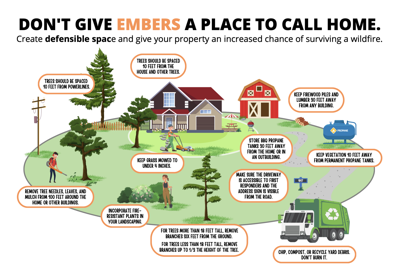
When firefighters “prep” a home, they’re doing just what they ask homeowners to do for defensible space: moving woodpiles, limbing branches and clearing vegetation near the house.
How to get started?
Get some loppers and start chopping.
For taller trees, remove all branches on the lowest 6-feet of trunk. The aim is to remove “ladder fuel,” low-hanging plants that could allow a ground fire to climb into your trees.
In Oregon, you can ask a professional firefirghter to look at your residence and make recommendations, for free, through the State Fire Marshal’s Office website.
“[W]e need to re-evaluate things like debris in gutters, firewood stored on decks, and bark chips in flower beds. In a wildfire, these things can become kindling. Simple steps can really make a big difference. Great starting points include keeping gutters and roofs clear of debris, trimming any overhanging branches away from the roof, and clearing vegetation and bark chips from the first five feet around the home,” Napoli said.
Other steps: replace any broken shingles, cover vents with 1/8 inch mesh, and mow the grass to four inches or less. Get rid of woody debris, if possible. Keep any firewood and BBQ equipment 30 feet from the house.
The Oregon Fire Marshal’s Office suggests putting up reflective address signs, leaving gates wide open during fires, and making driveways 20 feet wide and safe for very tall vehicles.
Trees can be the hardest part, being dangerous and expensive to remove. Cutting large trees can also be dangerous. But trees and bushes that stand within 10 feet of powerlines, houses, chimneys, or even each other should be cut down.
The aim is not only to remove ladder fuel but also to keep fire from dancing along between tree crowns and adjacent buildings.
More expensive measures include changing out the roof, siding and fencing for fire-resistant material like metal, clay, or asphalt.
How much does it cost?
Napoli emphasized many of the most impactful efforts are low-cost to free, depending on someone’s ability to complete the labor themselves: cleaning gutters, limbing trees, moving firewood, etc.
Other costs vary: a roll of metal screen to cover vents and windows can cost $25; replacing a roof, tens of thousands.
As for time, work can take place year-round, but managing vegetation in summer as part of the regular lawn-care or gardening routine can be immensely helpful.
For tree removal, financial help is sometimes available. The Community Wildfire Defense Grant program has funded nearly $400,000 in hazard tree removal projects in South Wasco County since 2024. Unfortunately, that money’s gone; now they’re looking for more dollars to keep the program going.
Napoli recommends contacting the Oregon Department of Forestry, The Dalles unit, at 541-296-4626 and adding your name to the waiting list for that program, if you need help with a tree.
Is it effective?
The Rowena Fire last summer was one of the most severe disasters Wasco County Sheriff Lane Magill had ever seen at the time, he said.
Nine homes in that area got risk assessments from the fire department before it ignited. Seven of those nine property owners followed up by removing combustible material within five feet, and reducing it within 30 feet, of their homes.
All but one house survived the flames.
That lone home could be due to combustibles built up on the roof, in the gutters and below the deck, said Mid-Columbia Fire & Rescue (MCFR) Division Chief Chris Grant. Or it could have been the slope, where high winds drove the ground fires and embers onto the property, or the wood stored near the garage. Or embers could have entered through the 1/4 inch screen vents; the fire department recommends finer, 1/8 mesh.
“A good rule of thumb is if a pencil will fit in the screen opening, it is large enough for a flaming ember to enter and potentially ignite the insulation or combustible storage in the attic or crawl spaces,” Grant wrote over email.
Since the fire, several more home assessments have taken place and two communities on the westside are working with MCFR and the Oregon Department of Forestry to develop a Firewise Community.
Free assessments take between 30 minutes and an hour. A firefighter will walk the property with its owner and then give them a comprehensive report.
If you live in the MCFR service area, you can ask for an assessment at www.mcfr.org or by phone. Outside the area, contact the Oregon State Fire Marshal or any local fire department.
Resource list
For free defensible space assessments: www.oregon.gov/osfm/wildfire/pages/defensiblespace.aspx.
Neighborhood-level organizing: www.nfpa.org/education-and-research/wildfire/firewise-usa.
In Wasco County, visit www.wascocountyforests.org/resources.
Fire Coordinator Melissa Napoli can help direct people to resources: melissan@wascocountyor.gov.


Commented
Sorry, there are no recent results for popular commented articles.