
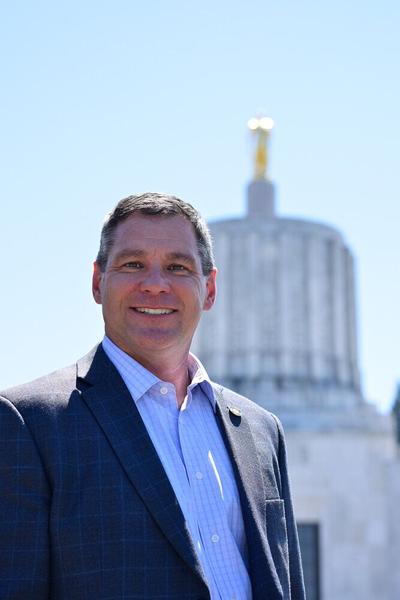

February was a month of celebration. Oregon celebrated its 164th birthday, and we completed our first month of the legislative session in Salem. Now the priorities are beginning to come into focus.
Housing & homelessness
The House Committee on Housing and Homelessness is expected to vote to advance the housing package in the coming days. We have been working hard on two large bills — House Bill 2001 and House Bill 2889 — and they have now been combined into one bill (HB 2001) covering many topics.
This bill is a step toward fulfilling the governor’s request for $130 million that accompanied her homelessness state of emergency declaration. I have been involved in these bipartisan negotiations as vice chair of the Housing and Homelessness Committee. In the most recent amendment, I was able to secure grant funding for agricultural workforce housing. This grant will aid Oregon agricultural producers in providing safe housing to farmworkers.
This provision signals to our rural and agricultural communities and businesses that they are included in this housing package. It is critical that housing packages provide opportunities statewide, not just in the metropolitan areas. This provision is a small yet important step in that direction.
Hood River and Wasco counties were not included under Gov. Kotek’s executive order declaring a homelessness state of emergency. This package will likely extend the state of emergency statewide to include all counties. There will also be funding for housing projects around the state included in the package.
Twenty-six years as a police officer taught me a lot about our homeless neighbors, and when talking about homelessness, we can’t ignore our drug problems.
I recently spoke on the House Floor about the failures of Measure 110. The Secretary of State recently released an audit showing what we already knew: Unelected bureaucrats in charge of implementing the program are failing, and people are suffering because of it. Oregon is the worst state in the country for our drug problems, and we are the only state in the nation to legalize hard drugs. This is not a coincidence.
A case in point: The collection of dirty needles on Portland streets has increased by 450% between 2019 and 2022. We can and must do better.
Bringing jobs back to Oregon
On the Semiconductor Committee, we are discussing options for incentivizing semiconductor manufacturing businesses in Oregon. A recent study showed how a $200 million investment from the state could add 35,000 jobs and nearly $3 billion in new revenue over the next 20 years. We are looking around the state at the available land stock to build a large-scale manufacturing facility. We must ensure Oregon is open for business to compete in the global economy.
Bills to watch
Before I go, I want to flag a few bills that could impact you and our community:
• Senate Bill 779 would require police officers in departments over 50 officers to have a four-year bachelor’s degree. For departments with less than 50 officers, the requirement would be a two-year degree. It’s hard enough to recruit and retain good officers in Oregon, and this would make it even harder.
• House Bill 2426 allows customers to choose between self-service and full-service gas in areas where self-service is banned today, which includes Clackamas County. A gas station may open up to 50% of its pumps for self-service, while the rest will remain full-service. Self-serve in Oregon can be contentious, but this bill balances between those who like full-service and those who want to pump their own gas. Recent polling has shown that nearly two-thirds of Oregonians support this approach.
• House Bill 2645 increased criminal penalties for carrying certain amounts of fentanyl and updates the law so that fentanyl in pill form will be treated the same under the law as fentanyl in powder form. I was proud to be chief co-sponsor this bill. It passed the House on a vote of 59-1.
As always, you can reach my office at Rep.JeffHelfrich@oregonlegislature.gov and at 503-986-1452. I am honored to serve you.
•••
Does the government have your property? The Oregon State Treasury is again raising awareness about its Unclaimed Property Program. Over the last 25 years, the Unclaimed Property Program has returned more than $500 million to individuals. Nearly one in seven people have unclaimed property.
Unclaimed property is any asset — such as uncashed checks, forgotten security deposits, tax refunds, and more — held by a business, nonprofit, or government entity for which the owner cannot be found. When an organization cannot contact or return unclaimed property to an owner after some time, usually one-three years, they must report the property to treasury to be held until claimed by its rightful owner.
Go to Unclaimed.Oregon.gov to search for any unclaimed property under your name. Searching is free and easy; you never know how much of your money the state might be holding!


Commented
Sorry, there are no recent results for popular commented articles.