
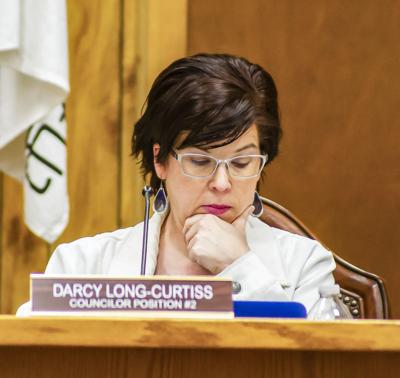
"I don’t want the state telling the city what they have to do.”
Darcy Long
Candidate, District 52
Darcy Long would like to see Oregon legislatures help city and county government fund big, statewide needs like the need for affordable housing and services for the homeless by providing targeted state funding, but in a manner that allows city and county leaders to decide what solutions are best suited to the communities they serve.
Long, the Democrat, Independent and Working Families candidate for Oregon House District 52, spoke Friday in an interview at The Dalles office of the Columbia Gorge News. She is running against Republican candidate Jeff Helfrich, who has not yet responded to interview requests. District 52 was modified this year to include The Dalles west to the Sandy River and Mount Hood.
Long said she got into the race when former Rep. Anna Williams (D-HR) announced she was not going to run again. “It feels positive, it’s obviously something I’ve been thinking about for a while,” said Long, who ran for the position in District 50 unsuccessfully in 2018.
Long said the biggest needs in the district, and statewide, are related to homelessness and housing, both of which are statewide issues.
Top priorities
“I think the biggest thing is the homelessness issue,” Long said. “The state can do things to support local cities and governments, because every city or government is going to need its own approach, one that works best for that community,” she said. "I agree with the League of Oregon cities, the state should let the cities decide for themselves how they want to handle things. But they need resources [provided by the state].
"State support needs to get distributed in rural areas as well,” she added, with funds passing through the counties."
A lot of issues tie into homelessness, Long noted, including a lack of mental health care. “That is also something that we need more of, at the state level,” she said. “That is extra difficult, because it’s hard to staff something that is so intensive.” Local and regional mental health services have been “struggling for awhile,” she said. “I think the employees do an amazing job with what they have, the framework they have to work with, but our local mental health system has been broken for a while,” she said. “People are not just slipping through the cracks, they are falling through gigantic holes.”
Another key issue facing the region is affordable housing. “There are a number a number of ways the state can help, whether it’s assisting with financing or looking at regulations that can be changed or waived for a period of time,” Long said. “But I don’t want the state telling the city what they have to do.
“I would like to them to provide options for the cities to choose from, because everybody has a different need.
“The problem in our district, throughout, we all have a shortage of affordable housing, workforce housing. But other places have different reasons for their housing crisis, like high rents. That’s not really the issue we have here, we just don’t have any housing at all.”
Long noted her work as a member of the City of The Dalles council, and chair of The Dalles Urban Renewal Committee and various state committees, has given her a broad understanding of how government works, and things the city can, and cannot, do.
“I feel like we’re headed in the right direction, I just think its going to take a number of small changes so cities and counties have different options, depending on what’s going on in different parts of the state.”
Bipartisanship
When asked what message she has for Republican party members in her district, Long said her work in city government had influenced her political views. “I think in terms of being nonpartisan, or at least being open to finding the middle on a lot of issues,” she said. “I’ve always been moderate — a progressive socially, but still, you know, always trying to make everybody at least a little bit happy.
“I have lots of friends who are Republicans, and when I sit down and write out my list of supporters, it pretty much falls along the demographics of the district, which are roughly one third Democrat, one third Independent or non affiliated, and one third Republican.
“I just find, in rural Oregon anyway, that we have a lot more in common with each other [than urban, partisan areas]. I think we’re more about personal relationships here. Everything’s kind of anonymous in the big city.”
Conclusion
“I’m just looking forward to getting to know all of the people throughout the entire district as individuals and figuring out what their stories are and what it is they need from a representative in Salem, and then doing what I think I do best, which is taking that rural perspective and sharing it with my colleagues, who aren’t necessarily from a rural area, and getting them to listen,” Long concluded.
“I have lots of people that I would consider friends in the legislature already, so there’s people that I can call on anytime — and I know they value my input.”


Commented
Sorry, there are no recent results for popular commented articles.