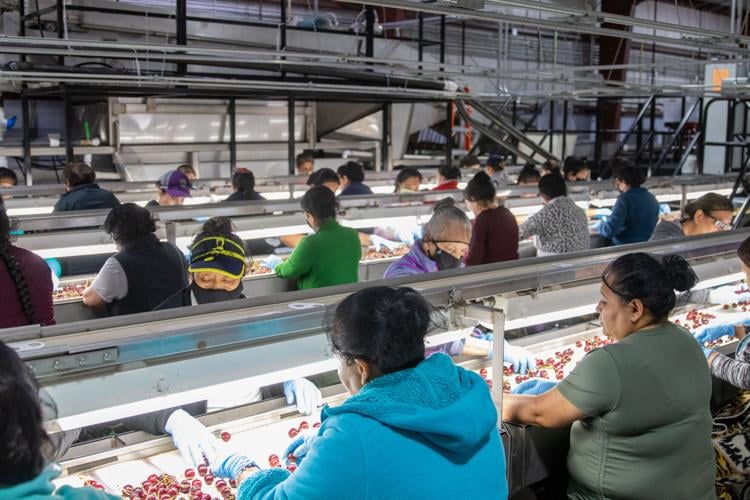
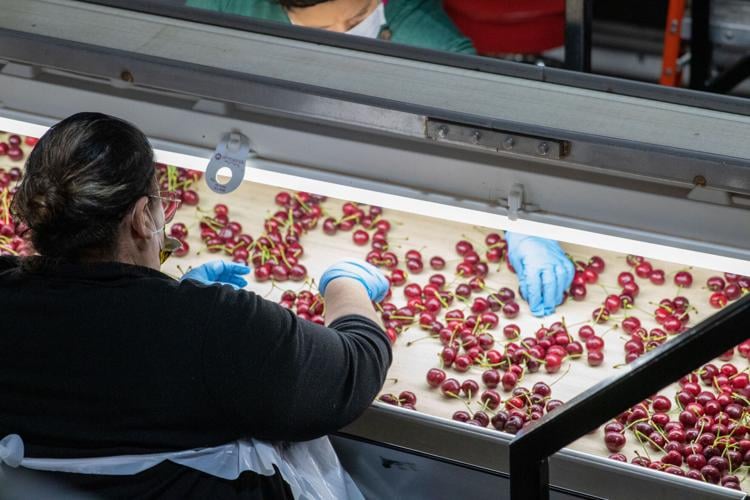
The Hood River Cherry Company is one of the few remaining fruit growers who sort and pack their cherries by hand. After the cherries are washed, they head down a conveyor belt where the small or damaged cherries are disposed.
Field and packing plant manager Kristoff Fowler inspects some fruit that has been picked. If he is not in the fields helping with operations he is maintaining equipment in the packing house.
The Hood River Cherry Company is one of the few remaining fruit growers who sort and pack their cherries by hand. After the cherries are washed, they head down a conveyor belt where the small or damaged cherries are disposed.
Noah Noteboom photo
Hood River cherry Company employees sort cherries at the Hood River packing plant.
Noah Noteboom photo
Field and packing plant manager Kristoff Fowler inspects some fruit that has been picked. If he is not in the fields helping with operations he is maintaining equipment in the packing house.
As the Hood River Cherry Company wraps up its 29th cherry harvest, owner Katy Klein and Field and Packing Plant Manager Kristoff Fowler — also Klein’s son — couldn’t be happier with the outcome despite unpredictable spring and summer weather.
Hood River Cherry Company is a family owned and operated business based out of Hood River. On top of the freshest, firmest, and juiciest cherries in the valley, they also produce cherry products such as jams, chutney spread and different salsa varieties. But you won’t find their cherries at farmers markets; Fowler said they offer online shipments or if you are able, you can find them in your local grocery stores. The Cherry Company has come a long way since planting their first cherry seed.
May 18, 1993, was a monumental day for the family. On the same day the Hood River Cherry Company planted their first tree, Fowler was born.
Since then, Fowler has seen his family’s company grow to almost 400 acres of cherry trees in the valley. Even with the amount of orchard area they own, the Hood River Cherry Company does things a little differently than most fruit growers.
All the sorting and packing is done by hand and is considered one of the last remaining fruit growing operations in the state that practices sorting by hand. Most of the workers have been with the company for decades. Petra Gamboa has been in the packing house since the Cherry Company was established in 1993. Due to their way of growing the fruit, the sorting and packing must be done by hand.
Traditionally, orchards pick the cherries before they are fully grown. Fowler and Klein both explained their approach. They leave the cherries on the trees a bit longer than most farmers so they can reach maximum sweetness. Most orchards pick their fruit when the cherries reach a sugar level of 15 brix, but Hood River Cherry Company wants their cherries in the 20 to 23 brix range. Brix is the density of sugar content by percentage in a cherry. For example, if a cherry is 17 brix, it is approximately 17% sugar.
“When you pick a cherry in the 16 to 18 brix range, you’ll get a lot more firm cherry,” said Fowler. “So, it’s harder to bruise and you can put it through an automated sorter and beat the crap out of it.”
“The Hood River Cherry Company fruit gets hand sorted because it’s tree ripened,” said Klein.
According to Fowler, there are some advantages to cherry farming in the upper Hood River Valley. They farm in higher elevations, which means cooler temperatures and sweeter cherries. Fowler explains that he invites the warm weather as well.
“If you get a hot day and a cold night, you get a lot sweeter, crispy cherry,” he said. “There are definitely challenges though.”
To combat the hot weather during the summer months, Fowler says sometimes the workers start picking at 1 a.m. They grab their headlamps and pick until the sun comes up.
“Imagine 250 guys and each person has a headlamp on,” said Fowler. “It sounds crazy, but at the end of the day we try to keep our fruit as cold as possible.”
Even during the summer months temperatures can get so low the cherry blossoms or the fruit themselves can be lost to frost. Fowler says a few blocks of cherry trees have been planted five times due to cold snaps that decimated growing trees and young blossoms. Some local favorites have fought through the change in climates and produced award winning cherries.
Fowler says they grow varieties such as Bings, Vans, Rainers, Skeenas, Lapins and many others. Keeping track of when to pick what varietal at the right time can get chaotic, but Fowler has one rule of thumb: For every 500 feet of elevation, you add one week to their branch life. Fowler says they have timed out each block of orchard to coincide with the next block that needs to be picked. For example, a plot of orchard with Bing, Van and Lapin will be picked one week, while the next scheduled plot is still ripening on the branch. After that plot of the orchard is harvested, they move on to the next section which will be ready to be picked. Each orchard has a collection of each type of cherry.
“So, we pick an early variety like a Bing, and then move on to a section of Van cherries until that block of orchard is picked. Then we go to the next orchard and do the same. It is very strategic,” said Fowler.
When cherries are not in season and harvest is finished up, Fowler’s job doesn’t end there. The Hood River Cherry Company head of field operations retired this year, which puts a lot more on everyone’s to-do list. Fowler says during the winter months he and a few other packing house workers maintain the equipment. They go as far as removing parts from water pumps and motors to gears and drive shafts.
“Fifteen minutes is the world to us. It’s not like we can wait a few days to pick cherries. That’s why everyone picks early,” said Fowler. “When you pick a tree ripened fruit, it’ll be ready to go tomorrow. But in three days, it’s going to be unpickable.”



Commented
Sorry, there are no recent results for popular commented articles.