
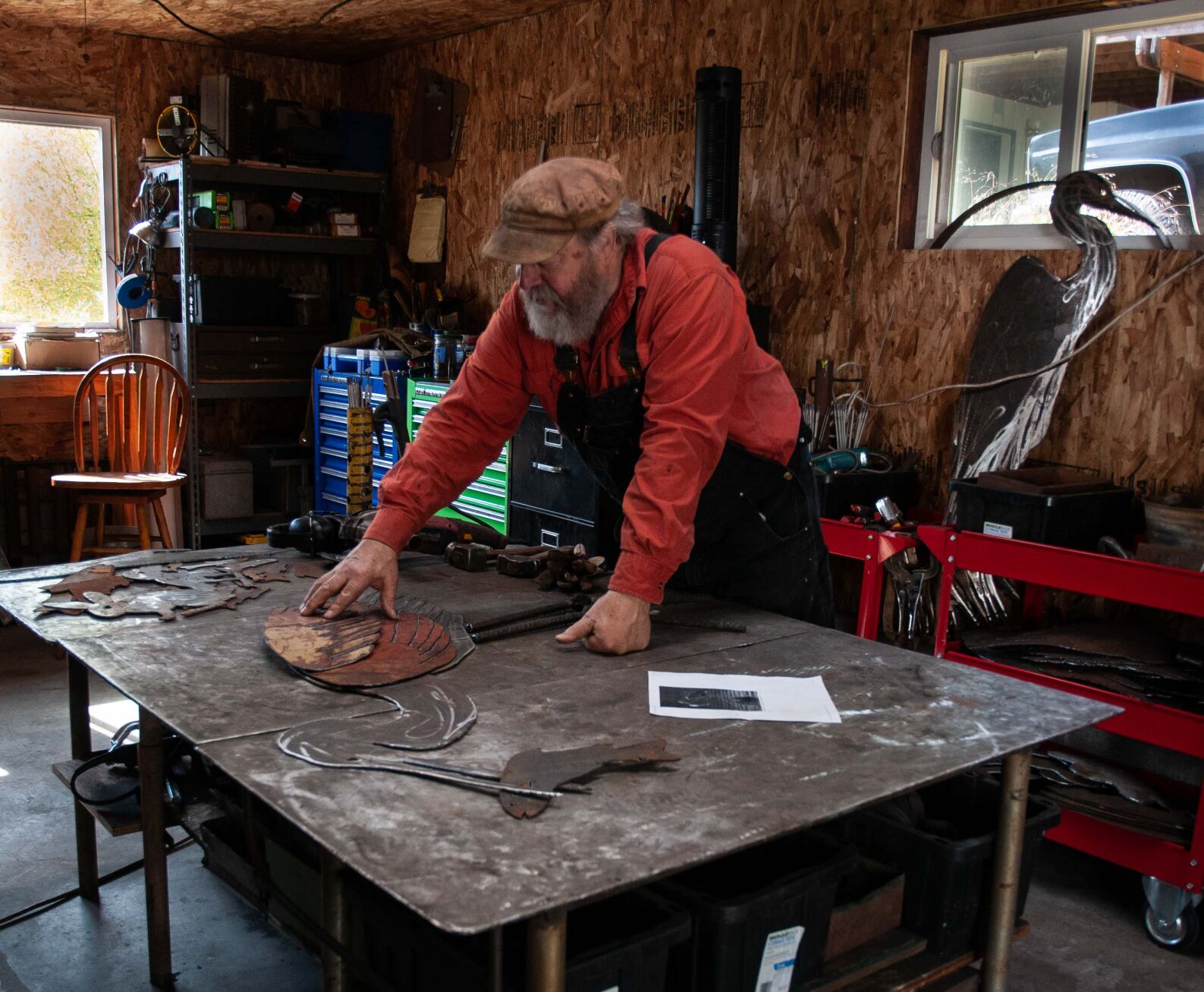
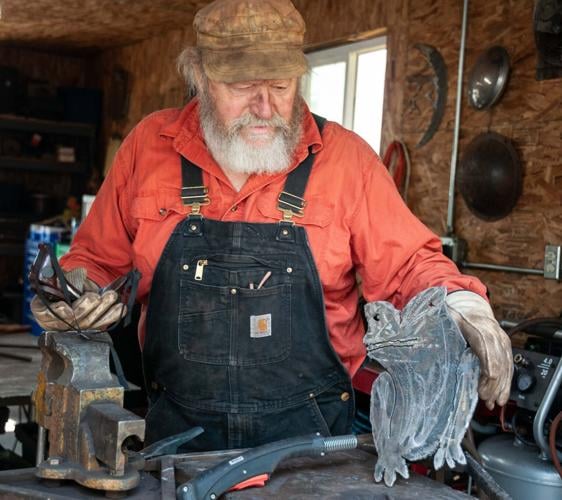

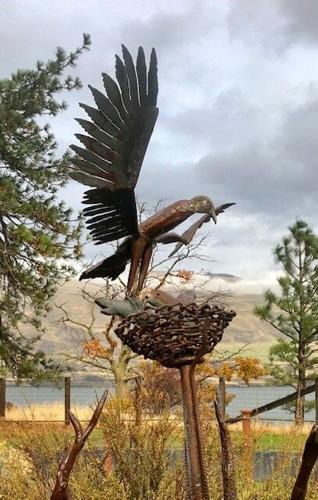
Ironsmith Alan Root often starts a project with unusual materials — 500 wrenches, for instance, or a wagon wheel — and ends with a freeform sculpture. His art can begin with things that others have already shaped or discarded: scrap metal, rebar and a vision.
“I really like the texture of the metals … so a huge part of the art I’m doing now is reflecting that and putting it in some sort of form,” Root said. “Sometimes I refer to what I do as farm punk.”
Root learned to weld in high school, getting an ornamental iron apprenticeship at age 19. After that, he took art classes and Root taught himself. As a welder, he worked across the country, from working jobs that ranged from welder at a carnival in Michigan to a boiler repairman in New York and Pennsylvania, before finally ending up back in Portland, where he started selling his ironwork at the Saturday Market in 1977.
One day, “someone came up to me and asked if I wanted a sales rep,” said Root, who said he didn’t know what this was at the time.
He began to create big items for showrooms, which were eventually displayed in 18 states. Later, after he moved up the Gorge to Mosier, his art was shown at The Dalles Art Center, and other local galleries.
Then Root quit. He moved back to Portland, where he spent 30 years painting houses before moving back to the Gorge three years ago.
Root comes from a heritage of ironwork that includes his father, as well as his great-uncle Wallace, who 100 years ago had the only blacksmith shop in Mosier just down from Root’s own Mosier home. Root’s grandfather Clyde apprenticed as a blacksmith while he waited for his cherries to grow and begin producing.
While Root doesn’t think this family history led to his own love of ironwork, his sculptures often depict aspects of local and family history. In 2012, Root created gates for Mosier Cemetery, where several generations of his ancestors are buried. The gates contain, among other imagery, stars and stripes for veterans, a tunnel and car for the Mosier Tunnels, a Japanese flowering cherry to honor the Japanese interned during World War II, and spiraling elements of water and wind.
“My cousin came to see this and she said, ‘Oh, I love the stork with the baby, for the babies that are born,’” Root said. “To me, it’s a heron with a fish… I put in the things that I see, but they see what they see.” Root adds, “I hope that all my stuff reflects the community and the environment that we live in.”
Root also hopes it helps people appreciate “the kind of art I’m doing, which is way out on the edge … and doesn’t really fall into very good categories.”
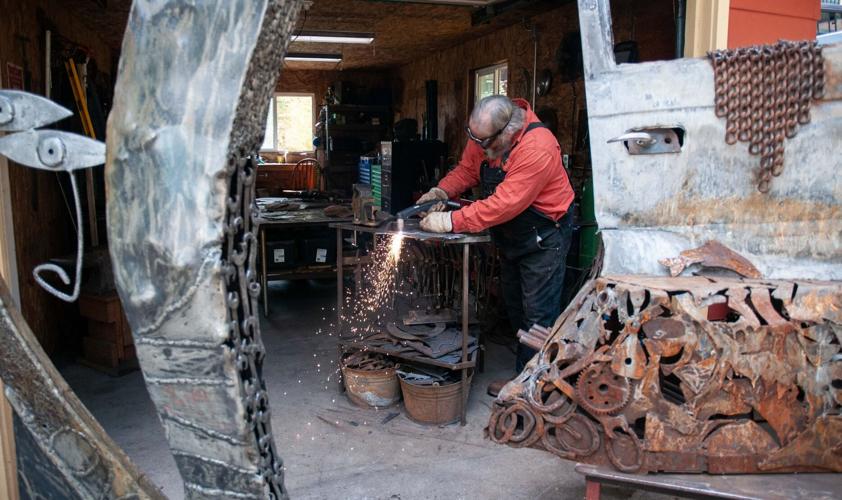
Now Root lives in The Dalles. Without the “full-on blacksmithing shop” he had in Mosier, his work has evolved. He creates many freeform sculptures from found objects. “This is definitely the biggest workshop I’ve ever had,” Root said. In solidarity with other artists, he has filled his home with sculptures and artworks.
Root creates sculptures from things others have already shaped, used or thrown out: wrenches, wagon wheels, pick heads, scrap, farm implements, old oil tank, tire chains, pipes, rebar nuts, gears, wire. Tractor seats become bird feeders. “I brought 20 loads of stuff from Portland,” he says.
Many farm implements come from a man in Roseburg, who brings them from Kansas. Sometimes Root purchases from estate sales and auctions. The closing of Red’s Trading Post was a windfall for Root, who brought home six truckloads of stuff, including the 500 wrenches.
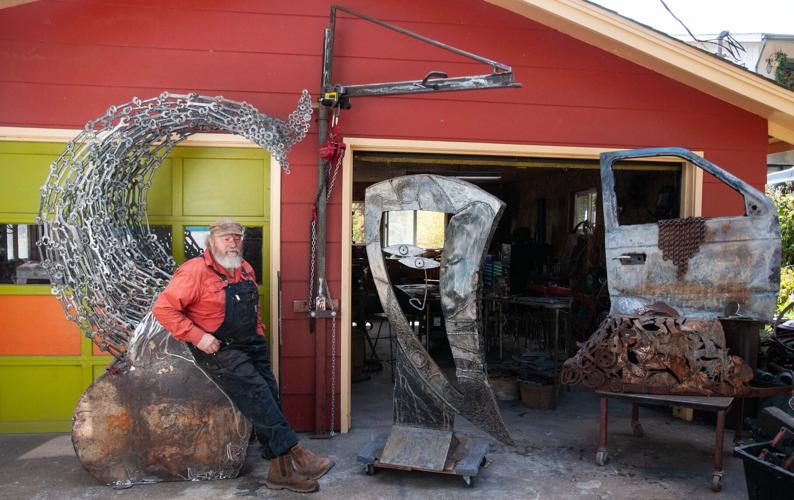
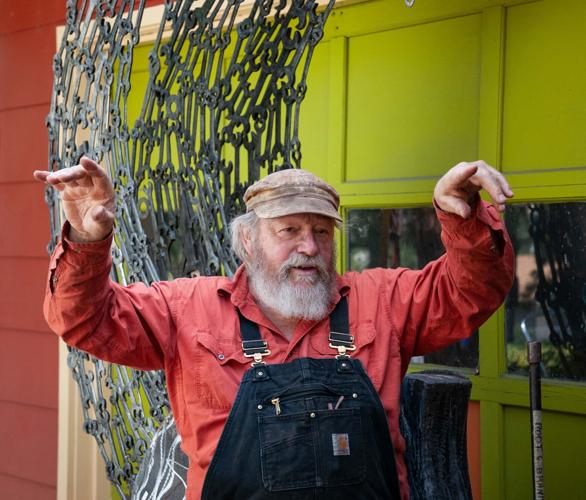
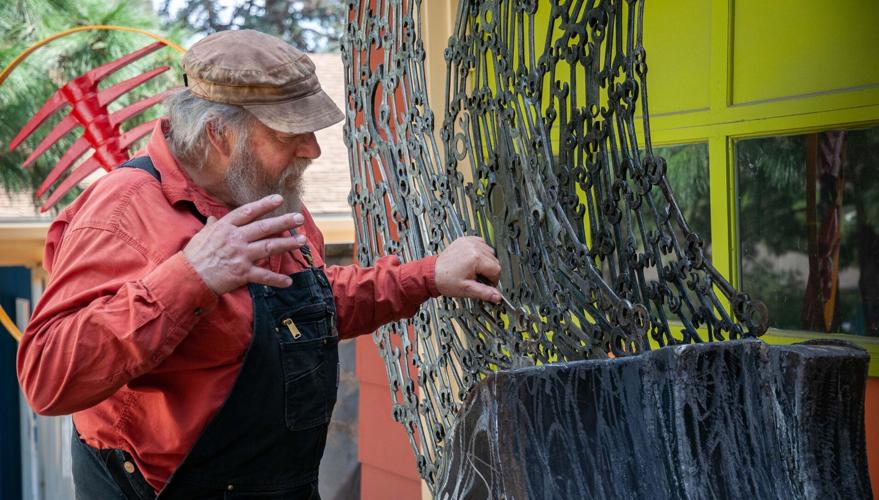
Some of those wrenches became “Surfs Out… a Tsunami of Wrenches,” in which the heavy tools rise in delicately curved, lacework waves from a heavy metal shape. Root was inspired by shapes he saw in a sitcom. “There were two of them in a door, and I just liked them,” he said, noting he thought they would be rainbows at first, but they eventually became waves.
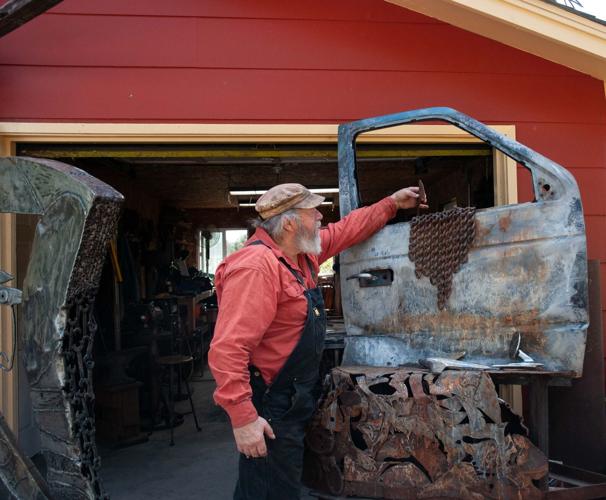
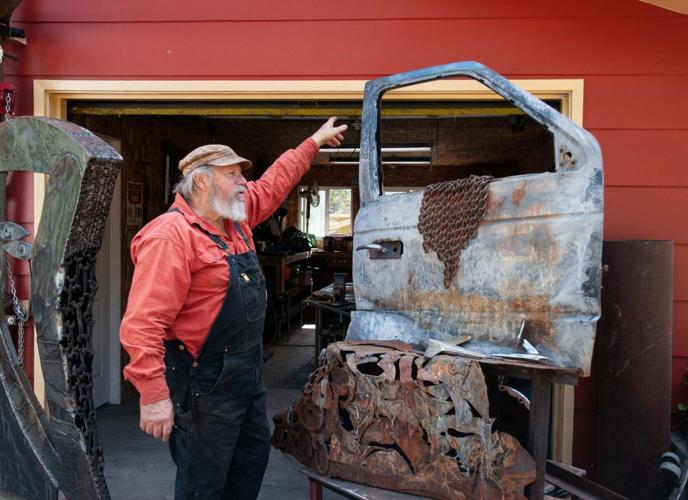
An old, twisted metal car door, collected from Taylor Lake after a recent fire, is becoming “From Out of Nowhere,” a reflection of human impact on the environment. It almost looked like a sculpture when he found it, Root noted, but now he’s adding things, including dangling chains, a series of jumping fish, and maybe a bird or two. “You can find this stuff at the bottom of a river … and wildlife still exists on this stuff,” Root said of the materials for this sculpture.
“I have an idea, a direction I’m going, then I just try to get out of my own head … and let it take its own path,” he explained.
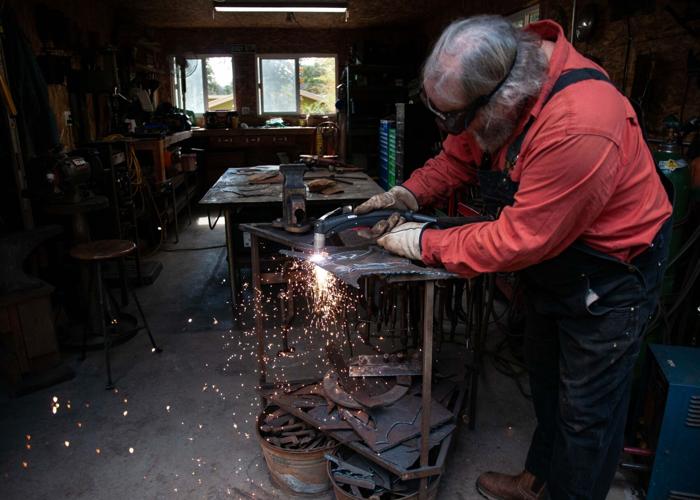
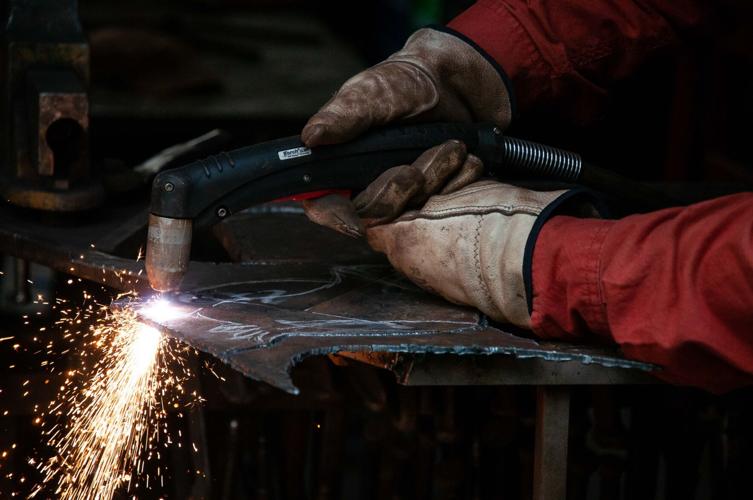
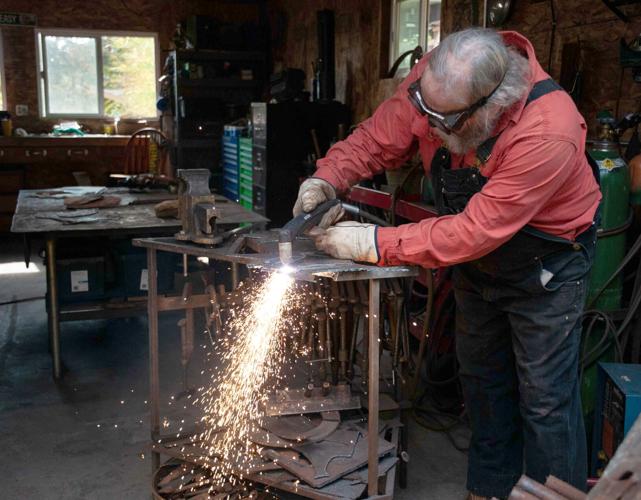
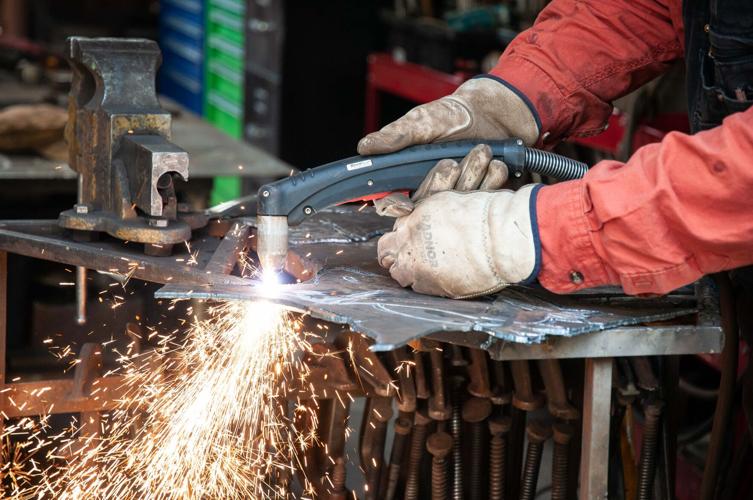
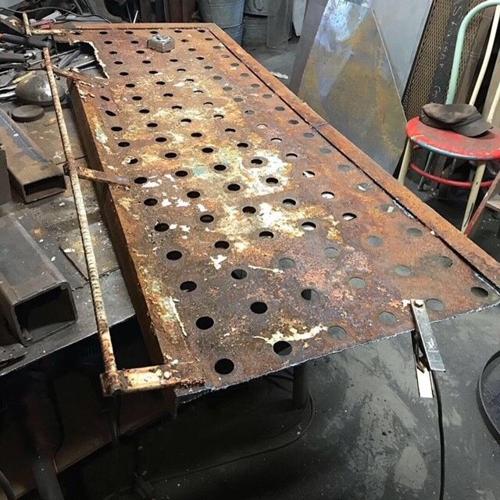
Root shapes the materials with a plasma cutter, welds them together, occasionally heats them. Sometimes he uses a metal conditioner to create extra color and texture.
Other sculptures Root paints with a brilliant oil-based urethane. “It’s the best product I can find,” he said. “This may weather and change over the years, but it’s going to change with the colors that I put on there. And these things could completely rust at some point… to me there’s just a lot of beauty in all that.”
Root likes the flexibility of working with metal. “There aren’t really mistakes, because you weld them up and grind them down,” he said. “In metal, there’s a lot of leeway.”
Some of Root’s pieces get big. At over six feet tall and bulky enough for Root to contentedly use as a chair, “Surfs Out” requires a small crane to move.
When sculptures are complete, Root usually donates them. He’s given out 36 pieces so far, including to Mosier school, Columbia Gorge Discovery Center and The Dalles Public Library.
Expanding the display of his work locally is important to Root. The county is rich in old farm implements; Root hopes his work inspires people to see new possibilities in all that old equipment. “Farm kids could see the piles of scrap … and inspire them to hopefully do their own art,” he said.
Sometimes Root’s art references the history of a particular place. “Somebody called me up a couple years ago … her husband collected iron for 50 years,” Root recollects, “and one thing he did was, he took all the prison beds from underneath city hall.” Root made the frames into a sculpture, “City Scapes,” now standing in front of city hall. “I like to do things that reflect and talk to the community,” he said.
Root can be an artist with words as well as metal. One piece, now at Wasco County Library, bears the title “Expect the Unexpected…Embrace the Occasional Mystery – In a World Teetering on the Brink of Unresolved Issues, Uncertainty and Chaos... Seek out the Balance and Harmony between Light and Dark Forces.”
“It spoke to me when I was making it, and that’s what it wanted to say,” Root recounts. “Some pieces just don’t have a voice.”
Root often returns to what he says are two basic ideas commonly taught in art: Less is more, and the balancing of negative and positive space. “I learn things from a lot of mediums, but it always comes back to the basics,” Root said. “My pieces have a life of their own … I just go with the flow.”
“I think you have it or you don’t,” he said of artistic vision. “It’s kind of like music, you just go for it… and sometimes it’s in your history. …I think we’re only in touch with a very small percentage of our capabilities,” he added, “given the right opportunity, we could be in touch with a lot more, deeper ones.”
Root’s work can be found online at alanrootironsmith.com.


Commented
Sorry, there are no recent results for popular commented articles.