April has arrived, with (somewhat) warmer temperatures and usually a few more clear skies. Our days are definitely getting longer, our nights shorter. At the start of April, we’ll have about 12 hours and 49 minutes of daylight. By the end of the month, that will stretch to about 14 hours and 19 minutes of daylight, a gain of an hour and 30 minutes during the month. Of course, that means shorter nights for stargazing, but with more comfortable temperatures.
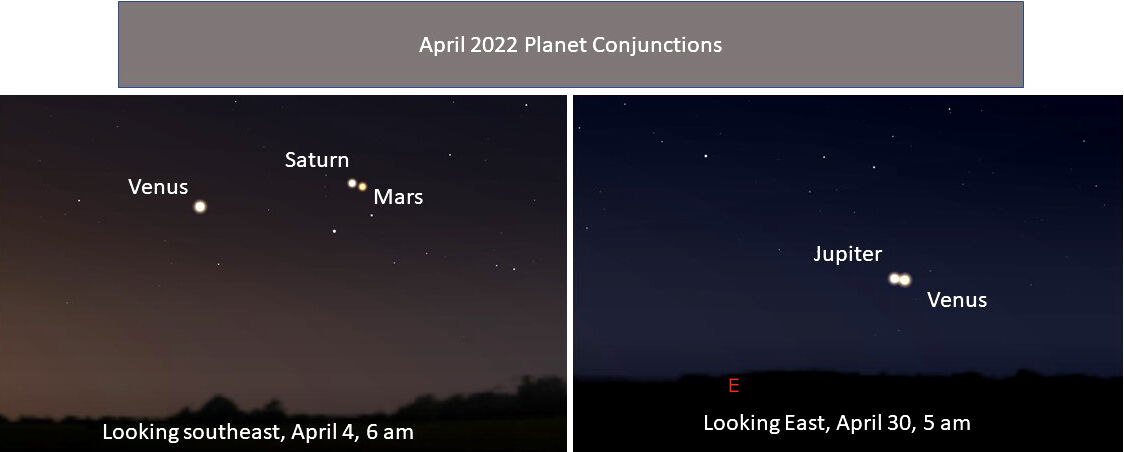
The bright planets remain in the morning sky. And they are worth a look, especially at both the start of the month, and the end of the month. On April 1, look for Venus, Saturn, and Mars very close to each other in the east-southeastern sky, before sunrise. Venus will be easy to pick out, easily the brightest star-like object in the sky. About three degrees to the right of Venus will be Saturn, and about another three degrees to the right of Saturn will be Mars. All three will be brighter than nearby stars, so easy to pick out. They will be about 10 degrees above the horizon at about 6 a.m.
A good gauge of those distances is your outstretched arm. Your closed fist covers about 10 degrees. Your three middle fingers, held together, covers about five degrees. Six in the morning or a bit later will be a good time to look. They will grow higher in the sky, but the rising Sun will soon obliterate them from view (sunrise is about 6:45 a.m.).
By April 4-5, Saturn and Mars will grow very close together as we see them, called a conjunction. They will only be about ½ degree apart, less than the width of your little finger at arm’s length. As the month goes on, the apparent distances between them will grow larger, and Jupiter will “join” them, to the left of Venus. By April 20, they should make a nice line in the morning sky, with Jupiter on the left, then Venus, then Mars, and finally Saturn. The waning crescent Moon will join them, below the planets, on April 25-26.
Another conjunction comes at the end of the month, when Jupiter and Venus join each other, again about ½ a degree apart. Hopefully we will have clear skies for these events!
The Moon begins April just after its “new” stage, and will be full on April 16. April’s new Moon will occur on the last day of the month. On April 4, look for the crescent Moon just below the star cluster Pleiades, low in the west after sunset. On the 8th, the Moon will be just below the Gemini twins, Castor and Pollux. On the 9th, the Moon will be just to the left of those stars. On the 11th and 12th, the Moon will be in the constellation Leo. On Tax Day, the 15th, you’ll find the almost full Moon just below the bright star Spica, in the constellation Virgo.
More spring constellations are beginning to enter the evening sky in April. Virgo and Corvus are above the eastern horizon by 9 p.m. By mid-month, Hercules, Bootes, Virgo, and Corona Borealis, the northern crown, will be above the horizon. See if you can locate them on a nice spring evening.




Commented