
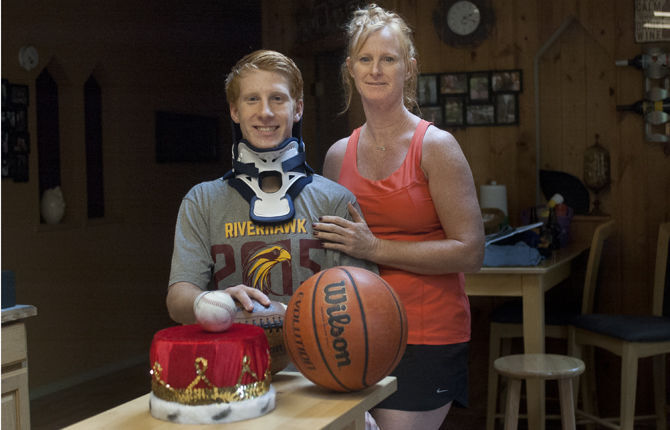
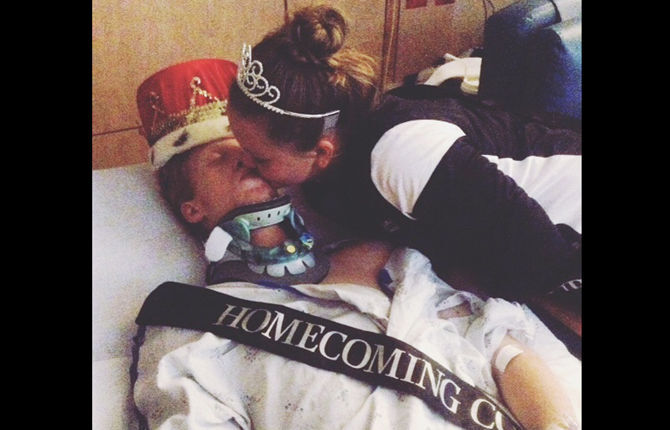
Still groggy from a marathon seven-hour surgery earlier that day to repair his broken neck, Storm Douthit listened in via phone from his Portland hospital bed as he was crowned The Dalles High School’s homecoming king last week.
Standing in for him at the Oct. 2 ceremony was his sister, Morgan Lynelle. His girlfriend, Emma Smith-Ell, was crowned homecoming queen.
Douthit, 17, was back home last Wednesday and hopes to be at school on Monday. He’ll wear a cervical collar for six weeks, and says full recovery will take a year. A three-sport athlete, he is now likely sidelined for his entire senior year.
A nearly month-long odyssey of pain and almost unbelievable perseverance preceded Douthit’s surgery.
Not knowing he’d “basically shattered” his sixth cervical vertebrae while roughhousing Labor Day weekend, he played football — with a broken neck — after rehabbing for a few weeks, and continued doing chores like helping friends buck hay.
His injury would’ve paralyzed him, he learned, were it not for his strong neck muscles and ligaments that girded his broken vertebrae and helped keep it in place.
Finally, nearly four weeks after he broke his neck, the increasing pain became too much and he ultimately ended up going directly from the local emergency room to Oregon Health and Science University on Sept. 29.
“A lot of people thought it happened from football, but it didn’t,” his mom, Melissa Pishion, said of his injury.
It started the Saturday of Labor Day weekend, when Douthit and his friends were roughhousing like they’d done countless times all their lives.
He and a buddy donned boxing gloves and headgear and were boxing in the yard, Douthit recounted. His friend “grabbed my head and pulled me toward him when I was facing him and I landed right on top of my head.”
When he hit the ground, “I just felt my neck tighten up and it just hurt pretty bad. I just saw a flash of light. I remember it, I didn’t get knocked out.”
He got upset at his friend, but “this doesn’t stop him from being my friend. I know it was just in the moment type of thing; it was just an accident.”
He lay on the ground for about 15 minutes, said his best friend, Damion Morris. He could move his legs, which was reassuring. “All I could say was, ‘You’re gonna be ok, dude,’ because he was scared and I was scared.”
Douthit couldn’t turn his head for about four days and was “just so sore.” He went to physical therapy and then started back with football practice. “Slowly I was getting back,” he said. He tried to suit up for the game on Sept. 11, “but just the weight of the helmet was too much.”
So he continued physical therapy — the physical therapist thought he had whiplash — and football practices, and felt he was getting better.
On Sept. 18, Douthit, a 6-4, 185 lb. linebacker and tight end, suited up against McLoughlin, played about 15 to 20 minutes, and made maybe three or four tackles. On that last tackle, “I got scared hitting someone. I just hurt pretty bad in my neck, so they took me out of the game.”
He tried to tell the coach he was ok, but he was benched anyway. The Dalles won 43-0. “Everybody was all excited in the locker room, it was a blast,” he said.
Pishion lauded the coaches and trainers for protecting Douthit. “They were wonderful.”
The next week, he started having migraine headaches, something he’d never experienced before. He was also vomiting. He drove to school one day, threw up as soon as he got out of his car, and just got back in and drove home.
The migraines and vomiting “were pretty much constant” for three or four days, he said. Finally, he went to see a doctor on Friday, Sept. 25. Douthit’s mom asked for an x-ray, but they didn’t do one because he didn’t show the classic symptoms of a broken neck – as Pishion experienced when she broke her own neck years ago -- like numbness and radiating pain down the arm.
The doctor thought Douthit had muscle spasms and sent him home with pain relievers and muscle relaxers.
“This is where I get upset,” Pishion said. She recounted telling the doctor “’He’s had a neck injury for two weeks and now he’s vomiting and can’t see.’”
Later, that doctor apologized to Pishion, she recounted. “It will be a learning situation for him, too.”
By Tuesday, Sept. 29, the pain was excruciating and that evening Douthit went to the ER and finally got the x-ray his mother asked for earlier. It showed his smashed vertebrae “squished out like Play-Dough,” Douthit said.
The doctor came and told him he broke his neck. “I said, ‘Are you serious?’” They told him he was lucky he wasn’t paralyzed.
He was told to head immediately to Portland, and he was driven in a private vehicle to Oregon Health and Science University. He slept on the way.
There, they learned he had cervical stenosis, a slowly progressive condition where a bulge squeezes the spinal chord. They told him it shouldn’t have taken that long for the symptoms to develop. “They said I was pretty tough.”
He had to wait until Friday, Oct. 2 for a surgery slot to open. That morning, the day of the homecoming game, Douthit was wheeled into OR at about 10:30 a.m. There, over the next seven hours, they went through the front of his neck and removed the broken C-6 vertebrae, “mashed it up, put in into a cage, put it back into its place, put a plate in, and then went into the back and put in a plate and more screws to fuse to my C-5 and C-7.”
He had a “horrible” two days after surgery, vomiting and hallucinating from the pain meds. When he threw up, “it really hurt,” he said.
His friend Morris was by his side in the hospital, just as Douthit had stuck by his side when Morris split his scalp open after hitting his head while cliff diving as a sophomore, and was hospitalized for weeks after the wound got infected and he developed sepsis.
“I went to the hospital and took care of him. We were there for each other,” Morris said.
When Morris had his accident, Douthit was the first person to help him when he came out of the water bleeding.
And, like Douthit, Morris was told he somehow escaped being paralyzed. “They said I’m lucky I’m not paralyzed from when I hit the bottom. My neck should’ve broke.” Morris thinks it’s because they’re tough kids who grew up “in the country.”
In the aftermath of his surgery, Douthit has a three-inch incision on the front of his neck, and an even bigger one in back.
For Pishion it was a “scary” time. She hated seeing her son in pain. “He’s very fragile and you know, the hardest thing was to see how sad he was during homecoming week. He felt really responsible. He felt he did it to himself, it was an accident and it was just from being stupid and goofing around. I think that was a big wakeup call for him: Don’t get so carried away, you’re not invincible.”
His family tried to decorate his hospital room for homecoming week. Focused on the game Friday rather than the halftime homecoming court ceremony, Douthit wasn’t really thinking much about whether he’d be crowned Homecoming king. “I wasn’t really into it. I wasn’t expecting to be voted into it at all.”
Morris saw Douthit Thursday at lunchtime and said he’s looking much better. “He’s gonna bounce back fast. Knowing him, he’ll probably be able to play baseball.”


Commented