
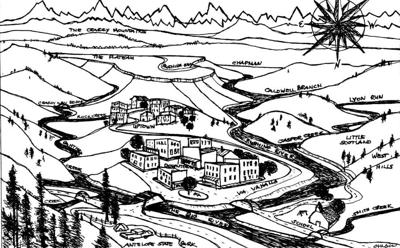
There remains something regal about the Lyon folk. Down through the generations this Warhaven family has cast an aristocratic air about them, some aura at levels casual, aloof, and deeply personal. This family was, after all, Scottish and noble, with Clan Lyon roots back before the 14th Century, to the ancestral home of Glamis Castle in Angus, home of the Earl of Strathmore and Kinghorne.
While this branch of the Lyon blood has been in America for close to 400 years, a dignified culture remains about them. Yet for their neighbors throughout the years, this was neither here nor there, for this is the American West, where titles and blue blood don’t count for much. We value pedigrees more in horses, hunting dogs and tomatoes.
Warhaven would not have prospered so if not for Ebenezer Lyon, co-founder of the Lyon Chapman Bat and Casket Company and the L and M Mercantile. With his wife Lenore, the Lyon vision of ethical leadership was intertwined with the DuMont, Chapman and McDaniels families.
The men were all veterans of the Battle of Gettysburg, and they took governance and community seriously. They were the initial crafters of Warhaven’s verve around commonweal. They established sincere, trusting ties with their indigenous neighbors, the Quaish. The first city council, established in 1870, was composed of Ebenezer Lyon, Paris DuMont, Gruff McDaniels, blacksmith “Anvil Arm” Anton Bergsdorf and Toneseek or Golden Bear of the Quaish. While their opinions differed on many subjects, they were consistently able to reach consensus.
David (1850-1918), son of Ebenezer, was the visionary who donated land for the airport in 1910. He was one of Warhaven’s rare victims of the Spanish flu and was the father of William. David served on the Warhaven City Council from 1891 until 1901 and presided as mayor in the years 1895 and 1900.
The reader may remember that over the decades the DuMont Foundation has funded retreats of the city council to remote natural beauty to conduct the city’s business in reflection, deep discussion, and uninterrupted conversation. The first of these occurred in 1916 when the sitting council traveled to the newly created Rocky Mountain National Park. David’s son, William, was one of those elected officials. The group and their individual themes for advocacy in long-range planning included: Downtown’s Abram Fieldman, age 37, sustainable fish harvesting; Maud Adams of Uptown, age 47, hospital and inoculation services; Wallace McVie, age 46, of the Plateau, education and the arts; Mayor Philander Jones of the West Hills, age 64, textiles, shoes, and shelter; and from the Craggies, William Lyon, age 42, trains, aeroplanes and automobiles (including rail, airfield and road construction).
Job Lyon, who wore the mantle of mayor in 1945 had much on his plate at the close of the World War II. There were many to welcome home, from the soldiers and sailors to the WACs, WAVES, WASPs and SPARS. Beyond those in uniform there were those of Japanese descent that had spent the war years behind barbwire in tarpaper shacks in the desert. It was Job, who in a city council meeting, in answering a question from Mary Means regarding relocation of the interned stated emphatically, “Warhaven shall give them a homecoming that demonstrates both our utter regret for their losses and our resolve to prevent such racist horror in the future. Our nation’s myopic, simplistic, xenophobic response to external threat has been shameful. We could have done better.” After the meeting Means strolled up to Job, nudging him kindly. “I just love your altruistic chivalry!” He blushed.
Andrew Lyon, Job’s child (1935-1978) served on the Warhaven City Council from 1966 until his death in an automobile accident in 1978. He presided over the council meetings as mayor in 1969 and 1974. He was mayor when so much of America was in social and political turmoil. In religion and education, it seemed every long-held tenet was being challenged as passé. Symbolically this came to a head for Warhaven up at the high school where the principal and dean of students were tired of growing disrespect and the degrading of the dress code through revealing miniskirts, daring braless halter tops, and rebellious blue jeans. They foolishly decided to ban blue jeans and made their point by giving in-school suspensions on a warm Wednesday in May to 97 students, filling a study hall to overflowing. It may have been that by midmorning every telephone in Warhaven was in use.
Andrew left his office at the LCBCC at 10:03 and drove up to the school district office where he met behind closed doors with the superintendent and the two high school administrators. At 10:15 he was back in his car, and by 11:00 the wayward students of fashion were liberated. Andrew, if you are interested in genealogies, was the husband of Hyacinth (Episode 28) and the brother to Sarah (Episode 162).
Twins Lucy and Lucien Lyon, great, great grandchildren of Ebenezer, live up the Craggies near the Old Stone Barn, in a pair of basalt and granite cabins built by the same stone masons back in 1872. Today this pair of consulting naturalists are rather looked down upon for their confessed interests in cryptozoology, most notably, in Bigfoot. We in Warhaven can be a conflicted lot, given our neighborhood’s elves, goblins, and gnomes. Yet, whatever criticisms or shunning the twins encounter, they mostly let it run off like water from their weathered, oiled coats.
These two are practitioners of anonymous giving and use the DuMont Foundation to channel resources back to the community, to the tune of $200,000 a year, back since they had reached the age of majority, their considerable contribution to the Lyon tradition of noblesse oblige. Neither have any interest in elected office; these siblings choose to exercise civic leadership through flying beneath the radar of community awareness, which is the way of hermits.
•••
About ‘The City Council’
The City Council is a work of fiction that sprang from observing contentious politicians. This narrative serial was initially conceived as a radio project back in 2006. That year it began to be published in print in the White Salmon Enterprise. It now appears every two weeks in the Columbia Gorge News.
This creative writing is set in the imaginary western town of Warhaven, which lies at the confluence of the Rushing and Big rivers. The town was settled in 1867 by veterans of the Battle of Gettysburg, who sought to leave the carnage and duplicity of the East for a more harmonious society in the West. In Warhaven, city government works efficiently with altruism for the commonweal of the community, which is the work’s overriding theme.


Commented