The year was 1866. The two men, who would become Warhaven founding fathers and principals of the Lyon Chapman Bat and Casket Company, stood together above the mighty muddy Ohio River, moving high and swiftly toward its confluence with the Mississippi, chatted about the future, purposefully neglecting their emotional and physical wounds inflicted upon them from the recently ceased Civil War. They stand on a bluff in Switzerland County, Indiana, a place their families have called home for several generations. They both are veterans of the Battle of Gettysburg, and the dark froth of memories flow past them as the pale brown waters of la belle riviere.
Andrew sighs, tugging at his thick beard. “The East is now tainted carnage. We could start anew out West, where the waters run clear, where the creeks and runs and branches have not flowed with the blood of men. Shall we commence the search, Ebenezer?”
Nodding, Ebenezer begins, “It is not the same, Andrew. We grew up with the powder keg of slavery just across the river. I doubt we ever imagined its explosive magnitude. How could war have crept up on us so stealthily? If we go, it shall be to create a community with an open heart of steel, a self-sufficient heart. It will be a place where all are equal in exercising rights and all are equal in accepting responsibilities. Our library will promote this; our schools will teach it. Our families will live it.”
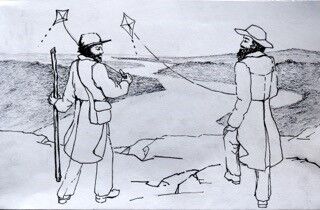
Warhaven’s founding fathers (and friends), Andrew Chapman and Ebenezer Lyon.
Artwork courtesy Katey Ellen Price
They stood on a manicured lawn, two yellow Adirondack chairs behind them. On the chairs rest red and white kites, each trailing long blue rag tails.
“The wind will pick up soon, Andrew.”
They had cut the spines and cross bars themselves from hickory and oiled dyed bedsheets for the kite canopies.
Chapman licks his finger, raising it to the breeze. “Imagine an incorporated village that owes nothing to no one, that has adequate natural resources, water, lumber, iron, coal, petroleum, skilled craftsmen.”
“Yes,” interjected Lyon. “Abundant water from clear running streams and rivers, bountiful with fish.”
“And,” added his best friend, “laws to force moderation and prudence of the use of these bounties.”
“Indeed!”
A gust of wind kicked up, blowing Andrew Chapman’s Kelly green quilted cap behind him. An agile man, he turned and leapt into a run, retrieving it as it skittered away.
As he returned, Ebenezer asked, “Perhaps a dinner next weekend, you two, we, the DuMonts, discuss this idealized migration, and what it might mean for us all?”
“Splendid, Mr. Lyon! Splendid!”
They readied their kites. The wind was now steady and strong, blowing east to west.
The kites lofted, aerial twins, bounding out toward the river. Time passed in silence.
The kites bit into the gale, now blowing strong northeast to southwest, racing them above the Ohio River toward Ghent, Kentucky.
Andrew Chapman was a successful businessman, owner of a large carpentry and construction shop, on demand in many counties in several states. Ebenezer Lyon owned much timberland on both sides of the Ohio, and his hardwood lumber mill was always a beehive of activity. With Civil Engineer Paris DuMont, these former Union officers would be the great brains of ambition behind Warhaven’s growth and idealism. The three called upon a fellow soldier, Sergeant Gruff McDaniels to join them (who with Lyon would form the L and M Mercantile). Gruff was a ready hand on all things logistical and could rouse men to courage and action with a few choice words and sentiment that displayed his own passion for the challenge at hand.




Commented
Sorry, there are no recent results for popular commented articles.