
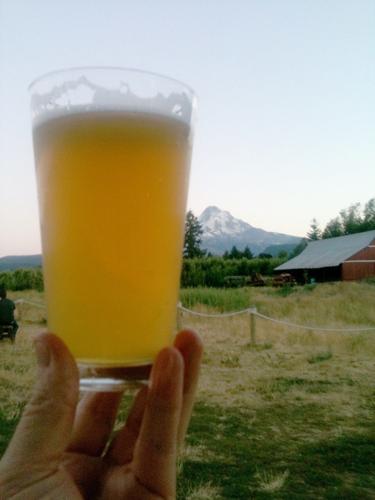
Solera Brewery in Parkdale brings out its first bottled beer April 15 at its fifth anniversary party. This is a fully-local ale; brewer Jason Kahler said the sour apricot ale is made from fruit grown at Mountain View Orchards in Parkdale and aged in pinot noir barrels from Syncline winery.
Featured music includes locals Ryan McAlexander, experimental rock band Voodoo Voltage, and Portland’s quick and Easy Boys. The party starts at noon, with minors allowed until 7 p.m.
Guest bartenders will handle pours, and other special beer tastings are planned.
•
Oregon Beverage Recycling Cooperative (OBRC) is partnering with Double Mountain Brewery & Tap Room on the pilot phase of a new refillable beer bottle program. The program combines the refillable operations at Double Mountain and the collection capabilities of BottleDrop Redemption Centers. The program launched on March 23 at Milwaukie BottleDrop, located at 6100 S.E. King Road. “We are excited to be a part of this bold environmentally sustainable program,” said Matt Swihart, Double Mountain founder and brewmaster. “Oregon is the perfect place to expand our current refillable bottle system and bring in more breweries to do the right thing.”
Representatives from OBRC and Double Mountain Brewery were on hand to return the ceremonial first Oregon refillable bottle to a retail location in 20 years. Double Mountain beer bottles will be accepted at any BottleDrop Redemption Center in the Portland metropolitan area and returned to the brewery. Since 2013, Double Mountain has used half liter bottles made of thick-walled glass, allowing the bottles to be cleaned and reused many times. Empty bottles can be returned to the brewery, where they are cleaned, sanitized and refilled with beer.
“A refillable bottle program is a progressive step in responsible materials management for Oregon’s craft brew industry,” said John Andersen, president of OBRC. “The beverage industry is committed to not only upholding the legacy of the Oregon Bottle Bill, but expanding stewardship efforts through new and innovative programs like this one.”
Refillable beer bottle programs, if developed properly, can be more cost effective and a better use of resources than traditional glass recycling. In spite of these benefits, few refillable bottle programs currently exist in the U.S. The lack of partner networks and necessary infrastructure have been common road blocks to creating refillable systems beyond a single brewery.
OBRC is a member-owned cooperative that collects and processes nearly all containers sold and redeemed in Oregon. OBRC counts, sorts, crushes, bales and recycles 1.2 billion containers each year, and operates BottleDrop Redemption Centers across the state. All bottle bill operations are funded and managed by the beverage and grocery industries, at no cost to taxpayers.
• Jules Bailey said OBRC is in negotiation with a Hood River property owner to install a “Bottle Drop Express” kiosk. The “Express” kiosk dispenses special bags, with labels, that can be filled with containers and then returned to the facility for weekly pickup. Any redeemable container may be placed in the bags.
• Interesting new brews:
“Smile. You’re in a Brewery.”
Chalkboard message at Big Horse last weekend serves as an excellent starting point for some tasty new concoctions at local breweries.
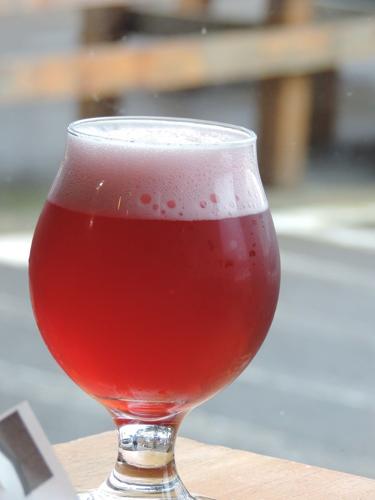
• My Pale Lady, a collaborative ale made from hibiscus, by women of the Breweries in the Gorge alliance, hosted by brewer Tessa Longnecker of Thunder Island in Cascade Locks. This ale is deep pink in color, nearly crimson, and it looks like it should be sweet but it is a gently puckering slightly tart brew. The women of BIG made this beer in February to honor International Women’s Day and it should be on tap another couple of weeks. The lacing clings with conviction and, amazingly, retains the pink color, a testament to how well-made is this ale.
• Bourbon-aged Wassail at Full Sail, made a surprise off-menu, out-of-season appearance at Full Sail pub last week. The server mentioned it was on when I asked for the barrel-aged barleywine (I had two other drivers at the table, so … )
Sandra Evans, Full Sail marketing manager, said, “This was pulled from our Brewmaster archive. We will be pulling beers from time to time from there and serving them in our pub. There are usually only one or two kegs of them, so they only last a short while.”
I sampled a five-ounce of the Wassail to go with my Reuben, and found it delicious, a good accompaniment to the tangy sandwich, yet a bit young. It bore a barrel-aged sidelight many do not like, but I confess I do: it was slightly boozy, but more on the bouquet than the palate.
I returned a few days later to sample it again, and tasted on its own it was mellower, while sustaining a flavor profile and sweetness from start to finish.
Brewmaster Jim Kelter wrote that bourbon-aged Wassail was brewed in 2011. It went into the barrel at approximately 7.3 percent ABAV. “We typically see an increase in alcohol of one to 1.5 percent, so 8.5 percent would be realistic. It was aged since 2011 in bourbon barrels from Schenley Distillery.”
• Still on tap at Double Mountain after introduction March 17 for the brewery’s 10th anniversary party: “Kerosene Hat,” which is, well, far tastier than it sounds. It’s named for a song by the band Cracker, surprise headliner at the party. Also, the mildly funky Saison Ventoux, named in honor of beloved British cyclist Tom Simpson, who died 50 years ago in Tour de France competition on France’s Mont Ventoux, as told by Ashlee Bridgewater, the new marketing guy at Double Mountain.
• The Pendleton porter (9 percent) at Big Horse doesn’t hit the senses like a high alcohol beer, and it’s smooth, delicious, subtle roasty quality carries a little more strength than most porters while keeping it faithful to the type.
• Augmenting porters is generally a case of gilding the lily — porter being a historic beer type that should hew to a traditional flavor, carbonation level, density and overall feel — but Northwest brewers have increasingly “strayed” in one or both of two ways: lack of opacity bordering on their heavier cousin the stout, or fangled flavorings. I believe there have been some fruit-laced porters out there I have chosen to forget.
Now, along comes the Imperial Maple Porter from Backwoods Brewery in Carson. The maple nudges the overall experience rather than dominates; a rich but not cloying sipper perfectly poured in a 10-ounce goblet at Volcanic Bottle Shop. ABV is 7 percent,
I borrow from our friends at the ever-reliable beeradvocate.com for this background on porter: “No other type of beer arouses so many questions as to its origin. What is it? Is it British or Irish? How does it vary from the Stout style? What does the name mean?
“Porter is said to have been popular with transportation workers of Central London, hence the name. Most traditional British brewing documentation from the 1700s state that Porter was a blend of three different styles: an old ale (stale or soured), a new ale (brown or pale ale) and a weak one (mild ale), with various combinations of blending and staleness. The end result was also commonly known as ‘Entire Butt’ or ‘Three Threads’ and had a pleasing taste of neither new nor old. It was the first truly engineered beer, catering to the publics taste, playing a critical role in quenching the thirst of the UK’s Industrial Revolution and lending an arm in building the mega-breweries of today.
“Porters of the late 1700s were quite strong compared to today’s standards, easily surpassing 7 percent alcohol by volume. Some brewers made a stronger, more robust version, to be shipped across the North Sea, dubbed a Baltic Porter.”
— Kirby Neumann-Rea


Commented