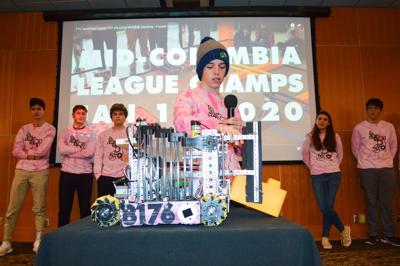
Student engineers from the Steelheads robotcs team showed just how well they stack up to the Hood River Rotary group in its lunch program last week. The demonstration was a run-up to Saturday’s First Technology Challenge Super-Qualifier at Hood River Valley High School.
The event is open to the public; see page B10 for related photos.
On Feb. 8, 25 teams from all over Oregon will compete, including four of the 10 teams from HRVHS. Steelhead won the Mid-Columbia League on Jan. 18, also at HRVHS.
FTC has been a program at HRVHS for 11 years, and the teams have gone to Worlds four of those years under engineering teacher and program founder Jeff Blackman. The associated First Robotics Championship teams have gone to Worlds both years since they were started in 2018.
“For a small town to have the largest robotics classes in the state of Oregon is pretty amazing,” Blackman said. “To make that happen, I have a lot of volunteers.
“It’s not all about the robot,” he said. “These guys do an amazing job for me and for the community — lots of community service,working with First Lego League, or FLL and Unified Robotics,” Blackman said, referring to the elementary school FLL program and, new this year, Unified, in which students with special needs are guided in robotics design, construction and operation by FTC students.
“They have put in countless hours on their robots and community service,” Blackman said.
The team came to Rotary in its Gorge Fab Lab, a refurbished school bus they regularly take to Gorge elementary schools to help youngsters learn robotics and other skills.
For Rotary, Steelhead did a dry run presentation on their robot and work plan, based on their engineering notebook.
“These students have done an amazing job with their notebook,” Blackman said.
On Feb. 8, the students will give a 15-minute presentation and plan on giving a 20-minute one if they reach Worlds.
Eight team members demonstrated what goes into a remote and manually-operated series of steps that they term inverse assembly — that means rather than simply stacking blocks, aka “stones,” they lift the stack and insert new ones at the bottom.
“A typical method a lot of teams use is lift a block and put it on top,” said team member Cameron Amer. “What we came up with is inverse assembly, by lifting a block up and placing another block underneath it, we greatly decrease the amount of time it takes to put another level on top.”
The teams are tested on their programming work as well as operating skills: The key scoring tests are an “autonomous” period where the programmers instruct the robot to do tasks, with no manual control, followed by a two-minute manual period where the team controls the robot.



Commented
Sorry, there are no recent results for popular commented articles.