
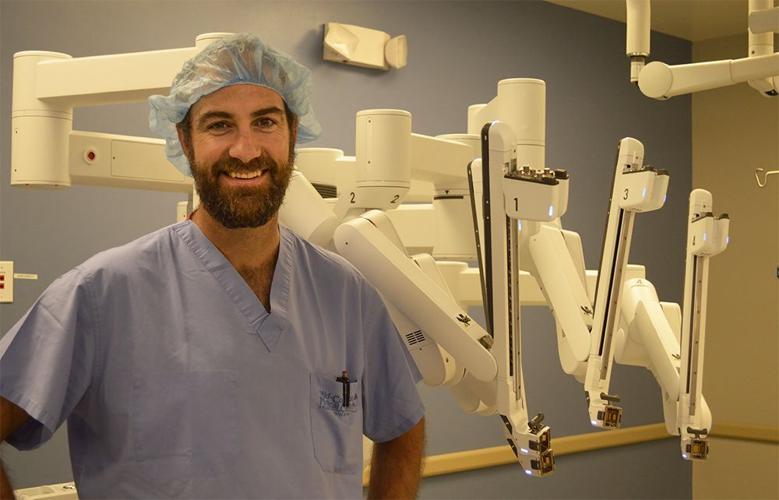
When Dr. Marc McAllister does traditional prostatectomies at Mid-Columbia Medical Center, he works directly over the patient, through a long lower abdomen incision.
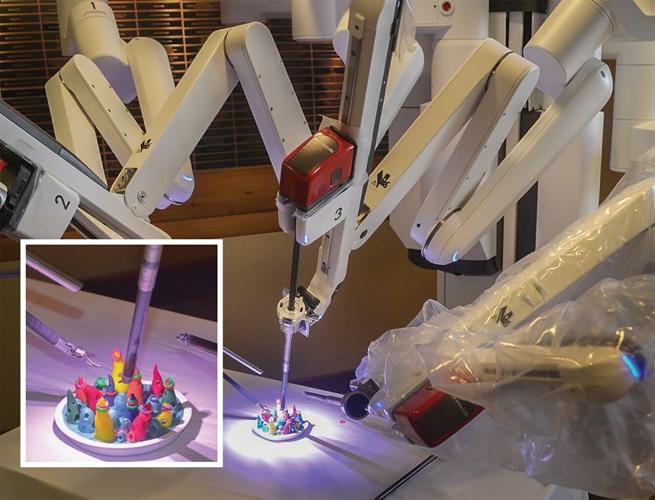
But since July, he’s had another option: sitting at a console 10 feet away from the patient, peering through a high-def 3D monitor as he manipulates the four intricately maneuverable robotic arms of the da Vinci surgical system—one with cameras—which access the patient through pinpoint incisions.
The best part from the patient perspective, said Dan Davidson, who has had a robotic procedure, is that healing takes a fraction of the time.
MCMC got the third-generation da Vinci in June and is now one of only 11 hospitals in the country with the Xi model. Surgeons here have already performed 27 procedures, said Dennis Knox, MCMC president and chief executive officer.
Most have been done by McAllister, a urologist, since da Vinci’s technology is primarily used in that field. Dr. Gary Gingrich is the assisting robotic surgeon, adding instrumentation as McAllister needs it.
McAllister said with just five tiny cuts in a prostatectomy patient, there’s little blood loss, and patients “take a couple of pain pills and go home the next day.”
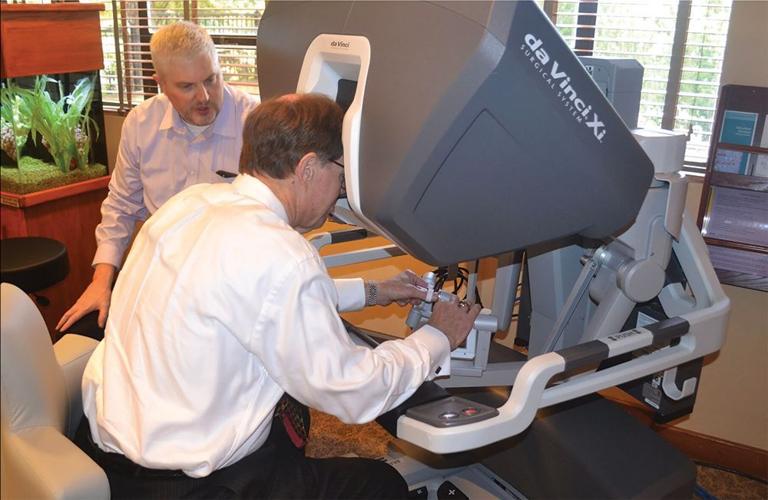
The robot is also ergonomic for surgeons to use. He rests his forehead against the padded console to view what the camera is showing, and the console has an arm rest. It’s also a back-saver because he doesn’t have to stand in an awkward position for three hours for a surgery.
McAllister has travelled to Portland’s Adventist Medical Center for seven years to do da Vinci surgeries there.
The new robot is easier to use, more efficient and has more features, he said, including a new simulator, which allows surgeons to warm up before a surgery or, if they are new to the technique, get some practice in.
Since he’s not having to go to Portland to do the procedure, he’s able to see more patients locally, allowing people to get healthcare here—which supports local jobs and keeping healthcare in The Dalles.
The da Vinci is a step up from traditional laparoscopic surgeries, where instruments are also inserted in tiny incisions, in that the da Vinci has a bendable “wrist,” as opposed to the unbendable laparoscopic tools. The delicate da Vinci controls exactly replicate the movements of the operating surgeon.
The joint on the da Vinci can move all the ways a wrist can, Knox said, giving it more precision and making it less invasive.
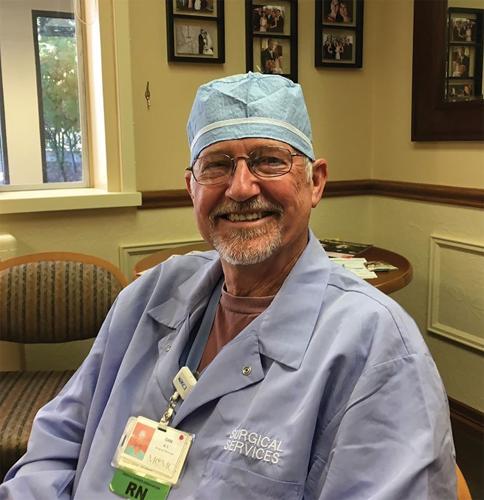
Davidson, a surgical nurse at MCMC, went to Adventist to have McAllister do the robotic prostatectomy three years ago. He was told to take three weeks off, but came back to work after just two weeks, and even that was a long time, he said. “I was bored.”
Davidson has helped Dr. Gingrich with many prostatectomies, which is removal of the prostate when it enlarges and gets in the way of urination.
“Most of what has driven the robotic surgery on the prostate is the patients themselves, and it’s because of the recovery time being shortened and the discomfort being less,” Davidson said.
The surgery itself costs more than the traditional method, but it also means a shorter hospital stay and quicker recovery, meaning less time off work, he said. Traditional recovery is six weeks.
Some still opt for the traditional open procedure, but very rarely. They used to do five or six a month, but they might just do that many in a year now, Davidson said.
Most surgical residents are trained on the da Vinci, Knox said, and if in the future MCMC is looking to hire urologists, “by golly, the fact that we have it here will be key because they’ve trained in it.”
Da Vinci is also used in general surgery, cardiology and gynecology. General surgeon Dr. Paul Moon has done nine da Vinci surgeries so far, Knox said.
“We’re thrilled to have it here. We think it’s what MCMC is about: bringing innovation to the gorge,” he said.
“Mid-Columbia Medical Center was recently awarded a ranking of 15th Top Workplace for Oregon and southwest Washington by The Oregonian Media Group,” Knox continued. “This exemplifies the positive culture at MCMC, and it takes this type of engagement by our workforce to be able to achieve our strategic initiatives, such as bringing to the Gorge innovative medical procedures like the da Vinci Robot.”
A year ago, Knox told the hospital board it didn’t pencil out to buy a da Vinci, which costs a cool $2 million. But MCMC worked with the robot maker, Intuitive Surgical, on a one-year lease agreement, where it could return the robot after a year if it didn’t work out.
The hospital needs to do just 30 surgeries a year to make it economically viable, but the hospital is on track to do a whopping 95, Knox said.
At triple the needed rate of surgeries, “We’ve blown the roof off and there’s little doubt we’re going to get it,” he said.
One of the robot’s arms contains two cameras, one for each eye of the surgeon, and that binocular vision provides true depth perception. “That alone is invaluable,” Davidson said, “especially when you’re working around structures you don’t want to nick or get close to.”
That is superior to traditional laparoscopic surgery, where surgeons had to constantly look away toward TV monitors with two-dimensional images to view the position of the tools they were manipulating.
The secret sauce is the knuckle or wrist at the end of the robotic arm, Knox said. “That little knuckle at the end gives them a very unique ability to get in there and do things they couldn’t do with laparoscopy.”
“Sewing inside the body is notoriously difficult,” Davidson said, “but with the da Vinci, it’s very easy.”
For a bit of a gross-out depiction, Davidson described the superior view offered by the da Vinci thusly: “It’s like putting your head in the abdomen.”
He admitted that non-medical people react to that concept as “gross,” while medical people say, “Oh cool!”


Commented