As humans bundle up in their warm cloths during the winter months the environment is devoid of insect life. Some are excited for the winter activities while others huddle beneath blankets hoping for the warmth of spring.
This is a time for Commercial Bee Operations to gear up for the annual migration of colonies into California. The honey bees, like most other insects, are clustered in their hive against the cold wintry days. They are not sleeping, but not active either.
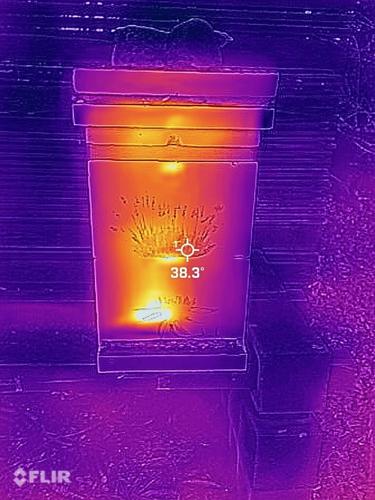
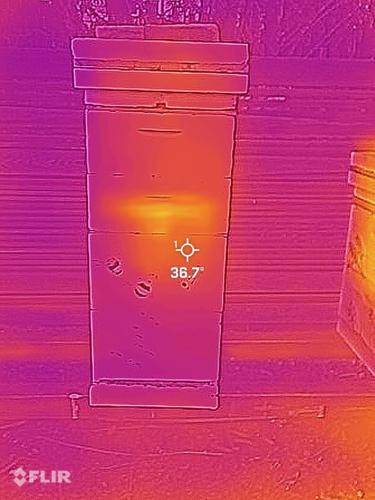
Hive cluster temperatures. Orange is warm, blue is cold.
Yet, the honey bee operations begin to load the hives onto trailers to carry them to the south. In years past as the colonies moved south one could see the hives with bees fluttering about. Nowadays, a veil is placed over the hives to preclude any danger to border inspection or others happening to be close by.
For the honey bee, especially in the Pacific Northwest, the girls should be clustering. But the movement of their hives onto the trailers, transport, and eventual unloading in California rattles their slumber senses.
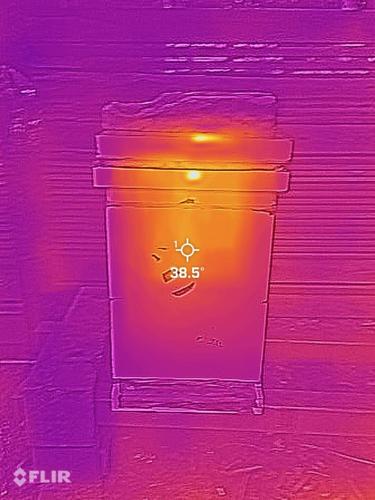
Thermal image of a warmer cluster.
Somewhere in the two-million number of colonies amass in the almond orchards awaiting their opportunity to pollinate the almond flowers. Bees come from all over the United States.
Upon arrival the colonies are fed sugar syrup. The temperatures in the almond orchards are greater than here in the Gorge. It is drier and warmer than here. Temperatures are typically above sixty degrees. At this temperature the honey bees are able to exit their colony for voiding flights. Stretching their legs!
Thermal image of an even warmer hive cluster.
Every hive must be assessed for its strength. The fees are paid by the hive and its strength. Inspectors move from hive to hive opening them and counting the number of interspaces (between frames) the number having evidence of bees. A number is assigned.
Then the waiting game ensues for the almond flowers to come into bloom. For the staging areas hives are moved into the orchards.
In the last few years, the orchards witnessed heavy rains. A lot of slushing around to place the hives.
It appears this year the weather may be more amenable to working the colonies.
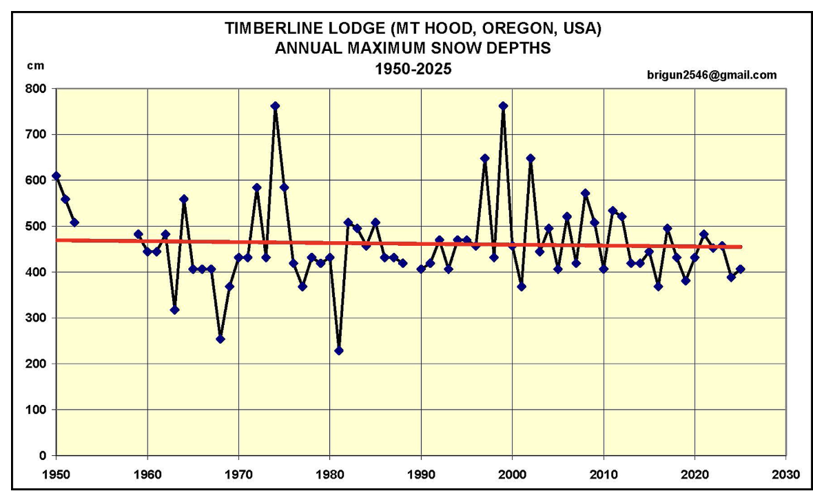
Snow levels, 1950-2020
The typical commercial operation places four hives onto a pallet to ease the transportation and placement within a orchard. The sole purpose for being in the almonds is its high nutrition pollen afforded. Thus, it is great for the almonds, growers and honey bees.
The colonies from the Pacific Northwest bee populations were in the winter mode of around fifteen thousand. Nurturing on the almond pollen drives the colonies to explode in population.
Unfortunately, once the pollination is complete there is no other nectar or pollen foliage to maintain their health either in California or the Pacific Northwest. Feast and then famine!
For the commercial operation the almond pollination service has the highest return with approximately $200.00 per hive. This assumes a high-quality colony.
Once returning to the Pacific Northwest, the price of pollination per hive drops to around $60.00.
The population has swollen to exceed the two-box configuration. Prior to transport back home, the colonies must be reduced back to accommodate a two-box configuration.
The reduction affords the opportunity to create new colonies to make up any losses or for sale.
The pallets of hives are reloaded onto trailers for transport.
For colonies coming back to the Pacific Northwest, especially here in the Gorge, the next opportunity for pollination becomes the cherries.
In the 2024-2025 winter season colonies arrived in California with a sixty-two percent loss. Due in great part to the devastation from Varroa destructor mite infestation. A business experiencing a sixty percent loss in revenue teeters toward failure. There is no doubt the agricultural operations must be operated with an eye to expense monitoring to squeeze out every nickel (used to be penny).
Some years are great, but there are those that drop the owner to their knees.
Back to the bee colonies — the seasonal changes that each colony goes through from their winter low to the foraging for nectar with high populations is a wonder to appreciate.
How a bee with a tiny brain is able to not only monitor their environment, but alter their behavior to meet the weather and foliage afforded.
The Columbia Gorge Beekeepers Association meets on the third Wednesday of each month, http://www.gorgebeekeepers.org/, at the Hood River Extension, 2990 Experiment Station at 6:00 PM. A different subject is presented by an Entomologists or experienced beekeeper. All are welcome. Visitors may attend in person or via Zoom. You may reach out to the club for login information - admin@gorgebeekeepers.org. You may also enjoy a visit to the Hood River Extension to view the three bee hives maintained by the Columbia Gorge Beekeeping Club and financially by the Hood River Master Gardeners, Klahre House and the Columbia Gorge Beekeepers Association.



Commented