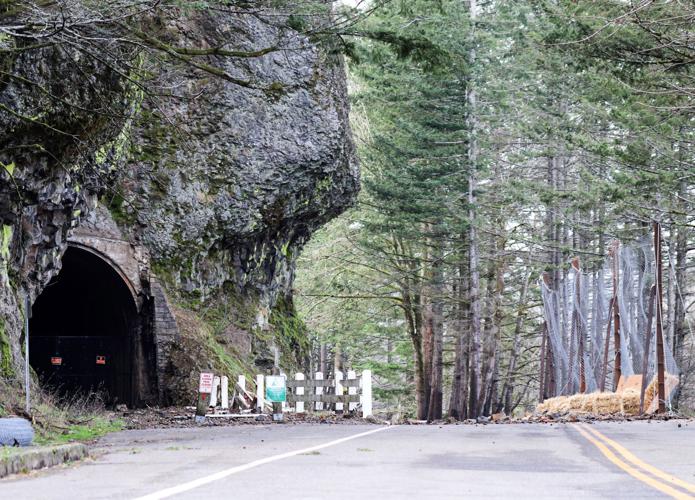
Rockfall scaling above Oneonta Tunnel was completed last week. A temporary barrier protected the railroad from falling rocks, but the road will need to be repaired.
Rockfall scaling above Oneonta Tunnel was completed last week. A temporary barrier protected the railroad from falling rocks, but the road will need to be repaired.
Emily Fitzgerald
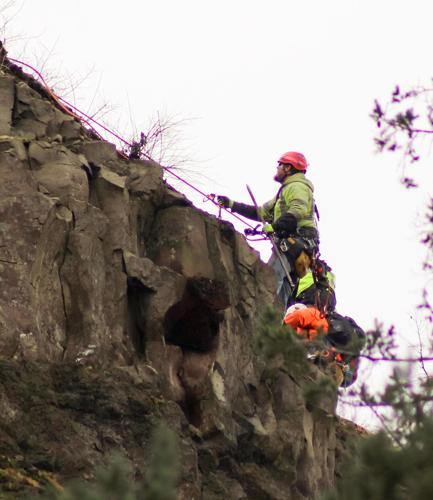
Rapeller with Triptych Construction works on the bluff above Oneonta Tunnel to knock rockfall hazards loose.
A section of the Historic Columbia River Highway was closed last week for rockfall scaling above Oneonta Tunnel, the first step towards reconstructing the tunnel after it was severely damaged in the Eagle Creek Fire.
“We think that the fire burnt out above the tunnel as well as burnt out through the tunnel,” said Tom Braibish, geotechnical engineer for the Oregon Department of Transportation (ODOT). “We were able to address the hazard trees shortly after the fire, we’re out here now taking care of the rockfall hazard that we think was impacted by the fire.”
ODOT determined that the rockfall hazard needed to be addressed before they could go in and start restoration work on the tunnel later this year.
“Oneonta has always been kind of a problem child in the Gorge,” said Terra Lingley, Columbia River Gorge National Scenic Area coordinator for ODOT. “We’ve had problems here since prior to the fire, the fire just made it that much worse: There were trees and bushes and shrubs that were holding those rocks together, and once they were gone, when they burned, it’s just a free-fall out there — figuratively and literally.”
Rockfall scaling, generally defined as the removal of loose rock from slopes, is done primarily through gravity: In this case, Workers with Triptych Construction LLC, a specialty rockfall mitigation company contracted out of Douglas County, rappel from the top of the Oneonta bluff to break up large pieces of rock and knock any rockfall hazards loose, sending it down to the roadway below, where it can be safely removed.
“We’re immediately above the highway, we’re immediately above the railroad, so we’re trying to break those larger blocks up into smaller pieces before we bring them down off the slope,” said Braibish. “To improve safety during the scaling, we’ve installed a mobile rockfall barrier at the highway to try and capture that rockfall that’s coming down and prevent it from impacting the railroad,” he added. “Unfortunately, we haven’t been able to prevent it from impacting the road, so we have some work that we’ll have to do there, but we’re taking all of the precautions we can.”
The road will be patched and reopened immediately after the scaling is complete, Lingley said, and repaving work will likely be included as part of the Oneonta Tunnel restoration.
Aside from the rockfall scaling work, the highway will be open for the duration of the construction work, said ODOT Public Information Officer Don Hamilton, with potentially some short-term or single-lane closures.
Oneonta Tunnel originally opened in 1914 as part of the Historic Columbia River Highway, and ODOT restored and reopened the tunnel for bicycle and pedestrian traffic in 2009 as part of the Historic Columbia River Highway State Trail. The tunnel’s wood lining was lost in the fire, and the concrete lining beneath was also damaged, so restoration work will involve repairing the concrete liner and replacing the wooden one.
While that restoration work isn’t set to start until late 2020, ODOT decided to complete the rockfall scaling work in February in order to mitigate the effect of the falling rocks on native wildlife.
“In the Columbia River Gorge Scenic Area, we have a lot of what we call endemic plants, so there are plants that only exist in the Gorge that are special and we want to protect them,” said Lingley, “and a lot of these plants actually live on the cliff faces like you see around Oneonta, so we had to make sure that we weren’t going to negatively impact those plants.” The plants are dormant through spring, Lingley said, “So that’s why we are really spending a lot of time to do it right now.”
Construction on the tunnel is expected to continue into 2021, at which time ODOT will reevaluate safety concerns and reopen the tunnel as soon as it’s safe to do so.



Commented
Sorry, there are no recent results for popular commented articles.