
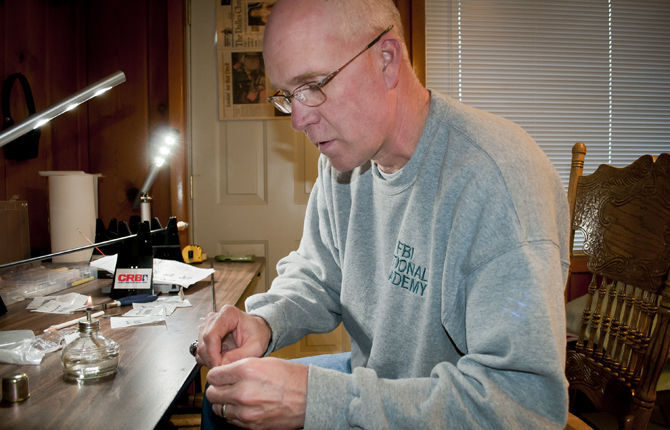
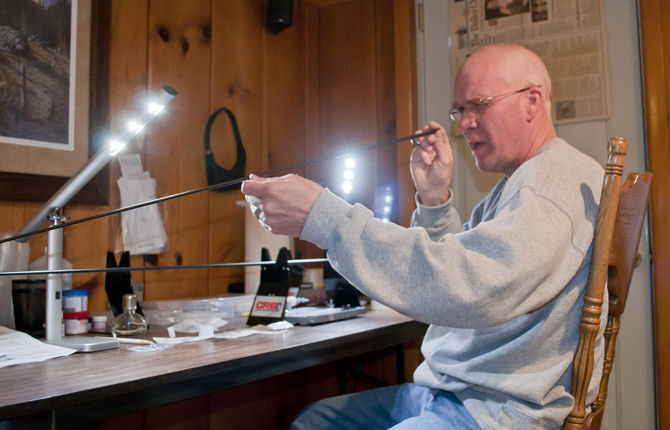
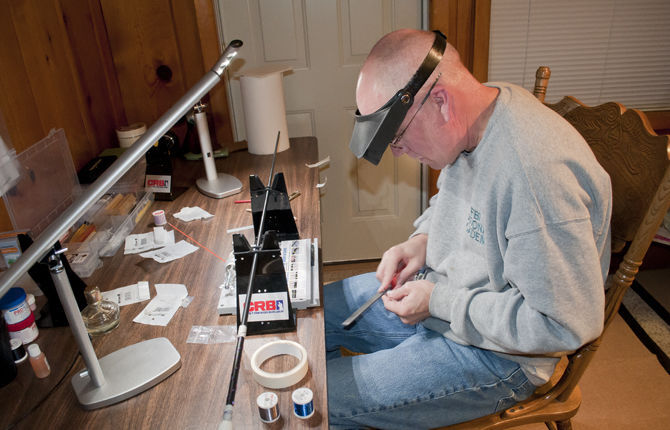
The work is meticulous and requires precision placement of the cork handle, reel seat, end cap and guides, but Lane Magill finds building fishing rods to be a source of relaxation.
“You can customize the rod anyway you want and the pattern of the thread weave, as well as the colors, can really make it personal,” he said, looking over the 9-foot fly rod that will use 5-weight line for general fishing needs.
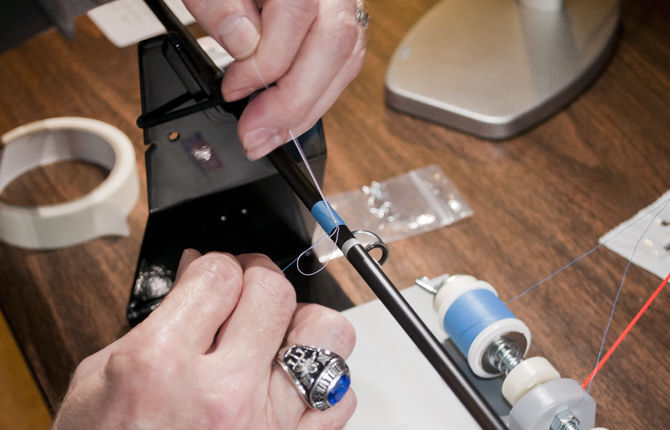
He is working along an invisible seam – determined by the way the rod bends – to set the guides. If he does not follow the line of least resistance on the pole, made from a rolled and baked sheet of graphite, it will turn wrong, forcing the fisherman to fight against it.
While he works, Magill mulls over his next project: building poles for salmon fishing that have the right weave and thread design colors on the base of the rod, and around the guides, to honor combat veterans from all four military branches.
“There’s hundreds of different combinations (designs)” he said.
Magill serves on the board of Outdoor Adventures for Military Heroes and is in charge of the annual fishing trips for wounded warriors. He envisions being able to give every veteran who comes onboard a pole that is sporting his or her service colors.
“People get so good at this that they can weave the threads to look like the American flag with stars,” he said. “I’m not there yet but I’m studying up on it.”
Last summer, Magill was urged by his wife, Sheri, to take up the craft. He had expressed interest in building rods as a way to unwind from the daily stresses of overseeing operations at a law enforcement agency.
Magill, who has 13 years of experience in law enforcement, is the chief deputy of the Wasco County Sheriff’s Office.
“Lane is never more relaxed than when he’s fishing and this was something I thought he’d be good at,” said Shari.
Lane first told his wife that he didn’t think he would have the patience.
“I said, ‘I think you have more patience than you know,’” said Shari, who is not quite ready to share her craft room with Lane.
“I’m messy and he’s not and I don’t think that would work out too well,” she said.
“We could tape a (do not cross) line down the middle of the floor,” suggested Lane, who failed to gain support for that idea from his wife of more than 28 years.
So, tucked into a corner of the family room, Lane set up his equipment and put the knowledge to work that he had gained from several months of studying You Tube videos and how-to books.
On his quest to learn the trade, he has become a fan of Marco A. Silva, who is renowned for his beautiful and complicated weaves.
“When I can make a design like he does, then I will know that I’m successful,” said Magill, who works one to two hours per night on a project.
He not only makes fly rods, but other salmon, steelhead and trout rod styles as well. He plans to delve into bigger rods for sturgeon, tuna and other larger fish in the near future.
He said rods can be made of varied materials and outfitted with basic equipment or expensive upgrades, which raises the price from about $150 for the rod he is currently working on to more than $3,000.
“There is no end to the things that you can do to customize,” he said, in reference to the Abalone shell inlay that can become part of a weave.
Magill’s first order after getting his operation up and running in September turned into a Christmas surprise for an Idaho couple, both of whom are also in law enforcement.
She asked Lane to build an ultra-light trout rod for her husband’s present, with the thread design in Boise State blue and orange. He asked for a rod that was decorated in his wife’s favorite colors of purple and silver.
“Both packages were delivered to the same block (their places of employment) on the same day,” remembers Magill. “They took them home and hid them and when they opened them, everyone was surprised.”
Those were his first creations and were followed by a rod for his son-in-law, Lee Duval, with the San Francisco 49er colors to commemorate his favorite team.
All of those rods took about 10 hours spread over a three-day period.
The thread used in the craft is specially made not to run when coated with epoxy – made from a mix of hardener and resin -- to protect it from fraying. It takes about 48 hours for the epoxy to dry, a process that is helped along by a machine that turns the pole to keep the air flowing around it.
“I grew up in Wamic trout fishing with a fly rod that I never used for fly fishing,” said Magill as he slowly winds a metallic royal blue thread around a black pole that he plans to keep.
Nearby is the silver metallic thread that he will soon add to the weave, along with the black that will be used to define the design.
“This is a great thing to do when the weather’s bad and you don’t want to be outdoors,” he said.
Next on his list is learning how to tie the flies that will be used on one of his poles. And, possibly, selling customized rods to make extra money for vacation – and more fishing trips.


Commented