
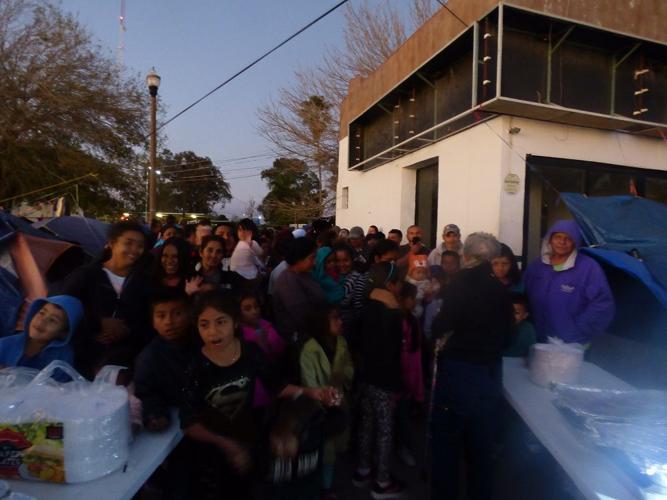
By the time volunteers had finished loading up their wagons with food and walked them across the Gateway International Bridge into the refugee tent city on the other side, it was dusk, and hundreds were waiting for a hot meal.
It was past dark by the time volunteers finished serving everybody.
One of those volunteers was Hood River resident Mariah Carlson, on her second trip to the U.S./Mexican border to help aid refugees.
“It’s a humanitarian disaster taking place at our borders right now,” said Carlson.
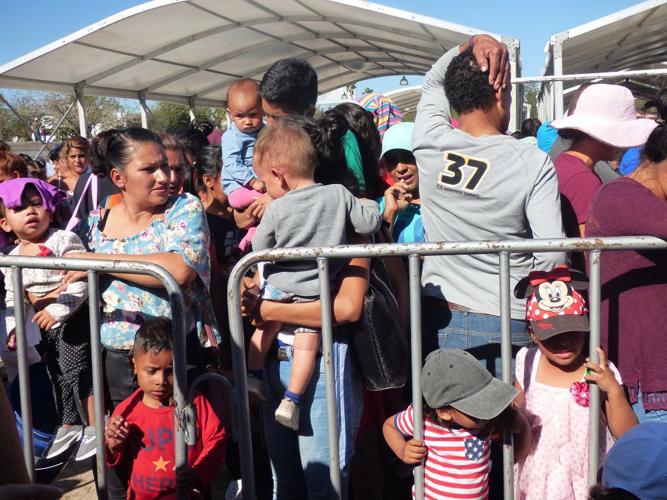
She estimated that there were approximately 2,500 migrants — many of them children, sent to the U.S. alone — living the crowded tent city outside Matamoros, Mexico when she visited for two weeks in January.
“People are getting really desperate,” she said, referencing the fact that parents are now sending their children to the border alone, hoping to give them a better chance of receiving asylum. “I know you have to be desperate to do that.”
As of Dec. 20, 2018, when the Migration Protection Protocols (commonly called the “Remain in Mexico” policies) were enacted, asylum-seekers are generally returned to Mexico while they wait for their case to go through U.S. immigration court.
Under the Protocols, immigrants (with the exception of unaccompanied children, Mexican citizens, or people who in “special circumstances” outlined in the documents ) are processed by the Department of Homeland Security and returned to Mexico with a “Notice to Appear” for their immigration court hearing, held in tents along the border, where a judge appears via-video in a “tent court” set up on the U.S. side of the border near Brownsville, Texas.
These “tent courts” have been widely criticized for their lack of transparency and, after months of backlash, opened some court proceedings to the public in late December 2019.
Witness at the Border, one of two organizations Carlson volunteered with during her January visit, protests outside of the tent courts and, now that they’re partially open to the public, sits in on proceedings.
“We’ve got to come back and tell people what’s going on,” Carlson said. “Otherwise, they aren’t going to know.”
A staff writer at the Brownsville Herald sat in on a tent court proceeding in late January and described the frustration exhibited by both the judge and asylum seekers, and instances incorrectly filled-out forms that set people’s cases out a month or more.
An interpreter is present in the tent courts — although they primarily speak Spanish and English, Carlson said, and many asylum-seekers are only fluent in their native indigenous languages — and documents are only given out in English. Asylum-seekers are also required to pay for their own legal counsel; they are not provided counsel by the U.S. government if they cannot afford to hire their own attorney.
According to data collected and released by Syracuse University, judges decided 67,406 asylum cases in 2019; of those, 19,831 (roughly 29 percent) were granted asylum or some other relief and 46,735 (roughly 69 percent) were denied. These numbers do not include cases that were dismissed before a decision was made.
“It’s all a scam and a sham,” said Carlson, adding that the tent itself purposefully “looks very intimidating,” surrounded by barbed wire and armed border guards. “It seems to me that the purpose of this is the cruelty … but these people are so desperate, they come anyway,” she said.
The tent city is purposefully set up in-sight of the tent court, Carlson said, so that asylum-seekers can regularly check that their court date has not changed. If they miss a court date, their case is thrown, and they’re not allowed to reapply.
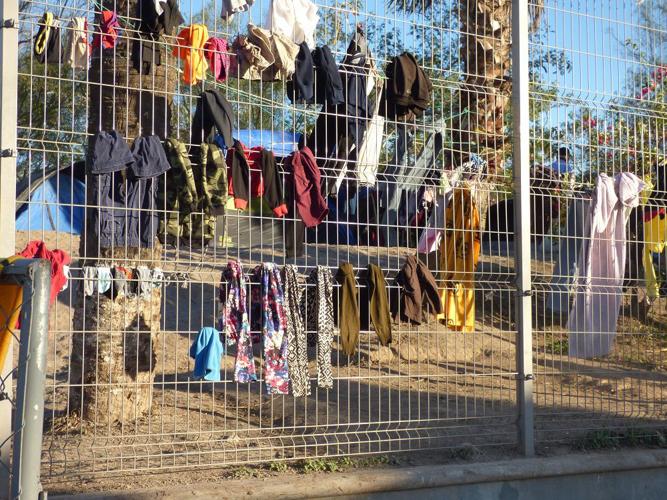
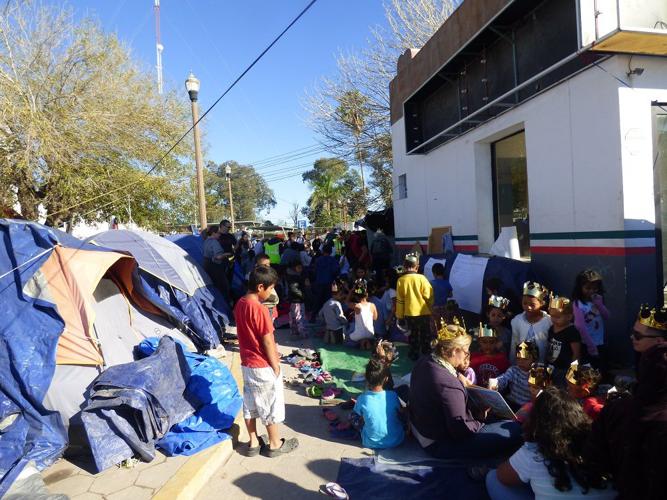
Carlson described walking past rows of tents covered in plastic, clothing hung up to dry after being washed in the Rio Grande (potable water was unavailable until recently, she said, when a volunteer group set up a water filtration system within the camp), and children hungry not just for food, but for enrichment — excitedly gathering for “Sunday Sidewalk School” activities, and Team Brownsville’s “Escuelita de la Banqueta” to learn basic instruction in English, math, geography and other subjects.
The “Escuelita” is one of four programs that Team Brownsville manages, each designed to help families and individuals legally seeking asylum in the United States. Carlson primarily helped cook, deliver and serve dinners, but the group also contracts a local restaurant to provide a basic breakfast, and helps asylum seekers who are dropped at the Brownsville La Plaza bus station make phone calls and book travel tickets so they can get to their sponsor location in the U.S.
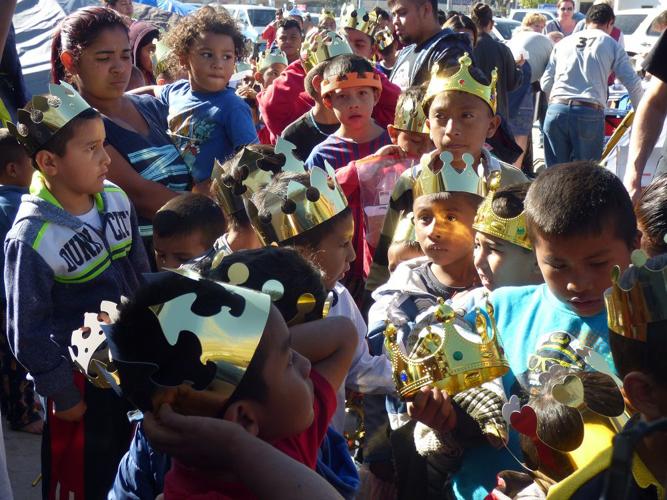
For Three King’s Day (also known as “Little Christmas;” the holiday is celebrated in Mexico more-commonly than Christmas), Team Brownsville delivered stockings stuffed with gifts, donated by people all over the country, to children living in the tent city. “It was just a generous outpouring of love,” Carlson said.
When asked to compare her experiences this past January to her prior experience volunteering at a shelter in El Paso in the spring of 2019, Carlson said that it was hard to compare the experiences because they were so different: In the shelter, they were in a position to help people one-on-one, while in the camp, migrants were largely forced to look out for themselves and each other — to the point of setting up their own “stores” of donated goods, such as tents and blankets, to help newcomers.
If anything, Carlson said that the people are more desperate now for asylum than they were when she visited last year, because more and more parents are sending their children to the border alone. “They’re getting to that point,” she said. “Someday, we’re going to be called to answer for all of this.”


Commented