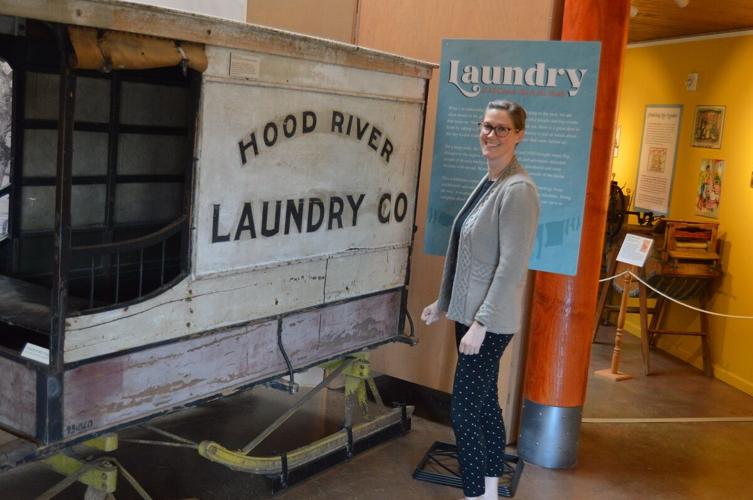
History Museum of Hood River County Executive Director Anna Goodwin stands by the Hood River laundry truck that greets visitors to the new temporary exhibition “Laundry: It all comes out of the wash.” The exhibit looks at the history and development of laundry technology and how it pertains to culture, community and life both nationally and in Hood River County.
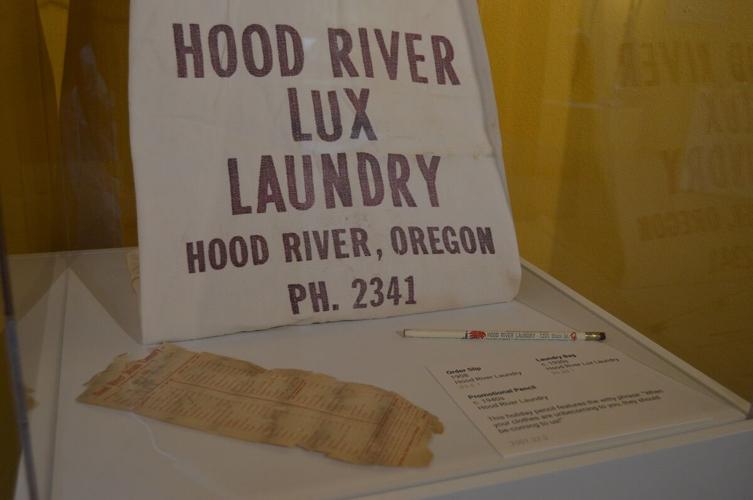
Items from Hood River Laundry include a pencil and order form. "Laundry: It all comes out in the wash" is the newest temporary exhibit at the History Museum of Hood River County and runs through June 25.
History Museum of Hood River County Executive Director Anna Goodwin stands by the Hood River laundry truck that greets visitors to the new temporary exhibition “Laundry: It all comes out of the wash.” The exhibit looks at the history and development of laundry technology and how it pertains to culture, community and life both nationally and in Hood River County.
Trisha Walker photo
HOOD RIVER — “What’s so interesting about laundry?” asks the opening “chat panel” that greets visitors to the History Museum of Hood River County’s new temporary exhibit, “Laundry: It all comes out in the wash.”
Plenty, as it turns out.
This is a fascinating look at how laundry technology has evolved — in the United States in general and Hood River County in particular — through roughly the 1950s. From the advent of washboards in the 1830s to the modern washing machine, the exhibit details how “something as routine as laundry” gives us insights about culture, community and life.
Laundry was a time-consuming, arduous chore, first done in the open water of a river or stream, clothes beaten against rocks to extract dirt. Later, laundry moved to a tub of water heated over an open fire, with each garment rubbed over a washboard before being wrung out and hung up to dry.
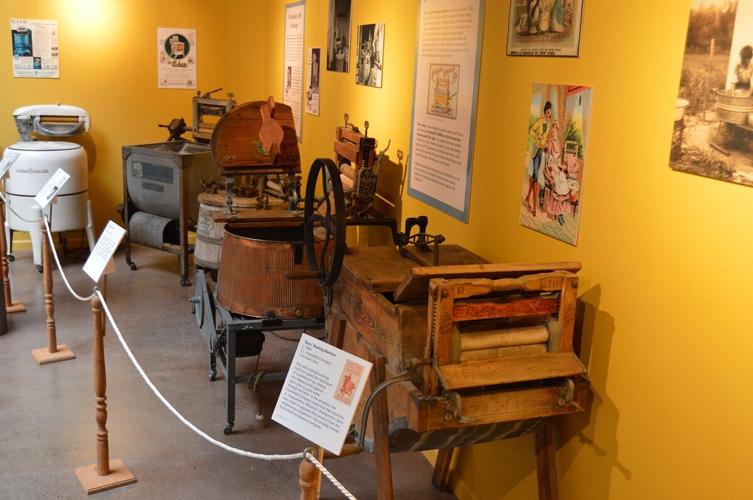
The evolution of the washing machine is on display at the History Museum of Hood River County. The exhibit runs through June 25.
Trisha Walker photo
Examples of the washboard system, including soap used, is displayed, as is a look into ironing, another time-consuming chore. There’s also an example of an electric “mangle,” circa 1940 — an electric machine that rotated and pressed fabric around a heater to remove wrinkles.
The exhibit contains several washing machines — including a circa 1899 wooden model, a 1921 Maytag and a 1949 General Electric. Small load capacity is a theme despite the change in materials of construction.
The exhibit acknowledges that laundry has long been considered “women’s work or a task for servants.” Laundry services were needed when white settlers established communities in the West, and that led to employment opportunities for women and immigrants. Chinese workers, who came to the Gorge on railroad crews, opened laundries when “typically male” work was denied to them because of their race.
The history of Hood River laundries is explored in one chat panel — one early business was located at the corner of Columbia and Fourth streets, run by Ho My and Yoe Kee from the late 1890s to the early 1900s; Columbia Laundry opened around 1902 on Oak Street and was operated by Japanese immigrant W. Oda and his family into the 1920s.
Items from Hood River Laundry include a pencil and order form. "Laundry: It all comes out in the wash" is the newest temporary exhibit at the History Museum of Hood River County and runs through June 25.
Trisha Walker photo
Laundry changed again with access to electricity. Hood River’s agricultural importance and proximity to hydroelectric power meant that area farms were some of the first to get access. That meant the birth of “power laundries,” the equivalent of today’s laundromats.
The exhibit also looks at how electricity paved the way for household appliances such as toasters and hand mixers — and the difference between manual and electric vacuums.
The exhibit opened at the beginning of March and runs through June 25. The permanent collection includes everything from Indigenous baskets and beadwork to the first windsurfing board.
The museum is open Monday through Saturday and is located at 300 E. Port Marina Drive in Hood River. Admission is $5 and free for children 10 and under.



Commented