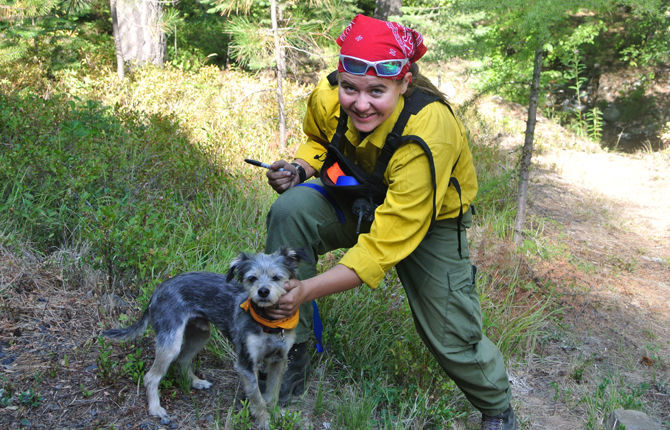
FIREFIGHTER Cassie Russell of the Oregon Department of Forestry takes a few minutes to calm “Zachary,” the dog of Yvonne Pepin-Wakefield, during the battle to save Pepin-Wakefield's cabin and other homes threatened by the Canyon Creek Complex fire near John Day. Contributed photo
FIREFIGHTER Cassie Russell of the Oregon Department of Forestry takes a few minutes to calm “Zachary,” the dog of Yvonne Pepin-Wakefield, during the battle to save Pepin-Wakefield's cabin and other homes threatened by the Canyon Creek Complex fire near John Day. Contributed photo
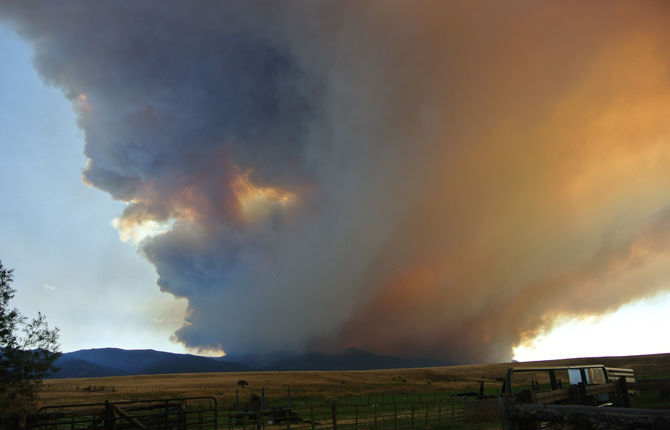
A pillar of smoke approaches Yvonne Pepin-Wakefield's cabin near John Day.
On Friday, Aug. 14, The Dalles resident Yvonne Pepin-Wakefield drove to her mountain property for a relaxing weekend. Instead she found herself in the line of a forest fire that was sparked by lightning and would grow to over 73,000 acres, burn 39 homes and threaten more than 700 structures, one of them hers. Following is the story about dealing with that threat and trauma, told in her own words:
I was 18 years old when I set out to build a log cabin on 80 acres abutting the Strawberry Mountain Wilderness just beyond John Day City in Grant County. Though many are gone now, the people around here helped raise me and this log cabin. Now they and this country were being razed by fire. As I drive east of Dayville, an eerie plume blooms — a range land wildfire I figure, hoping it’s nowhere near the direction I’m heading. It was.
The fire was sparked by lightening Aug. 12 and quickly spread in dry vegetation.
KJDY, the local radio station, broadcasts updates until the power lines burn and the signal dies. The plume continues to billow, covering the sun and shedding a bloody glow over the land. Yet, the sky is clear on the mountain top above Pine Creek where I am headed.
By the time I arrive it is clear I should not be here; burning embers rain down. I do not even open up the cabin but do take a moment to kneel by the creek below, blessing this special place fast becoming like the nearby forest, beyond prayer.
In minutes heavy smoke and smoldering pine cones and moss tossed by the inferno a mile away force me to say goodbye to the longest relationship in my life, this log cabin. I take only a sleeping bag and leave behind everything I’d built here to burn.
By the time I hit the county road the evacuation has begun. I pull to the roadside and sit on my truck tailgate, alongside my little dog Zachary, sketching the plume, watching an exodus of trailers, cars and trucks — people like me fleeing.
My parents died when I was a kid, leaving me with an inheritance I used to buy land and build the cabin. Through loss, I’ve known my share of desperation. But nothing like the helplessness I feel now.
This time I’m not alone though, there are hundreds of people around here shocked, not knowing what to do but watch the inferno grow.
That night I sleep in the truck within view of the blazing mountainsides, not knowing if the cabin will be there in the morning.
Level three evacuation means leave immediately. Danger to your area is current or imminent, and you should evacuate at once. If you choose to ignore this advisement, emergency services may not be available to assist you further. Do not delay leaving to gather any belongings or make efforts to protect your home, is the official definition.
The sheriff’s deputy at the road block just says “Take what you can and get back out,” then writes down my name and license plate number. The cabin is so off the grid there is no means to communicate if conditions change and they do within minutes after returning the second day of the Canyon Creek Complex fire.
Visibility is as cloudy as my judgment. How to prioritize a relationship with things when the only thing I want to save won’t fit in a truck bed. Smoke flows inside the cabin as I walk in circles, opening and closing drawers, deciding…an opportunity not afforded others nearer to this fire.
A few flannel shirts I wore when I built this place and some hand tools are all I take; they will be useful if I have to rebuild. Still, I’m not ready to give in to the fire. I haul buckets of water up from the creek, dousing the perimeter until a neighbor arrives on an ATV to say, “It’s useless. Four hoses were on a house in Canyon City and it burnt to the ground. Just leave,” he says.
Halfway down the rutty mountain road I am stopped by four firefighting vehicles heading up. They have come to assess how to save the cabin. If hope had a color it would be the value of yellow in the fire shirts covering their backs. I ride up in their rig to show the crew the lay of the land shrouded under swirling smoke.
Always super fire conscious, I’ve had lots of fuel load reduction work done on my forested acreage and as part of Eastern Oregon’s first Firewise program I cleared trail if needed in a forest fire evacuation.
Now the fire crew is planning to use it to bring heavy equipment to cut and bulldoze fire lines. They will also order a pump to keep a hose spraying from the creek. All of this will take days.
For the next three days I’m allowed through the blockade but spend the nights sleeping in my truck at the fairgrounds relief center alongside other evacuees, many not as lucky as me. We are camped just beyond a field of firefighter’s tents that will grow to over 900. The fair pavilion is spilling over with donations and kind, helpful people. I am given toiletries, extra bedding, dog food and a blanket for Zachary too.
On the fourth day firefighters in full gear appear out of the wilderness. I’m inside cleaning the cabin as if to prepare a body for burial when I see them through the window.
They have been tying pink surveyor’s tape to trees to mark fire line and I am told it’s time for me to leave and to not return until their work is done.
As of Aug. 25, more than 900 personnel are battling the fire, which is reported to be 30 percent contained.



Commented