
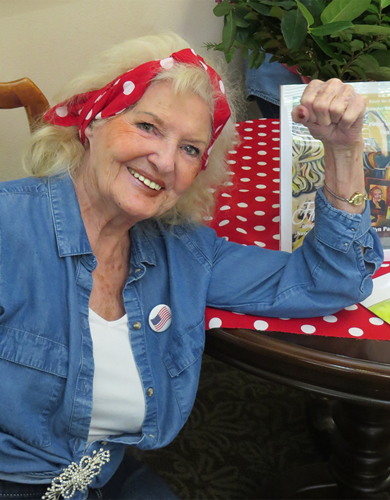
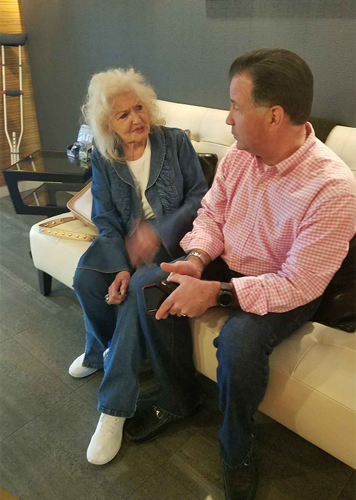
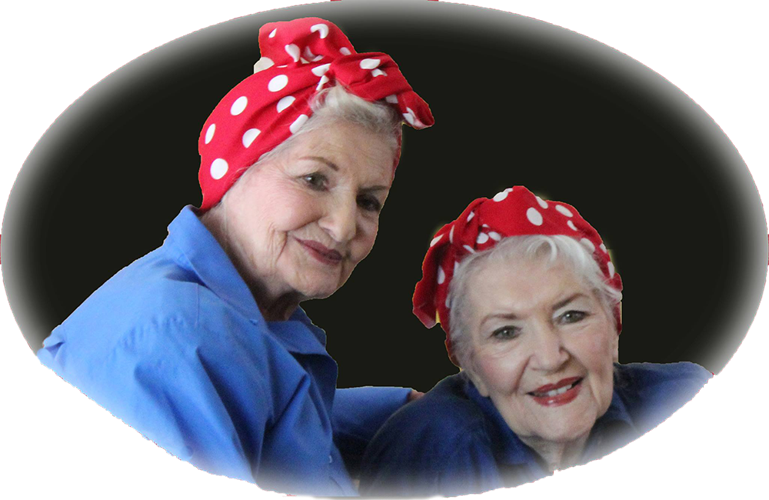
Ada Wyn Parker felt it was her patriotic duty to work at a military base in California during World War II, but never thought about the fact that she was starting a social movement.
Parker, 94, has always gone by the name Wyn and was the first “Rosie the Riveter” to build and repair airplanes during World War II. She and Eleanor Otto, the last female factory worker given the title, are being honored on Memorial Day by President Donald Trump and other government leaders.
“I think it’s absolutely fantastic, even though I don’t look so hot,” she said.
Trump is focusing this year on the contributions of nearly 19 million women who answered the call to meet labor demands while male workers were at war.
A rose in the White House garden is being named for the Rosies because of their important role in national defense.
“I was kind of surprised, I’m still kind of surprised,” said Parker about the upcoming trip to Washington, D.C.
She resides with her granddaughter, Debbie Talbott-Sands, who works at Flagstone Senior Living in The Dalles.
Parker admitted to being nervous about the May 28 meeting with Trump, unsure what she would say.
“God only knows, I’m going to pray,” said Parker. “That’s a good time to pray — it’s a big deal and I’ll probably faint.”
She plans to draw on the “We can do it” slogan of Rosie, the iconic figure shown flexing her muscles for propaganda posters.
She looks forward to riding in a red Rolls Royce convertible for the annual Memorial Day parade and meeting some of the other living Rosies, who will ride on a float behind her and Otto.
Her granddaughter is joining her on the trip that has been organized by the Oregon Spirit of 45, an organization focused on honoring heroes in the “Greatest Generation” and keeping history of the war alive.
Although there has been controversy for decades over who was the real Rosie the Riveter featured in posters, Parker’s sister, Naomi Parker Fraley, was identified as that woman through the six-year research of Seton Hall University Professor James J. Kimble.
He hunted down a copy of the vintage poster with the photographer’s original caption dated March 24, 1942, and the location, Alameda. Fraley fought to be recognized and was successful in that venture before dying at the age of 96 in January of 2018.
Wyn was 18 and Naomi 20 when they were hired to work in the machine shop at the Navy Air Base in Alameda, Calif. Their duties included drilling, patching airplane wings and, fittingly, riveting.
The sisters came from a family of eight children — they were third and fourth in line — and were urged by their parents after the Japanese attack on Pearl Harbor to help at the base.
“I decided that’s what I was going to do,” she said.
She aced the interview at the base when asked if she knew what a differential was and replied, “it is the rear end of a car.” She knew the answer to that question because her father had been a mechanic and she had assisted him.
Parker was hired on the spot and started her new job on Dec. 12, 1941. She and Naomi earned 65 cents per hour.
It was a time when women did not work in manufacturing roles, if they worked outside the home at all. Not everyone was supportive of the Rosies, which became a cultural representation of feminism, but Parker believed in what she was doing and didn’t let negativity affect her.
“At that time, few women were working in the building that manufactured and restored planes,” she said.
An actual riveter, Parker remembers planes coming in with the metal on the wings full of bullet holes. She worked with a male co-worker to repair the damage for eight to 10 hours per day. She worked on the Boeing 247, F4F Wildcat and F4U Corsair.
“It was horrible,” she said of the evidence that Americans were in harm’s way.
Once a recruiting drive increased the ranks of women, there were some safety challenges to deal with. Parker said Rosies were getting hurt because they wore heels and dresses to work. She remembers a few getting their long hair caught in machines.
She and Naomi were asked by administrators to pose for safety posters about what attire was appropriate and what was not.
They donned their father’s coveralls, cinched up the waist and sewed up the cuffs. The bandana had not yet been created so they found scarves and sewed on pearls to give their headwear more of a feminine look. Eventually, the white and red polka dot scarf was adopted as the official look.
“Women at that time didn’t even own a pair of pants,” said Talbott-Sands. “My grandmother didn’t realize that she was helping to change history forever. The thinking that placed women in the home was challenged.”
Naomi and Wyn were also enlisted to pose for pictures and posters in the recruiting drive. Wyn did not like being in the limelight and had to be tricked by her sister to be a model.
One of the promotions to attract women promised fun, such as riding a horse, along with the work. Naomi told Wyn that they were going on a ride after a photo shoot. Once Wyn realized that the horseback ride was not going to happen, she was angry so she got off the horse and walked home as the photographers walked behind her to see where she was going.
“It was quite a way, too,” she said. “They never tried that again.”
Reporters followed Parker and a newspaper story was written about her frustration with the situation.
“I thought that was a bunch of baloney,” she said.
One of things she most enjoyed about being on base as a young womanwas the lineup of men who wanted to date her.
“Of course, I liked that,” she said. “The men all treated me just great, they were really wonderful. It was a great time, it really was.”
She found herself drawn to the good looks and dignified demeanor of Navy Chief Petty Officer Merrill Graham.
His quiet strength led her to accept his courtship. They married and had two children before she resigned her Rosie status to become a homemaker in 1947.
She is proud to look back at the time on base as having played a part in the war effort that claimed the lives of 418,500 American troops.
Talbott-Sands’ mother was Parker’s daughter, Shaunna Graham-Talbott, who had four daughters. She died of cancer in 2004.
Parker’s son, Merrill Graham II, had eight children, and one of his daughters, Judy Shehan, will be with Parker and Talbott-Sands in D.C. for the festivities.
Parker has been widowed twice in a long life with both highs and lows. She is a little confused about why the big fuss is being made over the Rosies this long after her service, but she is appreciative.
“We just did our duty, doing right by our country, the best country in the world, and that is always the best decision anyone could make,” she said.
“I think it (having women in factories) was a good idea, I really do — we never hurt anybody. I sure had a good time at that job.
“The men were always nice, very polite and well mannered.”
In March, Parker was asked to attend a ceremony at the Rose Garden in Portland, where a bloom was named for the Rosies. The old-fashioned flowers of orange-gold tinged with pink were thought to be a fitting reminder of that era because the pointy and shapely buds are held by sturdy, glossy dark foliage as a “feminine symbol of charm and strength.”
On July 7, Flagstone will host a “Rosie the Riveter Day” from noon to 4 p.m. that will find Parker autographing posters, memorabilia and even a T-shirt that will be sold. A huge poster signed by her will be raffled off. Everyone is welcome.
Talbott-Sands, marketing director at Flagstone, has written a book about the life of her grandmother and how she helped redefine the role of women. Pre-orders of her work will be available on that day.
She expects the book to be published by February 2019 and will have a book signing later.


Commented
Sorry, there are no recent results for popular commented articles.