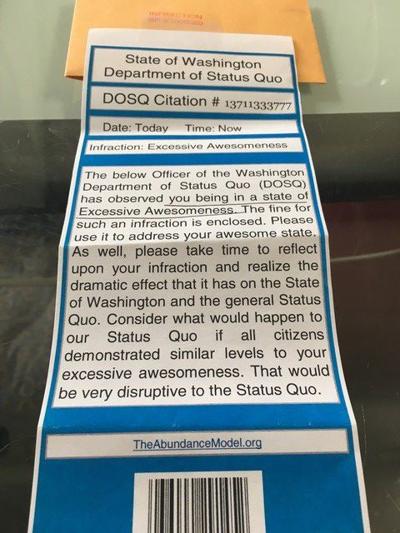
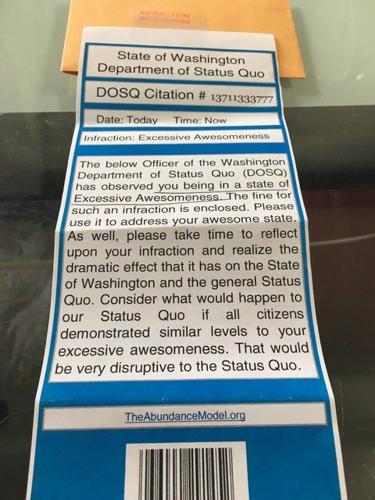
Ed Dietrich of Hood River was surprised recently to find this “ticket” for “excessive awesomeness” on his car in downtown Hood River, in an envelope marked “Infraction.” The unusual citation was not a windshield warning or penalty for parking, but a message from someone about the project Abundance Model (abundancemodel.org).
It may be that someone left the infraction notice after augmenting Dietrich’s parking meter, which is one of the pay-it-forward “abundance” techniques explained on the website.
The “awesomeness ticket” came from an unknown source, and appears to originate from Washington state. As the Abundance Model is a new concept for giving to others, here are some of the basics:
The home page starts with the message “Abundance isn’t a thing. It’s a state of being — an innate desire and a way to live. By utilizing a simple model — for how you manage your finances — and a state of mind, you can both live in abundance and become a funnel of abundance for the Universe.”
The website states, “As one practices the Abundance Model, she is likely to meet high potential people who are in need of mentorship and/or financial investment to fully realize their potential.”
It suggests channeling resources into three areas: Causes, people and magic.
“It is recommended that each practitioner of the Abundance Model adopt ideally one, but no more than three, strategic ‘causes’ for which he becomes a passionate partner for change.
“Directing assets to people could be: a nephew who develops a passion for volunteer work and wants to visit Honduras, a neighbor’s child who is seeking ways to attend music school, an inner-city child who dreams of attending summer camp, a penniless woman with a huge heart and a passion for helping others in need. These people do not need a ‘hand out’ — they need a little support and nudge to realize their potential ...”
As to magic, the Abundance Model states: “This world is magic, all of it. And as we experience this magic, we develop a desire to become magicians — for the simple joy of it. Ideally, allocating 10 percent of one’s net income towards magical projects could very likely be the most powerful piece of the Abundance Model.”
Examples of magic: upon leaving a restaurant, secretly paying for the meal of a young couple on their first date, or paying to have the lawn mowed for someone while they are in the hospital or away on vacation, secretly funding a theatrical group to perform at an elder-care facility.”



Commented