
Editor’s note: This reporter works for North Central Public Health District in tobacco prevention. She also participated in this survey.
THE GORGE — The good news from a statewide survey last year of local stores selling alcohol and tobacco is that none of the stores placed tobacco where it would be easily accessible for youth, a local survey participant said.
“Alcohol is a whole other story,” said Deanna Christiansen, Sherman County’s alcohol and drug prevention program coordinator. Health and prevention departments across Oregon conducted the Tobacco and Alcohol Retail Assessment (TARA) last spring.
The survey looked at stores open to people of all ages. It included 27 stores in Wasco County and 11 in Sherman County. It examined how accessible and appealing tobacco and alcohol are, particularly to youth.
While tobacco was never placed within 12 inches of youth-friendly products, alcohol often was.
Christiansen said intentionally noticing product placement and advertising made her realize how extensive it is: “It’s not just on the door, it may be on the marquee. We saw it on the floor.”
Being purposefully aware of the bright, eye-catching designs of alcohol and tobacco products, and where they’re found in a store, is a good opportunity for parents to show their kids how companies are pushing their products to youth, Christiansen said.
“We as adults become so used to it being present in our everyday life that we don’t think to have conversations about it,” she said. One thing to tell kids is that alcohol “is for grownups.”
Kids take risks as a natural part of growing up, she said, so it’s important for parents to regularly have conversations, awkward as they may be, around expectations about alcohol, tobacco and other drug use.
In stores, Christiansen found that cigarettes were always behind the counter or sometimes not even visible to the customer, but vapes, while behind counters or plexiglass, were sometimes displayed by items appealing to children, such as ice cream.
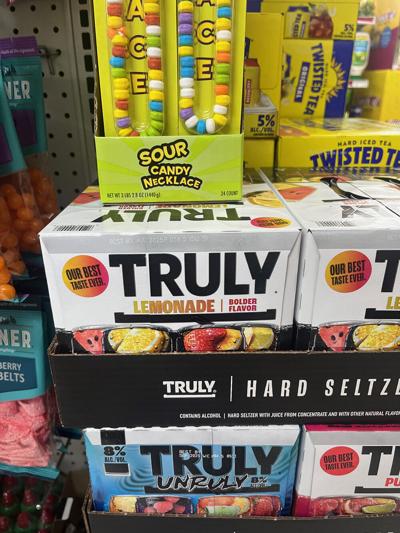
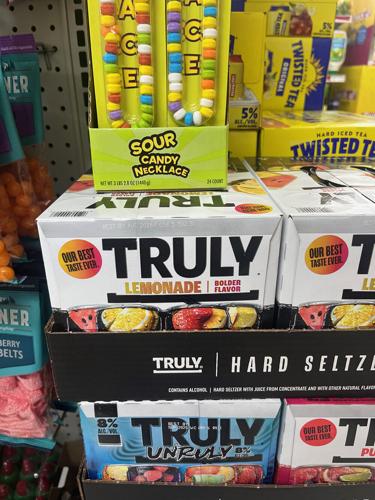
Alcohol, on the other hand, was often found throughout stores, and commonly next to kid-friendly food. Some stores even displayed candy directly on top of boxes of alcohol.
And alcohol often came in kid-friendly, bright colors.
“BeatBoxes look like juice boxes,” Christiansen said. “They’re brightly colored and they were right next to Pepsi and Mountain Dew. And it’s not like they were illegally selling, displaying or housing it,” she said of retailers.
Alcohol brands also partner with non-alcohol brands to offer “hard” versions of their drinks, she said, such as “hard” Mountain Dew.
A Sherman County high school student who helped Christiansen survey stores noticed some alcohol is “100% designed and presented” to attract younger people, Christiansen said. It was equally clear that other types of alcohol, like wines and hard liquor, were marketed to adults. “I think she used the term ‘classy,’ or ‘sophisticated.’”
Adult-oriented labels are darker and subdued, Christiansen said, “Whereas the BeatBoxes, the Buzz Balls, all of those things clearly are fun-spirited, colorful, flashy.”
In Wasco County, The Dalles High School student Evan Fuller helped survey some stores in The Dalles.
He was “shocked” at one store that offered a product he’d never heard of: kratom. “They had such a large variety in so many different ways.” But he felt the product was “definitely targeted toward adults because the signs and prices were all pretty basic. Nothing overly cartoonish or bright.”
Kratom is an unregulated product derived from a plant grown in Southeast Asia. It’s marketed as treating a variety of complaints from pain to anxiety and depression. It is not approved for any medical use, and the FDA has raised concern about addiction potential of some highly concentrated products made from kratom.
Fuller said two gas station mini marts he surveyed “both seemed to have very similar vibes with candy and juice being sold right next to the alcohol and vapes. I think this may lead kids to believe that it’s also a treat, just like candy or juice.”
A handful of stores had numerous Zyn-branded logos on the floor, at the cash register on penny jars, and on “register closed” signs on the countertop. Zyn is an oral nicotine pouch that is rapidly growing in popularity.
Most stores surveyed were convenience stores, and almost half advertised tobacco and alcohol outside the store. Cigarettes were in all stores, but vapes, or e-cigarettes, were found a bit less often.
The lowest average price for a pack of cigarettes in Wasco County was $8.19, and $8.80 in Sherman County. All stores in Sherman County carried oral nicotine pouches, with an average price of $5.16, and nearly all in Wasco County did, at an average price of $5.42.
Some store personnel shared that they were required to sell vapes made by the tobacco companies they contracted with. Vuse, for example, is owned by Reynolds American, and Njoy is owned by Altria.
Other stores told surveyors that Camel brand cigarettes do not allow them to display the price of their product. The store worker said the price changes often, and always increases.
Another store worker told a surveyor that Seneca brand cigarettes required that its product be the cheapest one available in the store.
•••
Our journalism needs your support. Visit columbiagorgenews.com to read more and subscribe.


Commented
Sorry, there are no recent results for popular commented articles.