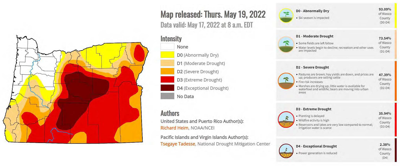
A May 17 drought map generated by the National Ocean and Atmospheric Administration (NOAA) shows all of Wasco County experiencing some level of drought, from “abnormally dry,” shown in yellow, to “exceptional drought,” pictured in purple.
A May 17 drought map generated by the National Ocean and Atmospheric Administration (NOAA) shows all of Wasco County experiencing some level of drought, from “abnormally dry,” shown in yellow, to “exceptional drought,” pictured in purple.
A megadrought that has parched much of the western United States has Oregon officials concerned the state could face another summer of record blazes.
“All signs point to a difficult 2022 fire season that will challenge our firefighting teams and the capacity of our response systems,” said Gov. Kate Brown during a Monday press call on the wildfire season.
Noting major blazes already burning in New Mexico and Colorado, Brown said recent rain in the northwest of the state had done little to lessen crisis-level wildfire conditions in most of Oregon.
Brown said fire danger was at the worst level since she became governor in February 2015.
“Already this year, I have declared drought emergencies in 15 counties — this is the most I have ever declared by this time of any year as your Governor,” she said.
Brown and top fire, National Guard and emergency officials said conditions in much of Oregon are concerning, especially with the state still recovering from the record-breaking Labor Day 2020 fires and several big blazes in southwest Oregon and other areas in 2021.
Oregon Department of Forestry Fire Chief Mike Shaw said conditions in Oregon were worse than last year, mainly because drought conditions from last year have continued — and worsened — in 2022.
The sustained dry periods make trees and other vegetation more likely to ignite if hit by lighting or human carelessness. The fuel is there to rapidly accelerate fires.
Brown’s warnings about fire dangers came on the same day that the First Street Foundation, a nonprofit research group in New York often cited by the New York Times, and used to judge risk for real estate transactions, issued a new searchable database of fire and flood danger in the United States.
The new Risk Report estimates that 1,106,192 properties — 61% of all properties in Oregon — have some risk of being affected by wildfire over the next 30 years.
Though fire officials say they catch the overwhelming majority of fires while still under 10 acres, those that expand too rapidly for firefighters to snuff out can grow to hundreds of thousands of acres.
In recent years, fire officials have had to contend with large fires merging into what is known as a wildfire “complex.”
In some ways, Oregon is better off that in the past two fire seasons. Firefighters have learned how to control the spread of COVID-19 among fire crews to keep more personnel on the front lines.
The Oregon Department of Forestry and other agencies received $220 million in additional funding from the Legislature, which has been used for more smoke detection cameras, additional staffing and equipment.
Shaw said that Oregon was not having as acute a shortage of firefighters as in other states. But weakness in any one part of the interlocking regional firefighting aid compacts could lead to shortages of crews and equipment.
“We’re going to be in pretty good shape as an agency, but we are going to get stretched,” Shaw said.
Brown said the rapid spread of fires shows Oregon residents need to be careful in forested areas and also be ready to evacuate immediately if ordered by firefighters.
“Being prepared can truly mean the difference between life and death,” Brown said. “It is also one of the best ways you can help our frontline firefighters do their jobs.”
Part of preparing for the fire season is to have a plan for where your family would reunite out of the fire zone, and a ready kit of documents, medicine that can’t be replaced and two weeks worth of clothes and other supplies.
“Be smart and be careful when you’re enjoying our outdoors,” Brown said. “You can help prevent tragic loss.”
The Risk Factor also projected a wide range of danger across Oregon.



Commented