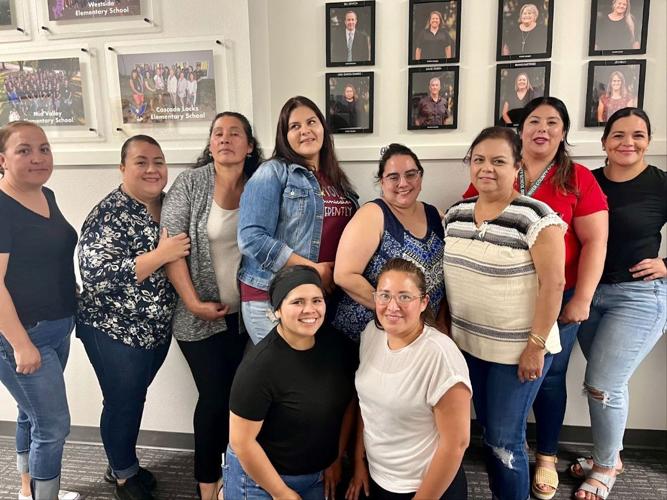
The district’s migrant education department is advised by the Parent Action Team, above. They represent all schools in the district, functioning much like a school board.
The district’s migrant education department is advised by the Parent Action Team, above. They represent all schools in the district, functioning much like a school board.
HOOD RIVER — Twenty-five Hood River Valley High School (HRV) students in the migrant education program will head to Washington, D.C., over spring break to take part in the Close Up Foundation’s High School Program, “a six day and five night program for high school students to experience their government in action” (www.closeup.org).
Hood River County School District board members approved the field trip, paid for by Federal Title 1C Migrant Education funds, at the Jan. 8 meeting. Migrant Education Coordinator Patricia Ortega-Cooper said students have attended this intensive civics program the last four years.
“This year, we are really looking for PFS students — that is priority of services students,” she said. “These are students that might not be meeting standards or might not be doing well in all the classes, but they have a desire to [go] … Sometimes, there’s that experience that can change a student’s look into the world.”
Before the trip was approved, Ortega-Cooper provided an overview of supplemental services migrant education students receive. “The goal is for students to graduate,” she said, “and to do well in reading and math.”
The program is federally funded — part of the Elementary and Secondary Education Act (ESEA) of 1965 — and based on the number of students enrolled. It does not utilize district funding.
“[The Migrant Education Program] provide services to students [ages] 3-21 who come from families who have high mobility because of the work of their family members” in agriculture, fishing or forestry, she said. As such, her team works year-round, guided by a Parent Action Team that includes a family representative from all district schools.
Because families are migratory — a requirement for the program — the team utilizes many avenues to find qualifying students, such as referrals from community partners and / or visiting local businesses, packing houses or orchards. Once a family qualifies for services in the school district, they are eligible for up to three years.
“It’s difficult, because not everyone who works in agriculture qualifies,” she said. “Not everyone who works in forestry qualifies, or in fishery qualifies. So sometimes, people have misconceptions … it’s tied to mobility. They have to move.”
Supplemental services include language arts and math tutoring as well as community resources, among others. HRV has the most migrant education students (111), followed by Mid Valley Elementary (93) and Wy’east Middle School (87). The program also serves 42 preschoolers countywide.
Another is graduation and services to out-of-school youth — anyone who has not graduated up to age 21. “One of the areas that we struggle a lot is working with out of school youth,” Ortega-Cooper said. “… They’re working in the fields, but it has been very difficult for us to identify those folks, and that’s why we’re going now more to the orchards and packing houses, because our job is to support anyone who hasn’t graduated until the age of 21.”
The board next meets Jan. 22 at Hood River Middle School starting at 6:30 p.m. More information about the meeting is available at www.hoodriver.k12.or.us.



Commented