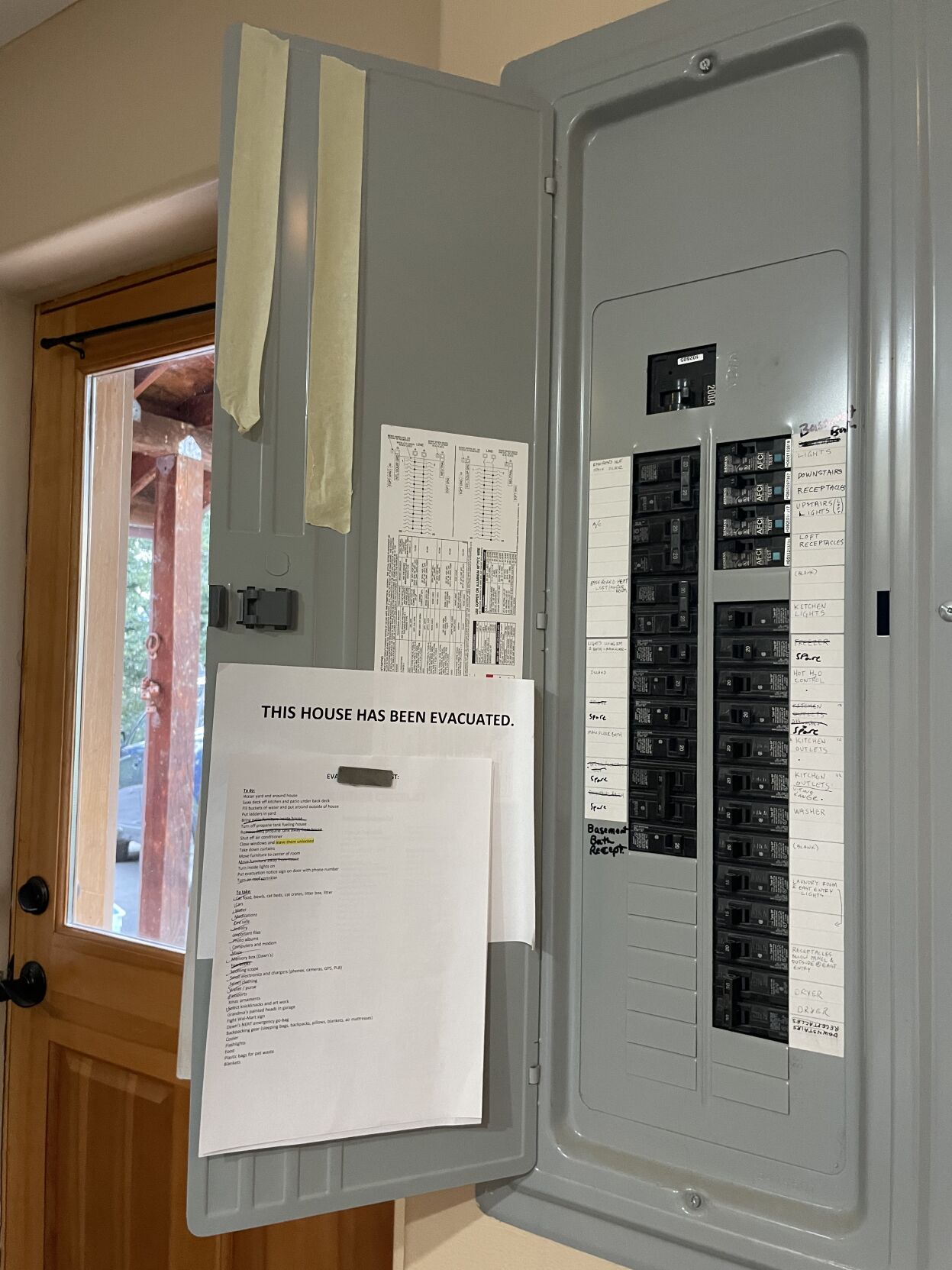
Above, this evacuation checklist is attached to the inside of Dawn Rasmussen's electrical panel by her door. Also handy is a sign she can post on the front door telling emergency responders they have evacuated, and it lists her phone number.
In 2020, Dawn Rasmussen had to evacuate her Browns Creek area home twice in two days. Once with an hour’s notice, once with no notice.
She and her husband Brad had already done a significant amount of work to make their rural acreage as defensible as possible from fire. Those evacuations led them to take even more steps.
Their property is in what’s called a wildland interface area. It’s a zone where rural homes are surrounded by lots of natural habitat.
Not long after they moved there in 2016, they began taking steps to reduce fire danger. The previous owners had beautifully landscaped their property, Rasmussen said, but they had to remove a lot of it because shrubbery was too close to the house.
She asked Mid-Columbia Fire & Rescue to come out and she got lots of suggestions that they implemented.
“One of the most important things that I’ve learned is the 10-30-100 rule as far as fire preparedness,” she said.
First, keep any vegetation within 10 feet of your house very low to the ground, very well watered, and not touching the house, she said.
Then 30 feet away from the house, you can have some trees, but limbs should be at least six feet off the ground. And finally, out to a 100-foot distance from her house, “We weed-whack everything to the ground.”
Pick up branches, fell dead trees, “and clear out stuff so there’s no fuel on the ground. You want to eliminate ladder fuels,” she said. Fire can spread from grass to bushes to trees, like going up rungs of a ladder.
“It’s a lot of work, and at some point, Brad and I are going to be too old to do this stuff so we’re going to have to figure something else out there.”
More recently, she built a sprinkler system for her roof. “That’s probably the biggest thing. People should be thinking about putting that in. It’s one less surface to ignite.”
When it comes to homes, the risk isn’t a wall of fire reaching the home, she said, but embers blowing onto roofs. They can catch debris in gutters on fire, and then burn the roof and the home.
Then she realized that fire could knock out the power, which runs the well that waters her roof in the event of wildfire. So they switched to solar power. “That’s great because that’s part of my green goals anyway, so we will have water. It runs our refrigerator and our freezer, so we don’t lose any stuff.”
She recalls seeing photos after the Mosier Creek fire in 2020, showing fire burning right up to houses, and those houses having things like wood stacked right by the home.
She said she and her neighbors are “all very concerned and I think each property owner has gone through the paces of making changes.” They’re doing things like creating and burning small burn piles in cold months to eliminate debris, and others are moving burnable things like wood piles away from the side of their home.
Above, this evacuation checklist is attached to the inside of Dawn Rasmussen's electrical panel by her door. Also handy is a sign she can post on the front door telling emergency responders they have evacuated, and it lists her phone number.
Contributed photo
She learned that she has “a high risk of getting burned out in the next 30 years,” but she’s also been told that “we have a pretty high chance of surviving that with what we’ve done with our property.”
Rasmussen has also taken neighborhood emergency response training. “One of the biggest misconceptions everybody has is if you have an emergency, someone is going to drive up and say, ‘What do you need?’ And oftentimes, you’re it. The farmers know that. They’re out there discing, they’re taking care of their own.”
She added, “Even city dwellers, you cannot just assume someone is going to be there, you have to be protective, and an ounce of prevention is worth a pound of cure.”
She’s spearheading an effort to form a local Firewise group with her neighbors. “We’re kind of mutually protecting each other a little bit more.”
Firewise is a national program run through the Oregon State Fire Marshal. It offers grant funding to make homes better able to survive wildfire.
She’s also upped her evacuation game, having had several rounds of practice. “We made some changes here how we stage stuff. Our photo albums are near the door so we can grab them.”
She knows exactly where her important documents are: In a fire safe. She’s included things like car titles, house title, her will, home insurance documents, marriage certificates, birth certificates, passports, college transcripts, diplomas, Social Security cards, and heirlooms and valuable jewelry.
“It saves a bunch of time if they’re all in one spot," she said.
She has treasures all around her house from her travels that are precious to her, but she also knows “at the end of the day, you save what you can, but if you don’t, you can’t sweat it.”
She said if a fire destroys her home, there would be losses and it would be traumatic, but saving family and pets is the most important thing.
She has an evacuation checklist by her door. She also has a paper she can put on her door that says she’s evacuated, and it lists her phone number.
“We have a whole procedure and we’re very thorough here and probably taking it further than we need to,” she said. She also encouraged people to sign up for emergency alerts. “Google your county or town name and emergency alert, then sign up for text/phone messages about evacuations.”
•••
This story originally appeared in “Fire in the Gorge: Emergency Preparedness,” a special publication of Columbia Gorge News with presenting sponsor Washington Department of Natural Resources.




Commented