
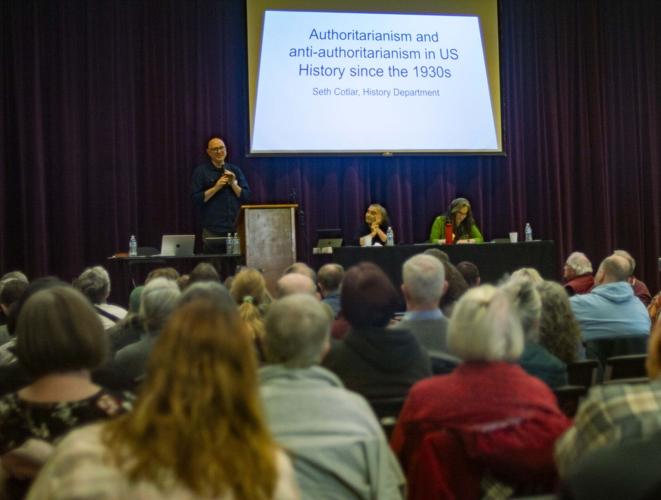
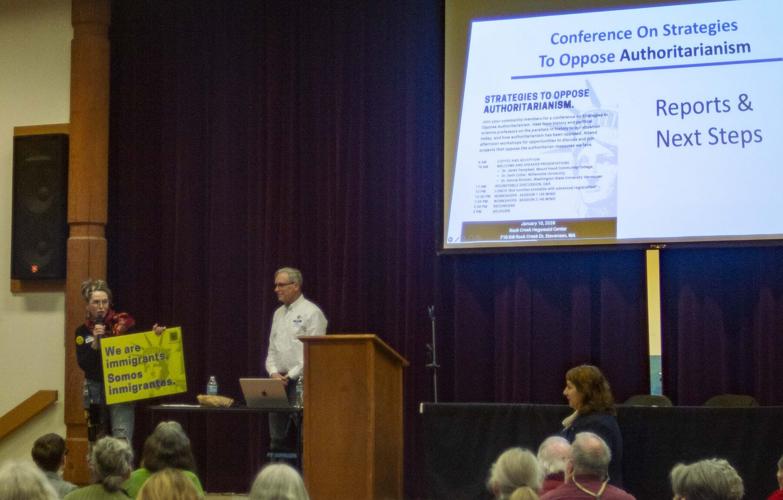
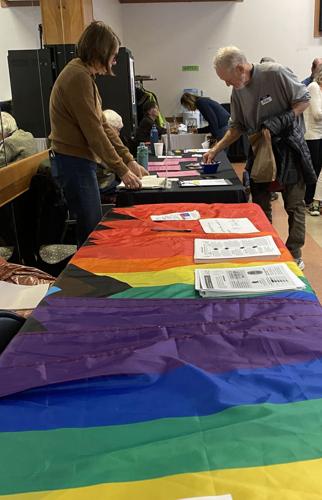
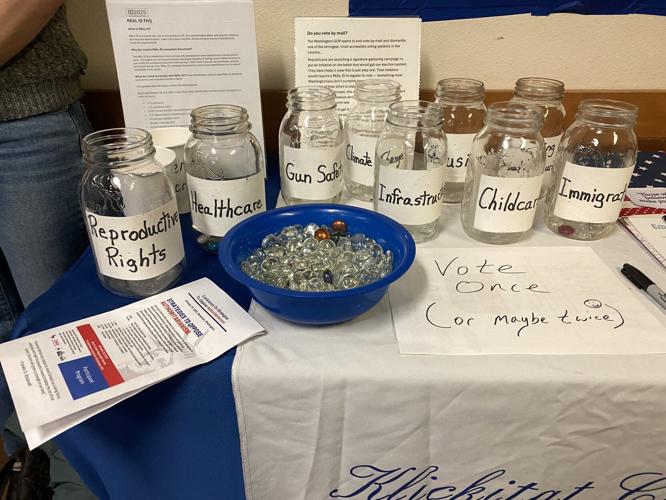
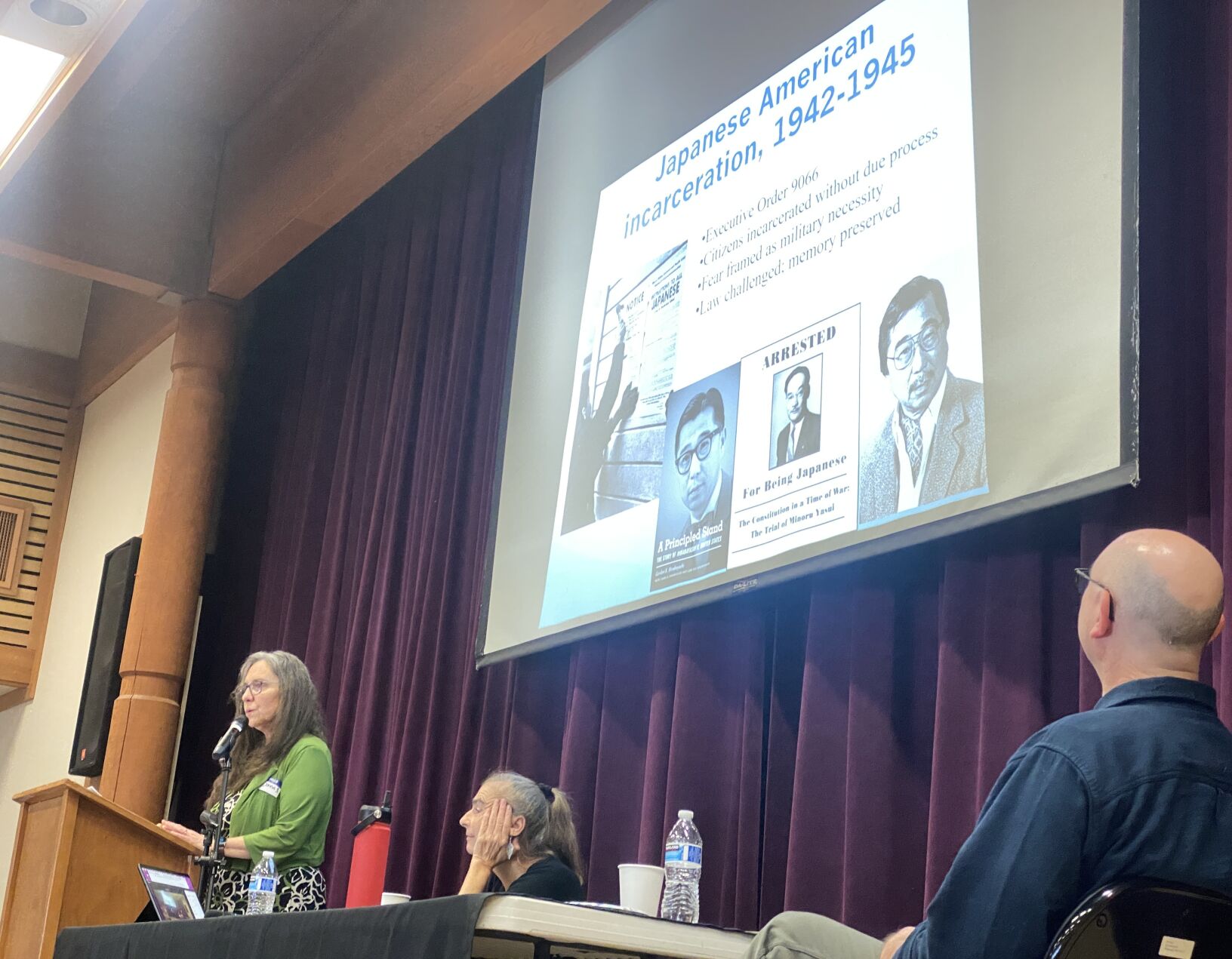
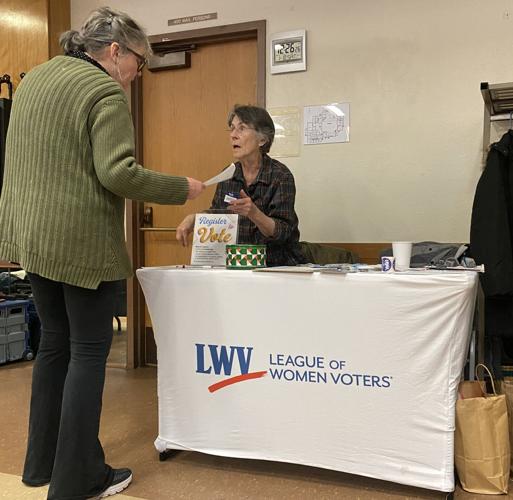
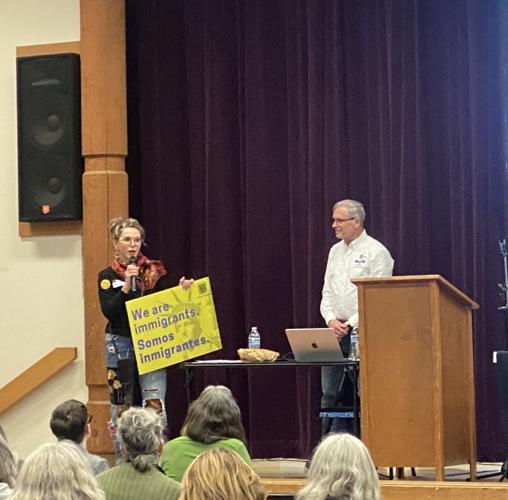
STEVENSON — A couple of hundred people gathered in Stevenson to workshop democracy, hear speeches, and learn from an old U.S. Army manual on “fascism” at a conference led by three university experts last month.
Janet Campbell has taught Political Science at Mt. Hood Community College since 1999, after stints at universities in New Zealand, Alaska and Scotland, and policy research for Washington State.
She described signs of authoritarianism:
Power becomes concentrated in a small group of people
Checks and balances stop working (when the president stops obeying the courts, for instance).
Lack of free and fair elections, because opponents are being intimidated.
The free press isn’t functioning.
The positives: quick decision-making. “That’s appealing to a log of people. ... at least it seems like, ‘Something is being done!’”
Democracy, on the other hand, is a long, slow, boring process of decision-making. And politicians who worry about getting re-elected may not undertake big, scary, unpopular decisions that are needed.
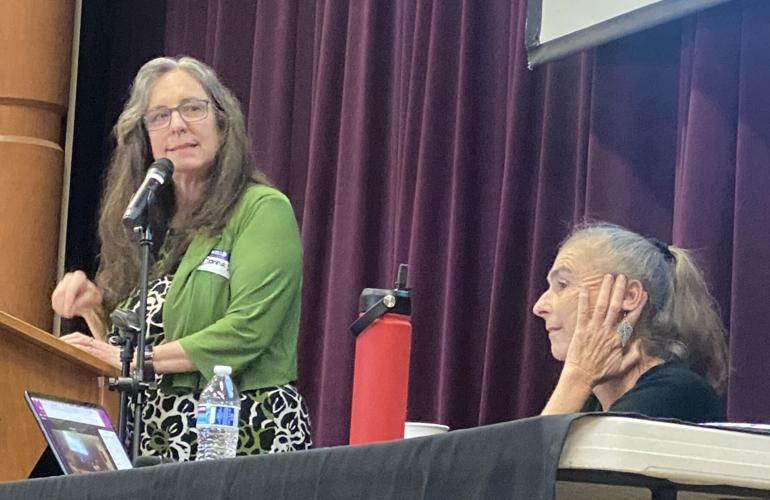
Donna Sinclaire — history professor, author, oral historian, and public history professional; former planning commissioner, school board member, Vice Chair of Clark County Democrats and Indivisible leader — gave a history of U.S. authoritarianism.
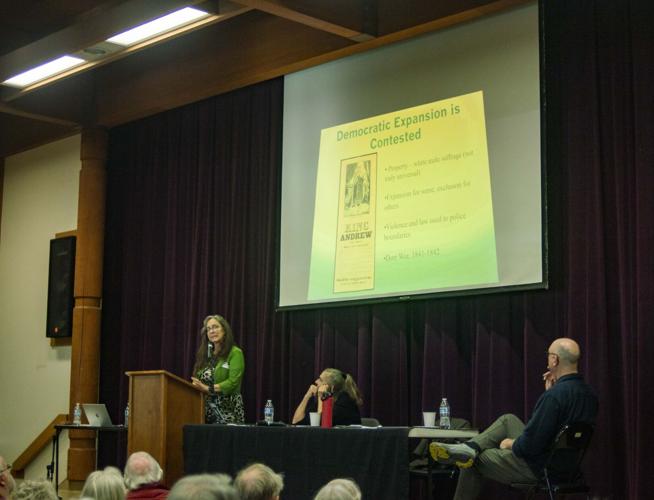
“At the founding, only property-holding men could vote,” she said. That included immigrant men; their voting rights were removed, state by state, gradually.
Violence would erupt repeatedly over voting rights as more groups sought ballots: non-property-holding white men, white women, Black people. Native American voting rights were not fully recognized until the Voting Rights Act of 1965. “Authoritarian power grows very quietly in the United States,” she said, through things like intimidation and exclusion, and making extraordinary measures seem normal — “all of these things we’ve been experiencing.”
According to Sinclaire, organized resistance by people, institutions and courts has been defending democracy in America since the 1700s.
She talked about Reconstruction, when democracy was systematically dismantled in the South through violence, voter suppression, and racist Black Codes law. That sent resistance underground into Black-led organizations like churches, schools and mutual aid societies.
She talked about how McCarthyism fell in the later 1900s to televised hearings and investigative journalism: “Public visibility that revealed the abuse of power, and when Americans could see it, fear lost its grip. So that’s another recurring pattern, transparency and narrative can collapse authoritarian authority.”
She talked about collective action — songs, symbols, fasting, hunger strikes; the power of stories that humanize the “other” person; boycotts and protests: “change came not from one tactic, but from the sustained pressure across law, culture, institutions and public conscience.”
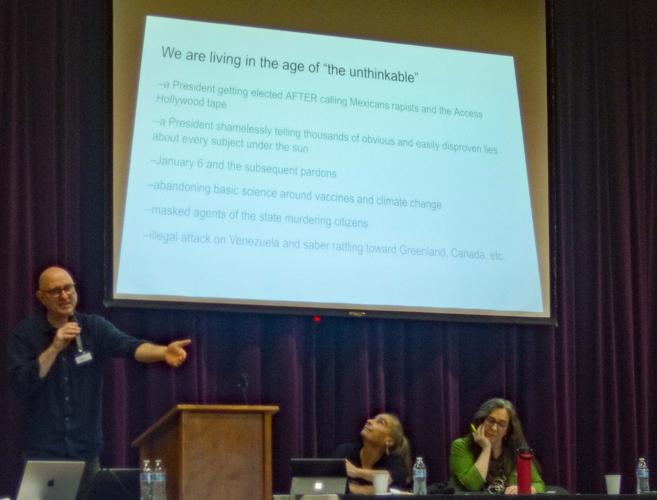
Seth Cotlar, a Willamette University history professor and author currently working on a project about Oregon’s far right, talked about the word ‘fascism,’ a word disputed in America right now: “a lot of people who need to hear about it just — shut off, because it’s inconceivable to them that America could be a fascist country...
“America is both an anti-authoritarian country and an authoritarian country. ... Our history contains all of that. And so history isn’t going to save us,” he said.
“No one’s coming to save us.”
In 2004, “when Donald Trump was a New York City playboy who was donating to Democrats,” Robert Paxton defined fascism as politics marked by obsession “with community decline, humiliation or victimhood,” and by “cults of unity, energy and purity,” when coalitions of nationalist militants and traditional elites join forces to pursue violence without ethical or legal restraint.
Cotlar carefully noted Paxton did not write this about Trump. “Until January 6 ... journalists would contact him and say, ‘Hey, is America fascist yet?’ And he was one of the guys saying, like, ‘No, that is an inappropriate term to use in reference to America.’ After Jan. 6, he’s like, ‘Yeah, okay, it’s fascist.’”
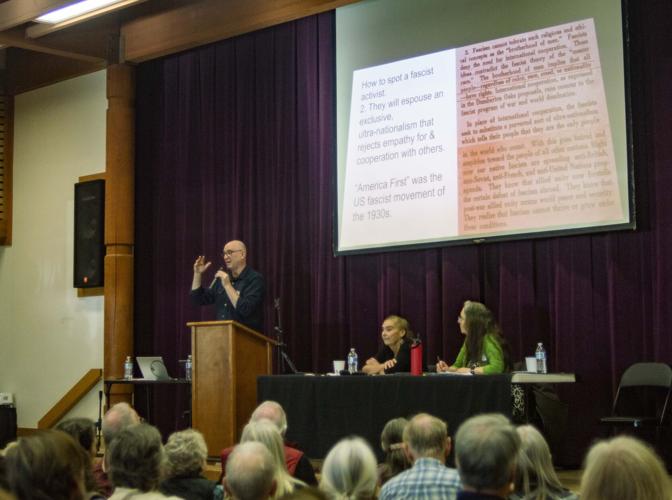
He then hauled out the U.S. Army Talk’s Orientation Fact Sheet #64, given out to officers in 1945. “And the point of it was, ‘We just fought this war against fascism in Europe. And it could happen in the United States,” Cotlar explained. “... we just spent all this blood and treasure. We need to be sure that this doesn’t reemerge in the United States, and the presumption was that it could, okay?”
The pamphlet defined fascism as “government by the few and for the few,” asking questions like “how can a violent program that enslaves the people win any support?”
Fascism had come to power in Germany, Italy and Japan during times of unrest, when a small group of rulers convinced the public through clever deception that fascism would give them what they wanted: Mussolini’s “greater Asia co-prosperity sphere,” Hitler’s announcements of plans to help “average” Germans, promising “everything to everyone.”
If fascism came to America, the 1945 pamphlet warned, it would call itself words like “Americanism” or “Christian patriotism.” People of different religions, races and financial situations would be pitted against each other. Cooperation and empathy with other countries would be called weak. America’s fascists would begin flinging accusations of “communism!” at their opponents.
Fascism would provide the miserable or angry American with a scapegoat for their ills — be it “Catholics, Jews, Negroes, labor unions, big business — any group upon which the insecure and unemployed can be brought to pin the blame for their misfortune.”
And the pamphlet had ideas on resisting by “making our democracy work and by actively cooperating to preserve world peace and prosperity. ... Freedom, like peace and security, cannot be maintained in isolation. It involves being alert and on guard against the infringement not only of our own freedom but the freedom of every American.”
Cotlar noted that under authoritarian rule, the law will bind some people (like Renee Good) but not protect them; and the law will protect others (like the ICE agent who fired the shots which killed Good) but will not bind them. “That distinction has become a very central part of the politics of our contemporary era, and that is truly frightening.”
But all three, speaking at an activist conference, encouraged the audience to hope and fight for democracy.
“Protests creates legitimacy and it draws attention, and the law follows. That has been part of the history of the United States. There has been a democratic expansion, access to democracy for different groups of people over time,” Sinclaire said. “...We have the women’s movement. We have the LGBTQ movement that builds on the women’s movement, as well. We have trans rights. All of these things are extensions of democracy that come from those early movements. And there are groups of people who don’t want everyone to be included, which is authoritarianism.”
Sinclaire’s got a task list:
“Resistance is multi layered. I don’t think I can say that enough, because a lot of us feel like either we’re not doing enough, there’s no point. In doing the work of resistance, but it’s multi layered. Every little bit matters.”
“Democracy requires maintenance. This one is really important. We can’t just get disgusted with democracy because it’s slow and because other people who we don’t agree with have a voice.”
“We need to build durable coalitions, not just moments of protest...
“We’re all on the same side.
“Defend institutions.
“Invest in narrative and memory, get those stories out there.” Most Americans have a 13-year-old reading level and 28% are functionally illiterate.
“Treat democracy as an active process, not a settled condition,” with involvement at the lowest levels of those 91,000 governments.
Campbell said, “I would remind people that we have 91,000 governments in America. We are a federalist system. We have state governments, local governments, school board, county governments, city governments, 91,000 governments. Pretty hard to centralize all of that [power].”
Local organizations sponsored the conference: Columbia Gorge Women’s Action Network, Skamania County Democrats, Skamania Pride, Hood River Latino Network, Klickitat County Democrats sponsored the day.


Commented