Columbia Gorge Community College has seen recent approval of its “Aviation Maintenance Technician” program by the college’s accrediting organization, the Northwest Commission on Colleges and Universities.
Columbia Gorge Community College has seen recent approval of its “Aviation Maintenance Technician” program by the college’s accrediting organization, the Northwest Commission on Colleges and Universities.
Columbia Gorge Community College photo
When a tiny NASA helicopter made the first controlled flight on Mars this spring, it carried fabric from the Wright Brothers’ flyer of 1903. Today, the Wright Brothers’ vision of powered flight continues to inspire new generations of aviators — and the skilled technicians who keep those airplanes flying.
But there’s a shortage of aviation mechanics, driven by retirements and the small number of training programs. Only two community colleges offer training in Oregon — and none east of the Cascades.
Columbia Gorge Community College is changing that, with recent approval of its “Aviation Maintenance Technician” program by the college’s accrediting organization, the Northwest Commission on Colleges and Universities.
However, that’s only the first step. The program must still receive approval from the Federal Aviation Administration for CGCC to offer a “Part 147” certification — the official designation for “airframe and powerplant” aircraft mechanics.
“Columbia Gorge Community College is eager to help alleviate the critical shortage of skilled aviation mechanics,” Dr. Marta Yera Cronin, CGCC’s president, said. “General aviation has a vital role in rural America, with our vast travel distances. This will only increase with emerging technologies such as electric propulsion.”
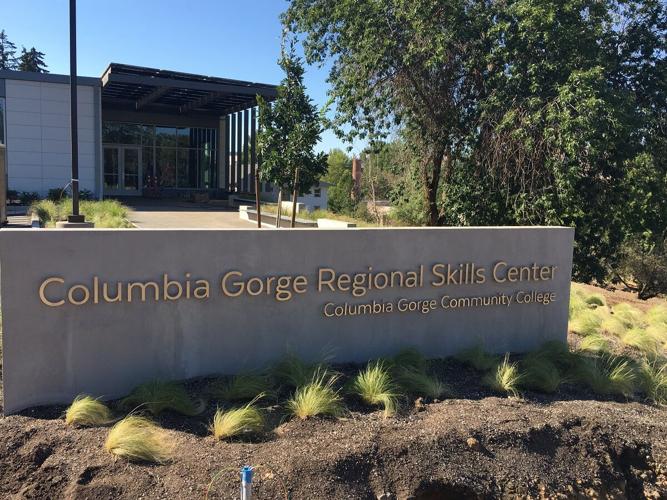
The CGCC Columbia Gorge Regional Skill Center sign.
Columbia Gorge Community College photo
Thanks to the generosity of a White Salmon Valley resident, Corey Williams, the college has an aircraft for student training. Williams donated his Cessna 172 to CGCC earlier this year. Other recent donations include aircraft engines from Portland Public Schools and the Cooper Family in The Dalles.
Donations of older equipment are welcome, since many vintage planes are still airworthy and mechanics need to be familiar with a wide range of models, explains Bryan Despain, CGCC’s Airframe & Powerplant instructor.
“All donations are considered, regardless of age or era,” Despain notes. “The basic foundations of the internal combustion engine of intake, compression, ignition and exhaust remain the same as they were when Charlie Taylor built the first aircraft engine for the Wright brothers in 1903,” Despain added.
The aviation maintenance program CGCC plans to offer will establish the foundational knowledge necessary for the students to expand the current boundaries of atmospheric flight and beyond.”
Meanwhile, the college is working with aviation-sector companies in the Columbia River Gorge and beyond. Several companies have already offered technical guidance, donations and letters of support for competitive grant applications.
“CGCC’s efforts to educate and train workers in the Columbia Gorge region is critically important as we grapple with workforce gaps in our industry and the economic realities wrought by the COVID-19 pandemic,” wrote Archie Vega, director of line maintenance at Horizon Air, and Jen Keller, director of talent acquisition for Alaskan Airlines/Horizon Air, in a joint letter of support to the Federal Aviation Administration.
The college’s initial plan, contingent on FFA approval, is to train students in the Port of Dalles Industrial Park starting as early as January 2022. The permanent goal is a dedicated hangar at Columbia Gorge Regional Airport in Dallesport, an idea which enjoys support from the airport’s co-owners, the City of The Dalles and Klickitat County.
The college is coordinating its efforts with area school districts, the Western Antique Aeroplane and Automobile Museum in Hood River, and Hood River Soaring.
Aviation maintenance training at CGCC would be a 15-month, 96-credit program, leading to a certificate of completion, or 18 months and 104 credits for an AAS degree.
The program will prepare students to sit for the Federal Aviation Administration certification exams (written, oral and practical) for the airframe and powerplant (A&P) airman certificate.
According to the Aviation Technician Education Council (ATEC) 33 percent of the aviation mechanic workforce is at or near retirement age. Industry needs another 2,700 mechanics annually to meet the 20-year demand. Boeing estimates a need for 192,000 aviation technicians across North America by 2039, and 253,000 across the Asia-Pacific region.
“The return on investment that students make in A&P programs is high,” according to Crystal McGuire, ATEC’s executive director. “The average starting annual pay for a certificated mechanic is $45,000,” and this is increasing every year. Experienced mechanics earn $70,000 per year or more.
Updates on the aviation tech program will be posted to the college’s website.



Commented
Sorry, there are no recent results for popular commented articles.