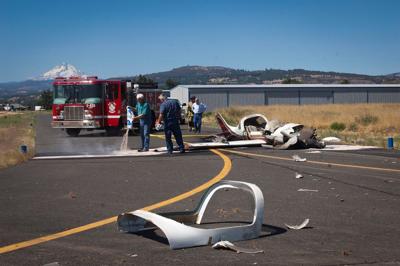
CREWS at the Columbia Gorge Regional Airport spread absorbent material over a fuel spill at the site of a plane crash Monday morning as a Dallesport Fire Department crew looks on. The pilot, a Hood River man, died in the crash.
CREWS at the Columbia Gorge Regional Airport spread absorbent material over a fuel spill at the site of a plane crash Monday morning as a Dallesport Fire Department crew looks on. The pilot, a Hood River man, died in the crash.
In what is believed to be the first fatality at the Columbia Gorge Regional Airport, longtime Hood River pilot Richard Sperling died Monday morning after his plane crashed on landing.
The Federal Aviation Administration responded to the crash from Hillsboro, and was on scene until about 9 p.m. Monday, said Rolf Anderson, an airport manager.
Sperling was flying a Lancair 360, a type of home-built plane.
A witness on scene said the plane was approaching to land when a wing appeared to dip and strike the ground. The plane hit the runway and slid into a taxiway that leads to a hangar area. Debris was scattered in a wide swath across the runway and taxi way.
Anderson said, “We happened to have the Coast Guard here traveling through. One of them saw the accident. The Coast Guard group was with Mr. Sperling within 45 seconds from the time the accident happened. They did amazing work. And then the ambulance got here just minutes after that. So he got on the ambulance and he was taken right over to Lifeflight. I don’t think the response could’ve been any more professional or quicker.”
Both the ambulance and Lifeflight are stationed at the airport.
The taxiway where the crash occurred was closed until about 10 p.m. Monday.
Chuck Covert, also an airport manager, said, “I think this is the first fatality at the airport that I’m aware of, and I hope we never have another one.
“We’ve had a few incidents where people have had accidents, but nothing like this, it’s a shame,” he said.
Anderson called the National Transportation Safety Board (NTSB) and the FAA to report the accident. The NTSB investigates accidents of all kinds, and the FAA assists. The NTSB will write the report on the crash, Anderson said.
Covert said Sperling had “been a local pilot for a number of years, that was just his latest airplane venture. Interesting guy. It’s just very unfortunate because he just loved aviation.”
He remembered Sperling’s first aircraft was a “powerkite deal. It’s kind of a kite with an engine on it.”
He got his current aircraft a few years ago. FFA records show it was manufactured in 2014 and is classified as an experimental plane.
Covert added, “I remember I loaned him my flatbed trailer to go back to Nebraska to buy it because it wasn’t flyable when he got it.”
He “spent a year rebuilding it to get it to fly. He liked to work on stuff. We have a few kit planes at the airport and I always admire the people who take the time and dedication to do that.”
Covert said Sperling, who was married, had flown the plane “quite a bit.”
Anderson said Sperling “had one just like it before this one, same model. And maybe another one. He’s flown for a long time.”
Covert said the NTSB and FAA will look at the aircraft and interview witnesses and try to determine the cause of the crash. And just as with automobiles, if the NTSB starts to notice an issue that repeatedly happens with a type of aircraft, they’ll put out a “directive” on it, or a recall.
Anderson said he believes Lifeflight first started taking Sperling to Oregon Health & Science University in Portland, but diverted to Mid-Columbia Medical Center. It could not be confirmed by presstime where Sperling was taken.



Commented
Sorry, there are no recent results for popular commented articles.