
A room full of agricultural business owners and a near-vacant lot with a view drew Gov. Kate Brown to the Gorge last week.
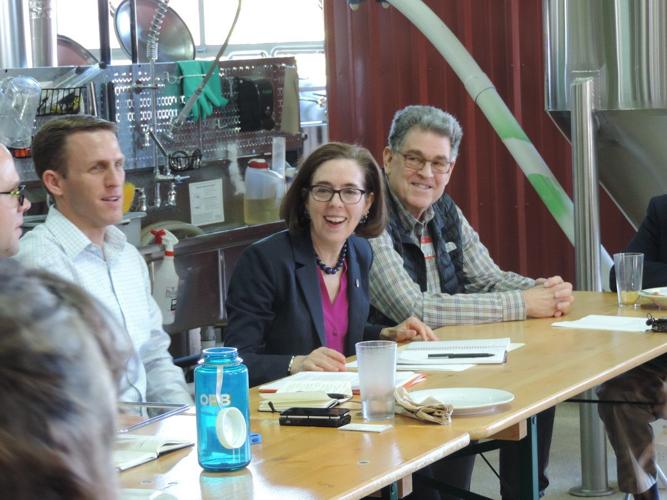
Brown had a listening session lunch April 28 with 25 farmers and entrepreneurs at Freebridge Brewing, where she pledged to continue supporting local farm commodities in the export market and to look for ways to fund agricultural research.
“Our first priority is assuring taxpayers their money is spent wisely and efficiently,” Brown said in an interview following The Dalles meeting. Parkdale orchardist Randy Kiyokawa asked Brown to do what she can to restore lost funding to research programs at facilities such as Mid-Columbia Agricultural Research Center in Hood River.
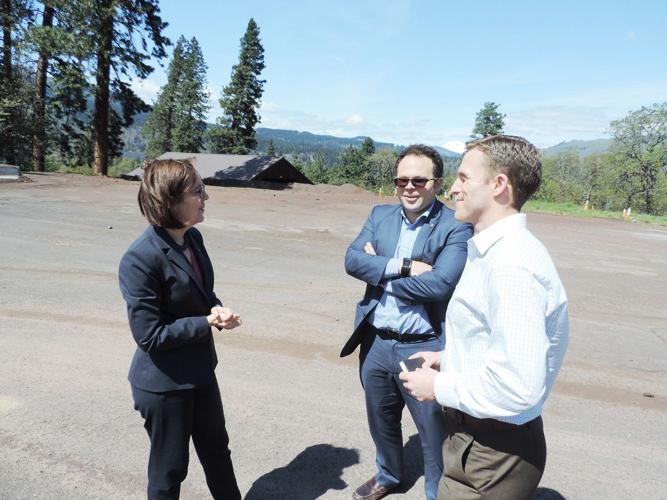
After the two-hour session, the governor stopped in Hood River to see the two-acre “yard” on West Cascade Avenue used by Oregon Department of Transportation — a potential site for housing. A total of $400,000 is available for property acquisition and development for Hood River County for affordable housing, through the Regional Solutions Fund, set aside in 2015.
“We are looking at under-utilized properties, or ones that can be used more efficiently, or differently,” including the ODOT yard, said Brown, who was accompanied by Jason Lewis-Berry, Regional Solutions director, and Nate Stice, coordinator for the Regional Solutions North Central Region, which encompasses Hood River, Wasco, Sherman and Gilliam counties.
(Regional Solutions works at the local level to identify priorities, solve problems and complete projects, according to the agency web site. These centers integrate state agency work and funding to ensure that projects are finished as quickly and cost-effectively as possible. In this region, priorities include workforce housing, technology development, transportation and infrastructure.)
Brown said that affordable housing or workforce housing is a severe need in Hood River County.
“We know that businesses are struggling to attract or retain employers because of the lack of available housing for low- and mid-range wage earners. This particular region is among the most challenged,” she said.
Stice said Regional Solutions and City of Hood River officials have talked with ODOT about seeing if a different site for ODOT is available in order to free up the West Cascade property for housing. The yard contains a storage building along the street and a massive storage shed for road cinders.
“This would be a great location for housing,” Brown said. “Look at the view,” she said, pointing to Mount Adams and the Columbia River.
City manager Steve Wheeler said that while ODOT has a clear need for a freeway-close location such as West Cascade, “It’s not the highest and best use for the property. It would be great if the state could move it.” Wheeler said the discussion has continued in all three years he has been with the city.
“We’ve been part of the conversation, but it has been a long conversation,” he said.
Brown noted that private-public partnerships for developing affordable housing, including one in Pendleton, have worked but one in Hood River is more difficult because of lack of available land. Lewis-Berry is working on proposals via the Regional Solutions Advisory team. He said he has held meetings with ODOT, Division of State Lands and other agencies to look at funding streams, technical assistance and other tools that can be put into “a potential vision” for projects in the mid-Columbia.
“It is even more of a challenge here, and each toolkit looks different in each community,” Lewis-Berry said.
“I was pleased to see so many sectors of the agriculture community,” Brown said. Attendees at Friday’s meeting in The Dalles included Tom McCoy and Joe Dabulskis, who both are Sherman County commissioners and wheat farmers; Brian Tuck, OSU Extension; Andrea Klaas, Port of The Dalles; and Mike McArthur, executive director of Association of Oregon Counties.
Brown heard a wide range of requests, including incentives for Gorge farmers to grow barley for breweries and malt it rather than relying on non-local providers, support for free range alpaca ranching, and training programs to help farmers who hope to retire to streamline transition of operations to younger family members.
“This points to improving support for OSU extension, and how are we meeting needs for training and professional development,” Brown said. She also said the state should look at land transfer tax implications such as estate tax regulations.
To Kiyokawa’s concern about ag research and support of “Farm to School” produce programs, Brown said she would look for sources.
“It’s about nutrition, but also about and connecting the rural urban divide,” Brown said.
Asked how she is working to help address agriculture community concerns, Brown pointed that former Oregon Department of Agriculture director Katy Koba is now Brown’s chief of operations.
“It’s good to have her (on board),” Brown said. “Her dad was a wheat farmer and she really brings that perspective especially in budget discussions.”


Commented