Start the year off right – given clear skies, after sunset, tear yourself away from the Bowl game and cast your gaze to the southwest. Brilliant Venus will join a dazzling crescent Moon in the early evening sky, with the planet Mars a bit farther to the left. Don’t wait too long, as the Moon will set by about 7:30 p.m. OK, now you can go back to football.
The big event in 2017, as far as the skies are concerned, will come next Aug. 21. A total solar eclipse will march across the country, coming ashore in Oregon, and exiting over the Atlantic in South Carolina. More about that in future months!
Jan. 2 will find that same crescent Moon, a bit brighter now, located right between Venus and Mars. This makes a great time to identify those two planets. Venus is easy, the brightest thing in the night sky other than the Moon. Mars will be much fainter, but about as bright as the brightest stars in the sky.
January’s full Moon will be on Jan. 12, with new Moon on Jan. 27. On Jan. 19, the 3rd quarter Moon will join giant Jupiter and the bright star Spica in the morning southern sky.
If you can brave the cold on clear nights, January is a great time to view the bright winter constellation Orion. The celestial hunter boasts two of the night sky’s brightest stars, Rigel (7th brightest) and Betelgeuse (10th). Rigel makes up one of Orion’s “feet” (the one on the right as we look at it), while Betelgeuse is the “shoulder” on the left.
If you compare the stars, you should be able to see that Betelgeuse has an orange hue, while Rigel is white.
Rigel is incredibly bright, over 100,000 times as luminous as the Sun, and comparatively large, possibly 100 times the Sun’s diameter.
That may sound big, but Betelgeuse dwarfs it; if Betelgeuse were located where our Sun is, we would be inside it. The star would extend out to the asteroid belt, beyond the orbit of Mars. The red supergiant star rises just about at sunset at the start of the year.
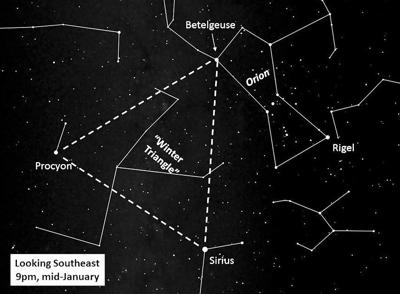
If you have read my columns in summer, you may be familiar with the “summer triangle” of stars which are overhead at that time of year. There is also a “winter triangle” which includes Betelgeuse. The other two are Sirius, the brightest star in the sky, and Procyon, the 8th brightest star.
Sirius lies below Orion, and Procyon is to the left of the Hunter. There is also a “winter hexagon” made up of 6 stars, with Betelgeuse at the center. The six stars include Sirius and Procyon, also Rigel in Orion, plus Aldebaran, Capella, and Pollux. See if you can find them!
As mentioned before, Venus and Mars will be visible in the evening sky. Venus will be the one bright planet in our evening sky in January. Mars is visible, but growing fainter as it moves away from us.
Jupiter will be prominent in the morning sky, and Saturn will make an appearance in the southeast before dawn.
On New Year’s Day, faint Neptune will be located just below Mars, providing a good time to locate our outermost planet.
You’ll need binoculars or a telescope though, as Neptune is a bit too faint to see with the naked eye.



Commented