Our shortest month is a bit longer this year, with 29 days instead of 28. Happy Leap Year!
Feb. 2 is famous as “groundhog day,” when Punxsutawney Phil is pulled out from his warm home to see if he can see his shadow. It also approximates the midpoint of winter – half way between the winter solstice and the spring equinox. A sign that spring is coming. Another sign will be the increase in daylight. During February, we’ll gain 1 hour and 24 minutes of daylight, as the Sun rises earlier and sets later.
If you read January’s column, you are aware that we had quite a lineup of planets in the morning sky, late in the month. That carries over to early February. For the first seven or eight days of February, be sure to check out the southern and southeastern sky just before daybreak (between 6:30 and 7 a.m.), if we get some clear weather.
Low in the southeast will be Mercury and dazzling Venus. Saturn and Mars will be in the south, and Jupiter will be in the southwest. Mercury is always low on the horizon, and will be highest in the sky on Feb. 7. If you see them all, you’ve seen all the naked-eye visible planets!
On Feb. 1, the 3rd quarter Moon will be right next to Mars, and will be next to Saturn on Feb. 3. On Feb. 6, the thin crescent Moon will be right above Mercury, and to the left of Jupiter.
New Moon will be on Feb. 8, with full Moon following on Feb. 22 of the month.
If skies are clear on the evening of Feb. 15, grab a pair of binoculars or a telescope, and take a look at the first quarter Moon. Starting at about 9 p.m., the Moon will slip in front of the Hyades Star Cluster, a group of bright stars in the constellation Taurus. You can watch stars disappear as the Moon moves in front of them, or appear to skim along the edge of the Moon’s surface if they just miss being occulted. After midnight, the Moon will occult the bright star Aldebaran, the brightest star in Taurus.
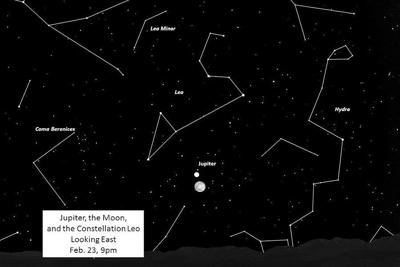
The giant planet Jupiter will not only be visible in the southwest morning sky, it’ll also be visible low in the east during evenings. Jupiter is moving closer to us, and will be closest on March 8 this year. It will be unmistakable, the brightest “star” in the east, just below the constellation Leo, the Lion. The Moon, one day past full, will be located right below Jupiter on Feb. 23.
Train a pair of binoculars on Jupiter, and you can see the planets four largest moons, Io, Europa, Callisto, and Ganymede. They’ll appear as little pinpoints, and will be in a line, since they orbit Jupiter on the same plane. From night to night, you can see that their positions change as they orbit the planet. Which moon is which? This Web site will give you the answer:



Commented