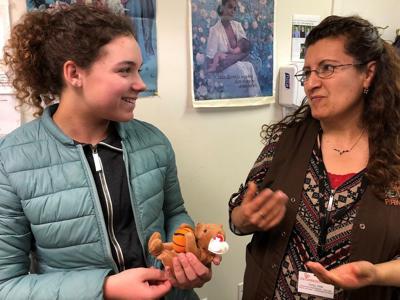
Amy Elliott, of White Salmon, learns from Vicky Valle, certified community health worker at Hood River’s One Community Health, about the value behind donating her stuffed animals to children at the health center. (submitted photo)
Amy Elliott, an eighth-grader at Henkle Middle School, donated 30 of her stuffed animals to One Community Health’s (OCH) Perinatal Program. To many kids, a stuffed animal is a plaything. But for several children whose parents are patients at OCH, such plush toys come to mean more, whether they realize it or not. In fact, the small gifts have a purpose. Over the years, people have donated beautifully handmade or like-new toys to the perinatal program. When it came time for Elliott to clean out her closet, she realized that donating the toys to a good cause made more sense than any other alternative — particularly just throwing them out.
“Since we have a connection with One Community Health, it made sense. Knowing someone else can use them feels good and it’s much better than them collecting dust in my closet,” said Elliott. Elliott was delivered by one of OCH’s former providers and the Elliott family has used its services over the years. They’ve chosen OCH for their dental care, plus the medical needs of several children they’ve fostered. “Our family has come to appreciate all that OCH does for its patients in the Gorge. We really applaud everything they do here and how they operate. We just really support their mission,” said Elliott’s mother Caroline. In being a “sibling” to foster children, Elliott has learned the value of giving back to children experiencing hardship and disadvantages. Knowing that some of the kids receiving her toys at OCH may not have many — if any — toys of their own. The stuffed animals, while small and simple, have had a powerful impact, through cheering up children and therefore making it easier for the OCH perinatal program to provide vital patient education. Additionally, it sends the message that inside the health center walls, kids have nothing to fear. Truly, these stuffed animals are “plush” with purpose. The staff at OCH are also very appreciative of Elliott’s donation. According to Vicky Valle and Delfina Reyes, the two certified community health workers who co-manage the perinatal program, the toys come in handy during long appointments, such as in the case of diabetes education for some patients. Two perinatal program patients recently visited OCH and met with Valle and Reyes. The children had the opportunity to dig into the box of stuffed animals and pick their favorite. The toy became a tool for
distraction as the moms learned about caring for their babies and could better focus on the education provided through the perinatal program. “Many young children are afraid to come to the health care center because they associate it with vaccinations. By giving them the toy to play with, they have a happy face, as well as something to entertain them while their parents learn how to care for their baby
and themselves,” said Valle. OCH is a nonprofit, Federally Qualified Health Center (FQHC) with locations in The Dalles and Hood River. Formerly known as La Clínica del Cariño Family Health Care Center, Inc., it was founded in 1986 and, today, has evolved into an official Patient-Centered Primary Care Home. OCH currently provides services to more than 12,000 patients.



Commented