
Remember Halloween in school when you were a youngster? The costumes. The candy. The hilarity!
One thing you probably won’t remember is what you learned that day.
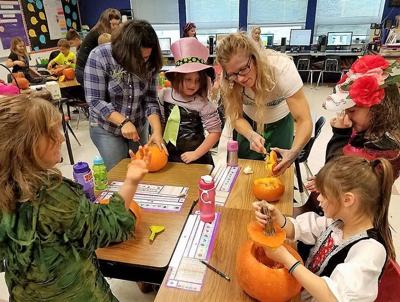
Students in Lyle Community Schools are already looking back on this Halloween’s excitement fondly, but less for the costumes and candy, and more for the learning. In Marlene Perez’ second-grade class, parents were invited to join the students as they carved pumpkins and practiced their math skills, like measuring circumference, during the process.
Meanwhile, in Donna Sholtis’ secondary science classes, students created “slime” from wood glue and borax, and conducted experiments with dry ice to observe matter changing from solid to vapor form. That evening, parents were surprised and gratified when students took to social media to rave about how much they love their science class.
The most recent test scores for Lyle Schools reflect these students’ enthusiasm and mental engagement in their classes. The 2015-2016 spring test results show dramatic increases in the number of students meeting the state standard across the elementary grades that were tested, as well as at eighth and 11th grade. There’s a real spirit of excitement and optimism among students, parents and staff.
A Unified Campus
The district has come a long way in the past three years, since state test scores ranked it in the bottom five percent of Title I schools – those with the highest poverty — in the state. Enrollment was dropping and an important maintenance and operations levy failed to pass twice as the community’s confidence in the district eroded.
But the situation was not without hope. It came in the form of a three-year School Improvement Grant (SIG) awarded to the district by the state. In addition, the board hired Superintendent Andrew Kelly, who brought extensive experience in helping turn around schools and districts in similar conditions. The SIG grant provided a fiscal jump start at the middle school level and allowed the time and space to put strategies and structures into place that Kelly had observed successfully help transform other districts statewide and nationally.
Tough decisions were made, too. Perhaps the hardest was to close the 20-year old Dallesport Elementary School and merge all students, pre-Kindergarten through 12th grade, under a single roof on the Lyle campus. “It was about efficient use of our limited resources, both people and facilities,” Superintendent Kelly says. With multiple classrooms sitting unused in each school, the financial savings in utilities and support personnel resources were undeniable.
Not everyone supported the idea at the outset. For parents, community member and students, there were mixed feelings, and the staff was not immune to them. The unification of the two campuses presented challenges, and some were concerned about the timing. But staff pulled together to make the most of the unusual opportunity, working to explore ways meet the needs of each and every student in new and innovative ways.
Fourth-grade teacher Lori Smith was excited to see the schools, staff and students come together on one campus. She attended Glenwood Schools as a youngster and enjoyed the feeling of being part of “one big family” that a K-12 campus allows.
Smith also notes there are learning opportunities that a merged campus creates. Currently, a high school student is working as an aid in her classroom for a period each day. The fourth-graders get the benefit of an extra helper in the room, and the high schooler is getting a head start on a possible career path, much as her counterparts in larger school districts are able to do. When the elementary school was in Dallesport, high schoolers couldn’t drive back and forth and spend any appreciable time in the classroom in a single classroom period. Now, the opportunity is available to any student, regardless of whether they have a car and without taking too large a bite out of their class schedule.
Lyle staff are grateful that the community has shown its support by raising $40,000 in grants and donations to ensure elementary students have an up-to-date and safe play structure on the Lyle campus The structure will be assembled on November 23 during a community build day.
Parents and staff are excited that music, a program that was cut due to past budget woes, has been restored, thanks to the savings generated by operating one campus. What’s more, the district has already seen interest developing in the use of the Dallesport facility as a rental facility for everything from post-high school educational programs to independent sports programs, use that could eventually result in the building being a profit center for the district and bring new vitality to Dallesport.
The Kids are Alright
Just two months into the merger of the schools, younger students will tell you they always liked the idea of coming to the Dallesport campus, primarily because they knew they would be in close proximity to older siblings and friends.
Their older siblings, however, had other thoughts at the outset. “I was worried about little kids running around all over the place,” seventh grader Kyla says. “Actually,” she adds, “It’s not that bad.” Classrooms for younger students in pre-K through grade three are in a separate wing of the building from grades four through 12. In addition, schedules are slightly different, with elementary students riding different buses and eating meals at different times. Nor do younger students mingle with older students in the hall between classes.
Yet, when it’s helpful for an older student to be available, it’s easy to make that happen. In more than one instance, a high school student has been asked to comfort or reassure a younger brother or sister having a hard day.
Morgan, an 11th grader, didn’t like the idea of a combined campus originally. But conversations in a leadership class helped change her thinking. “I feel like older kids can be mentors,” she says. She and other students from her leadership class are working on a program to make that happen.
Morgan and Delsie, a senior, pointed out another advantage. Students won’t have to go through the stress of getting used to a new school when they move up from elementary to middle school, and middle to high school. “Everyone knows everyone,” the girls agreed, meaning there’s less chance for a student to fall between the cracks.
Seventh graders Wyatt and Kyla both tried attending other schools outside of the district at various times, and both noticed it was harder to get help at those larger schools when they didn’t understand an assignment. They’re both back at Lyle and happy to be there.
When a student needs extra support, there are staff available to provide it, thanks to the district’s current levy and the SIG grant. In a high-poverty school with approximately 28 percent of the student body meeting the federal definition of homeless, support staff often make the difference in whether many kids are able and ready to learn, or not.
What’s ahead?
Superintendent Kelly now has an eye to bringing more Career and Technical Education (CTE) classes – previously known as Vocational Education – back for the secondary students. These generally relate to high-paying jobs that don’t require a four-year degree. Kelly would also like to add Advanced Placement (AP) courses to Lyle’s curriculum offerings to support the school’s college going students.
“Strong schools are the heart of strong communities. I took this job because I believed the kids and community deserved better, and believed it could be done,” Kelly notes.


Commented