
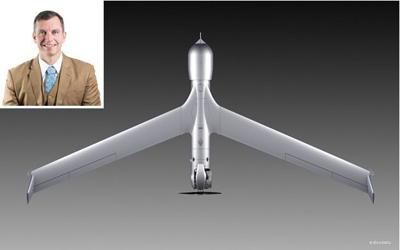
As the Insitu Group’s new leader, Ryan Hartman sees his company as coming full circle.
One of Insitu’s many alumni of Embry-Riddle Aeronautical University, Hartman knew he wanted to work in the aerospace industry since he was growing up listening to his grandfather relay stories of serving in the military.
Years later, Hartman would follow in his grandfather’s footsteps by serving in the military himself, this time in the Air Force and the Navy.
“My grandfather was very passionate about his time in the military and his time in aviation and it rubbed off on me, so my career started with pursuing military aviation and that’s what led me to the Air Force and then the Navy. Then when I got out of the military I wanted to continue working in aerospace,” Hartman said.
Hartman, who was named president and CEO of the Boeing subsidiary in August, climbed the ladder to the company’s top position after a little more than four years. During that time he served as senior vice president of Insitu programs and before that senior vice president of business development.
Just a few months after taking over for former Insitu CEO Steve Morrow, Hartman traveled to the Euronaval Exhi-bition and Conference in Paris where it was anything but business as usual for the Columbia River Gorge’s premier producer of unmanned aircraft.
At Euronaval, Hart-man unveiled Scan-Eagle 2, a continuation of Scan-Eagle, the 44-pound unmanned aircraft Insitu saw so much success with for years in the defense industry, but began as an option for civil and commercial uses when it was first introduced as the SeaScan, which was originally planned to help fishermen locate schools of tuna and track weather data. For Hartman, the release of ScanEagle 2 is a way for Insitu to make its way back around to the commercial market.
“ScanEagle 2 is part of that vision of getting into the commercial market. Of course, it’s going to be a product that’s applicable to our military customers, but more importantly it’s part of our preparation for the civil-commercial market. The civil and commercial market requires a system that has high reliability, that’s cost effective and can be certified, meaning whether it be in the U.S. or in the international commercial market, the system will have to receive a certification from some sort of agency, like the (Federal Aviation Administration), so we’re designing the system with that in mind,” Hart-man said.
Last week, Insitu launched its 2,000th ScanEagle and has logged more than 800,000 operational hours with the system. During all of those hours and all of those flights, Insitu made note of the need for a more reliable engine, which can be found in the new generation of ScanEagle. Hartman said Insitu essentially held a global competition among engineering companies to narrow down which would design an engine that could withstand longer flights and increased carrying capacity.
Through the competition, Insitu chose Orbital Engineering, an Australian firm that designed an engine that is, in Hartman’s words, “exceeding expectations.”
“Up to now, engines for unmanned systems for ScanEagle came from the hobbyist community. They’re designed for remote-control airplanes for high-end hobbyists. They’re not designed for the environment that we put these systems into, so it requires a lot of modifications to those systems,” Hartman said.
ScanEagle 2 is also constructed in such a way that its sensors are easily adaptable, depending on a customer’s specific needs, making it more affordable for those who might want to use it outside of the military.
“The farmer who is trying to understand the health of his crops doesn’t need the same sensing technology as a Marine fighting in Afghanistan, so ScanEagle 2 enables us to bring those new sensing technologies quickly and efficiently with lots of options for the aircraft,” Hartman said.
Additionally, ScanEagle 2 will allow customers who purchased the previous platform to easily retrofit it with all of these new aspects while still using many of the technologies stemming from the original ScanEagle, like its launch and recovery system as well as its ground control station, Insitu Common Open-mission Management Command and Control (ICOMC2).
While it is the hope that ScanEagle 2 will make its way into the commercial market, Hartman said the easily adaptable sensors and more robust engine will be prime for customers in the U.S. military, as well as Insitu’s defense customers around the globe that make up around 40 percent of the company’s business in 17 countries.
“It doesn’t mean we won’t be involved with the military anymore. That’s a firm foundation of our company right now and we’ll never lose sight of the fact that we have a very important role to play in providing information through the use of unmanned systems to our military so they can have decision making superiority so they can save lives. That’s a very important aspect of the work that we do,” Hartman said.
ScanEagle 2 is currently undergoing flight testing and will be available for purchase sometime in 2015 and while its release marks a very exciting time for Insitu, Hartman said it’s imperative that the company retain the culture created by its founders, one of which was responsible for recruiting him. Former Insitu CEO Steve Sliwa, who now oversees his own company called Seeq, saw potential in Hartman while he was working in the unmanned systems portion of Raytheon.
After visiting the Gorge, he knew it was time to make the move from his home state of Arizona.
“We were competing for probably four years and then I was ready to make a move in my career and Steve Sliwa had a conversation with me when I was ready and suggested that I come visit the Gorge and Insitu to see if that was something I might like to pursue,” Hartman said. “It just fit well with us. It was a place we knew we’d like to live and raise our family and it’s just kind of a bonus that you can work for such an awesome company and live in such an awesome place.”
Hartman said it was Sliwa’s methods of managing the company by constantly challenging employees, founder Tad McGeer’s insistence on “designing elegant aircraft,” and Andy von Flowtow’s involvement by constantly improving and introducing new capabilities that formed Insitu’s culture that Hartman feels responsible for perpetuating.
“When you combine those three they really do make up the core of the company’s heritage. It’s that we do deliver elegant designs that are efficient and are done so in an iterative fashion that it solves hard problems for our customers and are absolutely innovative. So we’re an agile company, we’re an innovative company, and we value the diversity of thought that results in people solving hard problems every day with some pretty awesome solutions,” Hartman said.
Outside of focusing on the technical parts of his new job, Hartman said he wants to see continued outreach to the community, especially when it comes to creating educational opportunities, like the annual RoboFlight Academy that allows students to learn about unmanned aerial systems.
“Our hope is that we can create educational opportunities for our kids so they can get the education they deserve, but then come back and work for us. It’s pretty cool how many of those employees we already have, but as we continue to grow and sustain the business we have to create a steady pipeline of engineers and other math-related disciplines,” he said.
But it’s not all about Insitu all of the time. Hartman also enjoys mountain biking and hanging out with his family while he waits for the next opportunity to come up as his company continues on the path to coming full circle.
“When we talk about what luck means inside of Insitu, luck is the intersection of being prepared for an opportunity and that’s how we’re approaching the commercial market. We’re preparing ourselves, because there’s going to be an opportunity at some point and the way we’ll get lucky in introducing the next awesome product into the new commercial market is that we’re going to be prepared for it,” Hartman said.


Commented
Sorry, there are no recent results for popular commented articles.