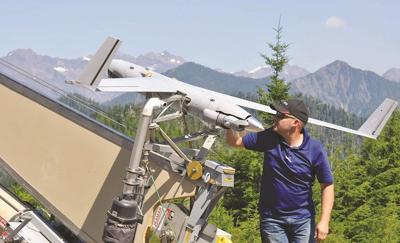
Insitu Rapid Response Team member Joe Cooper prepares an Insitu ScanEagle for launch during a fire monitoring demonstration in Olympic National Park last month. (Insitu photo)
Insitu Rapid Response Team member Joe Cooper prepares an Insitu ScanEagle for launch during a fire monitoring demonstration in Olympic National Park last month. (Insitu photo)
Insitu demonstrated recently over the Paradise Fire in Olympic National Park that unmanned aircraft can play a critical role in fighting wildfires.
Aug. 19-25, Insitu’s Rap-id Response Team (RRT) launched the Bingen company’s workhorse unmanned vehicle, ScanEagle, into the smokey sky over the Paradise Fire, to see what it could see and send back information fire managers on the ground could utilize.
The event, according to Insitu spokesman Jennifer Beloy, “marked the beginning of an operational demonstration [for the U.S. Department of Interior] designed to show how unmanned aircraft technology can be a powerful force multiplier in the fight against wildfires.”
The weeklong demonstration also marked the first time the Interior Department (DOI) has used an unmanned aerial system (UAS) to fight fire.
The ScanEagle flew six operations and delivered more than 37 hours of infrared video in real time to incident commanders, “to aid in situational awareness, mission planning, and initial attack tasking,” Beloy said.
The ScanEagle’s imaging technology enabled fire officials to pinpoint the fire’s perimeter and identify areas of intense heat, called hot spots. Fire managers also received information from overhead that helped them evaluate water-drop locations and guide water-dropping helicopters to their targets.
Brad Koeckeritz, DOI’s national UAS specialist, told The Seattle Times the demonstration was “highly successful.”
He said fire managers “were able to see through the smoke very clearly. They were able to determine intensity of the fire and clearly see the fire’s edge.”
ScanEagle flew within an emergency certificate of authorization, issued to the Interior Department by the Federal Aviation Administration, that permitted its operations within the confines of the temporary flight restriction, according to Beloy.
The ScanEagle test was “one of a series of an ongoing solicitation from DOI to further UAS use on wildland fire in national Parks,” Beloy noted.
Mark Bathrick, director of DOI’s Office of Aviation Services, said the recent UAS demonstration “will serve to guide our policies, procedures, and requirements for safe, phase integration of UAS in support of wildfire management.”
He added, “These demonstrations are part of a larger interagency strategy aimed at employing UAS to provide firefighters on the ground with time-sensitive information that will give them the highest level of situational awareness and support possible.”
Currently, wildfires in the Pacific Northwest have burned more than 625,000 acres and occupied the attention of thousands of firefighters.
Insitu President and CEO Ryan Hartman said the company “is honored to support the individuals who are risking their lives to protect the natural resources endangered by wildfires.”
“This exercise demonstrated our ability to collect, process, and deliver information that helps fire officials achieve better outcomes,” Hartman added.
Insitu’s RRT on this recent test consisted of six members and included pilots with commercial certificates. “Specifically, there were five flight crew members and one individual responsible for video processing and dissemination,” Beloy explained.
The Insitu spokesman said Insitu works hard to attract and train operates that are the best in the business.
“A few of the individuals involved in this operation have specific firefighting and aviation fire support training, including Incident Command system training and certification,” Beloy pointed out.
Will the ScanEagle be put further use in the Northwest as a firefighting aid? Beloy said, “Insitu’s Rapid Response team is back home and preparing to mobilize again if the fire suppression agencies in our region request unmanned support.”



Commented
Sorry, there are no recent results for popular commented articles.