While the future of its June 2012 Husum/BZ Corner Plan and Zoning Update may be in the hands of a state appellate court, Klickitat County’s board of commissioners plans to hold a public hearing on April 23 to take public comment on revisions to or the possible repeal of the update.
Formal citizen complaints about a cultural resource requirement for land use applications embodied in the update’s regulations are driving the County Board’s decision to revisit the update, according to information gleaned from County Board meeting minutes. A group of residents and landowners in the lower White Salmon River valley, led by Husum Hills Golf Course owner and former county commissioner Don Struck, are upset because of the costs of complying with the cultural resource surveys, which these landowners contend are overly expensive and burdensome.
The group submitted its concerns in writing to the County Board on Jan. 20; a discussion bet group members and followed, according to Jan. 20 meeting minutes.
The requirement — which is applied case by case in a limited sector of the planning area — is the result of a settlement agreement reached by the county and the Yakama Nation in 2011 that re-solved the nation’s environmental challenge to the update and removed one obstacle to adoption of new land use zoning for the planning area.
The public hearing on April 23 will be held in the Senior Services dining room at the Pioneer Center in White Salmon, 501 NE Washing-ton St., starting at 6:30 p.m. Testimony from the public will be received for the record and used to help form a decision by the County Board. Repeal is among the actions the commissioners could take.
District 1 Commissioner Rex Johnston (R-White Salmon) said last Friday “there is no huge, underlying reason” for scheduling the hearing, though he acknowledged “some people are a little bit upset about the settlement agreement and part of that is what prompted the need for the hearing.”
Some residents and landowners in the lower valley have been calling on the County Board to consider repealing the update in order to do away with the cultural resource survey requirement. However, nobody has put their concerns or gripes in writing; the County Board has received no letters or petitions regarding the 2012 up-date, according to Clerk of the Board Cris McEwen.
That said, Struck read a prepared statement to the County Board on Jan. 20 that was not made part of the meeting record because the county failed to ask for a copy.
Struck spoke for himself and area residents Rick Graves, who is also a county planning commissioner; Jerry Smith, George Mersereau, Jim Fritchey, and Jim Rhoads.
Struck told the County Board his group appeared that day to ex-press ongoing concerns about the 2011 settlement agreement that was incorporated into Title 19 of the Klickitat County Code.
In a nutshell, the agreement required the county to amend its code to include guidelines for cultural resource surveys on certain tracts alongside the White Salmon River; the code states the surveys may be required before construction can begin on these properties. “Within these areas, a cultural resources survey is required on properties where land disturbance will occur within [500 feet] of an archaeological site or a historic archaeological resource...The survey shall be of areas of the project site that will be disturbed temporarily or permanently,” according to the code.
Struck said he felt the board was unaware of “the dramatic effects this action has upon constituents in the Husum/BZ Planning area.”
“The community is largely unaware of the difficult nature of complying with the County’s new regulations with respect to potential cultural issues on private property,” Struck said.
Smith, a Husum resident, said the settlement agreement changed the intent of the 2012 update. He said he supports the plan that was presented to the Planning Commission but feels the community would not now because of the change of intent.
Struck noted that the settlement agreement was aimed at three specific cultural resource sites but now there are more than 30 “and the list is growing.”
Struck advised the County Board that, in his view, the Yakamas are not meeting the intent of the settlement agreement in that “they have appealed a development that ws not within a cultural site buffer.”
Graves, of White Salmon, suggested the County Board consider amending Section 19.02 of the code by adding language that identifies the three cultural sites, as specified in the settlement agreement.
District 3 Commissioner Jim Sizemore (R-Centerville) expressed concerns about following the proper procedure and said he has been advised by the Planning Department that “for the board to rescind the Husum/BZ plan would require a public hearing to be held.”
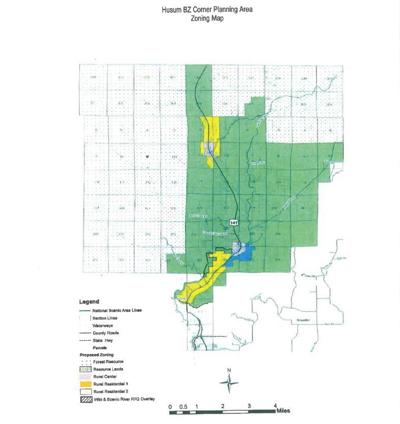
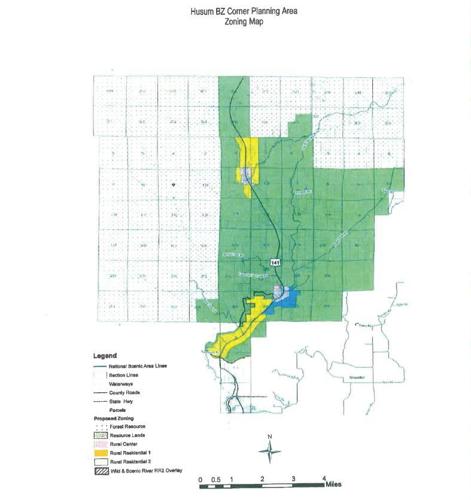
In thee nearly three years the 2012 update has been in effect, 13 new lots have been created in the planning area, according to the Planning Department. The update was designed by county planners to focus growth in 4% of the 50,000-arce planning area yet still meet a projected need for 259 new residential lots over a 20-year period (about 13 new lots per year).
“It’s been three years and we’re curious about how the people feel about [the 2012 update],” Johnston said. “We’re going to open it up and see how everybody in the area feels, not just special interest groups, to feel the pulse of the public.”
The Enterprise asked Planning Director Curt Dreyer for the list of landowners who would be affected by a repeal, but did not receive a response before its press deadline.
Dreyer told The Enterprise, though, that if the County Board repealed the 2012 update, “the prior policies and zoning would be reinstated and the current/new requirements would go away.”
The result, he said, is that some properties in the planning area would be “down-zoned” to the old zoning per the 1996 plan and zoning update. Repeal of the current/new zoning would “up-zone” a number of properties that would revert from 1- and 2-acre zoning to high-density zoning, he noted.
Dreyer said the County Board has not yet requested a staff report or presentation for the hearing, “although the Planning Department likely will provide a short update on development which has occurred since the new zoning was enacted three years ago: 13 new lots, less than anticipated in the county’s land capacity analysis.”
As for the cultural resource requirement, Dreyer said his office has not received any formal complaints but “questions and concerns about cultural resource requirements for proposed development sites have arisen, although in most instances, county requirements are not applicable. Most undeveloped properties don’t trigger the requirement if the proposed building footprint can be altered to avoid the cultural resource.”



Commented
Sorry, there are no recent results for popular commented articles.