
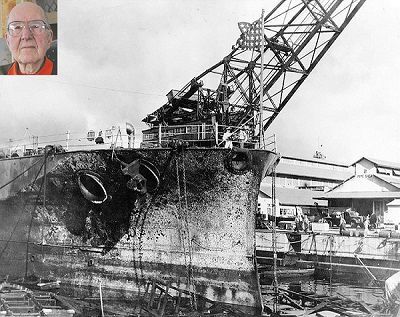
Max Fletcher was there when the bombs fell.
This Sunday, Dec. 7, marks 73 years since the Japanese attacked Pearl Harbor, triggering the United States’ involvement in World War II. At the time, Fletcher, now 93, had been in the Navy for two years and was stationed in Hawaii at a receiving station, which was where personnel moving from one ship to another or one assignment to another were accommodated until that ship or assignment was ready.
“I was there when the Japanese arrived,” he said.
A native of southern Idaho, Fletcher had never been farther from home than a few hundred miles, driving him to join the Navy right out of high school.
That was 1939. In the next two years he would go through boot camp in San Diego and then for a brief amount of time was assigned to the USS Oklahoma before heading to the receiving station in Pearl Harbor.
Then on the morning of Dec. 7, 1941, Fletcher, who was 20 at the time, and the sailors he worked with were awoken by the sound of approaching aircraft.
When they went up on the roof of the building where they lived and worked, the first assumption was that it was all a very realistic drill.
“We heard a big commotion and planes where flying over us, so we went up on the roof. Somebody said ‘well this is really a realistic maneuver. Look, the planes even have red balls painted on them,’ which was the insignia of the Japanese war plane,” Fletcher said.
It quickly became apparent that this was not the case as they watched chaos unfold as torpedoes dropped on the ships around them, including the USS Oklahoma.
“The torpedoes hit several of the battleships and sank them and the Oklahoma took such a strong hit that it turned turtle, as we would say, or turned completely upside-down. One of my good friends was an engineer and was in the engine room when that happened. I never did see him again,” Fletcher said.
After the initial attack, Fletcher said an executive officer, who like others had been on shore leave for the weekend, had gotten back and was calling for volunteers to head over to the USS Pennsylvania to prepare for the second round of Japanese attack.
Fletcher was one of the sailors who volunteered, so he and 20 others headed over to the drydocked Pennsylvania just in time for the second phase of the attack—this time high-level bombing—to arrive.
Once on board, Fletcher was situated at the end of a corridor and was meant to pass shells off to those operating a 5-inch gun.
Before anything like that could happen, a bomb hit the gun, filling the corridor with fire and smoke.
“As the explosion came down the passageway with fire and smoke I was over there in a T-shirt and rather strangely there were no burns where my shirt covered me. There were burns up my arms and my eyebrows and hair were singed off,” Fletcher said.
Of his brush with potentially fiery death, Fletcher can only say that he was “damned lucky.” After a short stay in the hospital for minor injuries, he was released back to work and soon after promoted to First Class Petty Officer and awarded the Purple Heart.
According to the U.S. Navy Museum, 2,008 servicemen were killed during the attack on Pearl Harbor. Twenty-six of those fatalities occurred on board the Pennsylvania.
“There were a lot of deaths there. The Arizona took the worst hit. A bomb went right down through the decks to the powder supply room and she exploded and a very large part of the crew was killed,” he said.
Following the attack, Fletcher didn’t spend more than a few more months at Pearl Harbor before being transferred to an oil tanker where he was promoted to Chief Ships Rider.
That’s where he spent the rest of World War II until he was selected for V-12 school, or the Navy’s college training program, which he attended in Pocatello, Idaho, earning three years of college credit.
From there he attended the University of Washington for the last semester of pre-supply corps school and eventually finished training in the supply corps program at Harvard.
He would end up earning his bachelor’s degree in economics from the University of Washington, as it fit so nicely with the supply corps training he received, but once he was finished he found that the end of the war in 1945 resulted in low demand for his profession.
“I found jobs were scarce because with everyone getting out of the military at the time the job market was flooded,” Fletcher said.
He worked as a supply corps officer for a while, but said he “didn’t want a lifetime in the Navy,” so he got his masters in economics from the University of Idaho with the intent of going for his Ph.D. at the University of Wisconsin.
During that time, he became a Fulbright Scholar and studied in England at the London School of Economics.
“The Fulbrights in English-speaking countries and in London where there were wonderful research facilities were really competitive to get. I spent one year there,” Fletcher said.
It was during his time in London that he met his wife, Ann. The couple will be celebrating their 60th wedding anniversary this month.
They honeymooned in Paris, but decided to stay for a year before returning to the United States. Fletcher then made a career teaching for 30 years at Marquette University and the University of Idaho and was even head of the economics department there.
Fletcher has been retired since 1984, making his time in retirement just as long as his time working as a professor. He and his wife still travel to Paris for vacation, but Fletcher said moving to Lyle allows Ann to regularly walk some of the wooded property they own there.
“We’re told that we’ve bought the oldest house in Lyle. It’s over 100 years old and some parts show the wear, but it’s a great house,” he said.


Commented