
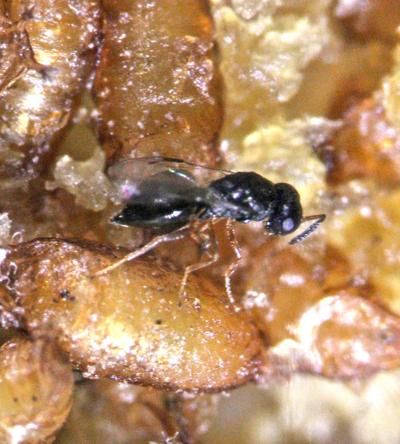
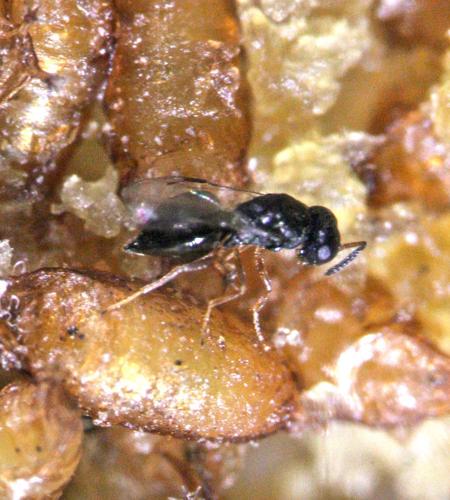
A parasitic wasp has shown tremendous potential attacking and controlling spotted-wing drosophila—an invasive, destructive fruit fly that costs Oregon fruit and berry growers close to a billion dollars a year, according to Oregon State University researchers.
Biological control is the use of beneficial insects to manage other insects, which means using less pesticides.
“Spotted-wing drosophila is very difficult to control,” said Vaughn Walton, professor and Extension entomologist in OSU’s College of Agricultural Sciences. “It’s got a very, very high reproduction rate, many generations a year. Because of that, when using pesticides, they have to be applied constantly.”
If successful, the wasp could have a big impact on orchardists in the Gorge, said OSU Extension horticulturist Ashley Thompson, who works with growers in Wasco and Hood River counties. “It’s a major problem for growers here,” she said of the spotted-wing fruit fly.
Cherries become susceptible to the fly when the fruit begins to gain color in the spring.
Thompson monitors fly numbers throughout the year, with well over a dozen traps in orchards from Dufur to Mosier.
Trap results are reported to growers. “That gives them an idea of what is out there, and when they need to spray,” she said. “Growers use a variety of pesticides to treat for the spotted wing,” and may spray four or five times a year when numbers are high.
She said if found to be a successful control, the wasp will be an important part of controlling the invasive fly. “This will be an important tool, especially for organic growers,” she said. Currently only one organic pesticide, based on soil microbes, is available for use.
The parasitic wasp could also decrease the frequency of spray use, Thompson said.
Pesticide application can cost $150 per acre, and reduced application represents significant cost savings, she said.
Researchers noted that blueberry growers are most impacted by the fly, and may have to spray weekly when numbers are high.
“Using that much pesticide is not economically or environmentally sustainable,” Walton said. On average, spotted-wing drosophila, also known by the acronym SWD, destroys 10 percent of fruit value. The fly is especially destructive for blueberry growers, and management in the blueberry industry alone costs $100 million a year. Other crops affected include strawberries, raspberries, blackberries, cherries and, if conditions are right, grapes—a worrying possibility for Oregon’s wine industry. In Europe and the eastern U.S., the pest is already a serious problem in wine grapes.
Researchers have high hopes for the wasp. “Based on the survival and host-killing capacity of the wasp, we have concluded that it has tremendous biocontrol potential against SWD,” Walton said.
The OSU researchers published their findings in the journal PLOS ONE.
Usually a parasitic insect burrows into its host, which can then produce antibodies to fight it off. But P. vindemniae lays its eggs on the outside of the larvae skin, avoiding the antibodies. That’s what makes it so effective, Walton said.
A native of Southeast Asia, spotted-wing drosophila arrived in Oregon in 2009 and has now spread throughout the world. The P. vindemmiae wasp is one of only two parasitoid species that have been naturally found to successfully attack and kill spotted-wing drosophila in the field, according to Walton.
Adult drosophila flies resemble the small fruit or vinegar flies that buzz around the kitchen or rotting fallen fruit outdoors. Infested fruit shows small scars or speckles made when the adult female lays its eggs. The eggs soon hatch and the maggots begin feeding inside the fruit, causing damage that results in severe crop losses.
The chances of deterring spotted-wing drosophila improve with cultural practices like good sanitation, correct pruning, drip irrigation and weed cloth.
Drip irrigation lowers the longevity and reproductive ability of spotted-wing drosophilia.
Weed cloth provides a barrier to keep the flies that drop from the fruit from burrowing into the ground and laying eggs.
“The wasp helps, but you must do the other things as well,” Walton said. “None can stand on its own. If you’re doing all of the cultural practices, you’re going to have a much lower problem. I had a call from a grower who was doing everything right and he wanted to know if he could spray less pesticides. Even removing one application is a significant cost savings. That’s a lot of savings if you can do all of these things together.”
The parasitic wasp has gone through rigorous testing and Walton is awaiting a permit to raise and release the wasp in large numbers.
In the Columbia River Gorge, the spotted-wing fruit fly peaks in October, and numbers begin dropping in December, Thompson said. “We are still catching some,” she said Dec. 11. In winter, the flies feed on fruit left on the ground.
The flies are always present, but their numbers vary year to year, she added. “Some years we spray less frequently than others.”
Kym Pokorny of Oregon State University contributed to this report.


Commented
Sorry, there are no recent results for popular commented articles.