
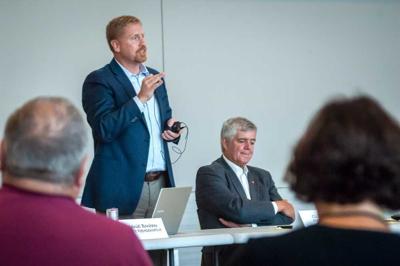
Oregon Senator Cliff Bentz (R-Ontario) and Representative Daniel Bonham (R-The Dalles) expressed a desire to find solutions to a warming climate that did not have a detrimental impact on the state’s economy during a public forum to discuss CO2 emission reduction Tuesday in The Dalles.
Bonham noted in his opening remarks that although Oregon Republicans had at least temporarily stopped the passage of House Bill 2020, a cap-and-trade bill with strong Democrat support in the Legislature, “The question now is, what are we as Republicans going to do to find a solution to this problem?” He added, “We want to hear what people want, this is an important issue to the people of the state.”
Bentz, who was a member of the committee that prepared the bill, said Oregon needed to decide how best to use the state’s limited power to deal with climate change in a real way. “It’s not enough to take all the carbon out of the state,” he said. “That doesn’t mean doing nothing,” he added. “We should figure out how to sequester CO2 in Oregon, we have some resources to do that.” He added the state is already developing alternative power, especially solar power in the southeast corner of the state, and could be better managing forests to maximize removal of CO2 from the atmosphere.
Bentz, part of the Republican leadership in the Senate, said he left the state to stop passage of the bill “because I knew the impact this bill would have on all Oregonians,” he said. “This is a great big deal—everything about this transition is going to impact every Oregonian.”
He said final attempts to negotiate changes to the bill were ineffectual. “I told them, we have got to think about truckers. Everybody here tonight relies on freight. But that was not addressed,” he said. He also objected to the “emergency clause” which avoided the bill being brought before the people for a vote. “The governor wasn’t willing to take it to the people,” he said.
Bentz also pointed out the bill had inadequate funding for a transition to cleaner modes of transportation, because the Oregon constitution requires money collected as a gas tax to go to roads, which it does through the Oregon Department of Transportation. Because of that, funds raised by the bill cannot be used to build the infrastructure that will be needed for electric vehicles or other forms of transportation, he said.
“We need to change the constitution so this money can go to the transition, not just to roads and culverts and butterfly crossings,” he said, referencing an ODFW project request for a wildlife overpass.
Bentz said leaving the state to stop the bill wasn’t an easy decision to make, but he believed it was the right one. Although the bill appears now to have lacked the votes to pass, “walking out raised awareness substantially,” he said. “That was the best thing to come of it.”
As the legislators opened the floor to questions and comments from the audience, moderated by Betsy Hege, chair of the Wasco County Republican Central Committee, Bentz was both praised and criticized for leaving Salem to stop a vote on the bill.
After several suggestions that he supported doing nothing to stop or reduce climate change, Bentz said, “I’m not saying do nothing, I’m saying let’s use our little state wisely. I am not saying to do nothing.” He said he had been sponsoring solar power bills for a decade, and said that was why money from any “cap and trade” program needed to be available for transitioning to new energy sources, noting that the $400 million a year in projected revenue in HB2020 could substantially increase funding for those projects. “The solar capacity in Oregon is astonishing,” he said, noting that there were dry lake beds in southeastern Oregon in close proximity to grid transmission lines.
Bentz added that he preferred a revenue-neutral carbon tax, which is more efficient, and could, with changes to the constitution, be used to fund the transition to cleaner energy.
Roger Kline, manager of the Northern Wasco County People’s Utility District, thanked Bentz for stopping passage of HB2020. “As a provider of carbon-free power, thank you. I appreciate you did what you had to do,” he said, and expressed the hope more useful climate policy would now be considered.
Several speakers decried the walk-out, saying the senators were not doing the work they were elected to do. Others suggested the presentation was one-sided. “You need to present both sides,” said Kate Mercer, who was handing out a sheet listing “ways in which HB 2020 is good for rural Oregon,” with 30 talking points. She added that the situation was desperate, with only 10 years to make major reductions in CO2 emissions.
One opponent of the walk-out asked Bonham, who voted against the bill in the house, if he supported the walk-out in the Senate. “Yes, I’m proud to say I did,” Bonham said. “It’s not an easy step to take, it’s a terrible choice. Sometimes you have to stand in the face of opposition and do what is right. I think what Bentz did was the right decision.”
Bonham said reducing CO2 was important. “You have two people here who really want to find a solution to this problem,” he said, but added that he thought HB2020 was not a good solution.
After several suggestions that Oregon was doing nothing in face of a climate emergency, Bonham objected. “Oregon has done a lot,” he said, citing a number bills supporting alternative power and energy conservation. “We are doing something, but it’s never enough. I don’t think anyone knows the solution, the technology doesn’t exist yet.” He said reducing emissions was important. “Our goal and mission is to drive toward those goals without destroying our economy,” he explained.
A number of those attending suggested HB2020 would have a serious, detrimental impact on their business.
Todd Stoffel, of Washougal, Wash., and founding member of a timber unity group, said that as a truck owner he has fixed costs and a 3 percent profit margin. “Guys like me, with one truck, it’s a fixed cost, and a 10-cent increase in the cost of gas would be a game changer.” He added that instead of penalizing Oregonians with a tax, the state should incentivize positive change. “These forest fires put out more carbon dioxide than trucks do. We need to clean up the forests, thin and replant. Trees are carbon-eating machines,” he said. He said cleaning the forests would provide jobs and reduce CO2.
Aron Asai, a farmer out of Hood River, said walking out was the right thing for the senators to do for the state’s farmers. “A few cents in gas, that may not mean much for a lot of people, but for us that’s thousands of dollars,” he said. He noted, in a later conversation, that he would be happy to shift away from diesel and gas. “Show me an electric tractor that can haul 20,000 pounds, I’ll buy it,” he said.
Bentz, when asked again why he opposed some aspects of the bill, said “I want us to do the right thing, in the best possible way. We need to do this smart.”
Bentz praised the civility shown by those attending the town hall—all were given a chance to speak for three minutes—and said that was the most critical commodity to effecting change in the state. “We need civility in our politics, or we can never come together to find a solution,” he said.


Commented
Sorry, there are no recent results for popular commented articles.