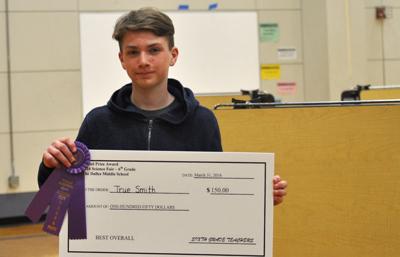
True Smith won the overall grand prize at The Dalles Middle School sixth grade science fair for proving that an herbal wormer was more effective on horses than a chemical one. He was one of 200 students to participate. Contributed photo
True Smith won the overall grand prize at The Dalles Middle School sixth grade science fair for proving that an herbal wormer was more effective on horses than a chemical one. He was one of 200 students to participate. Contributed photo
Seeing that whitening toothpastes cost more than those without whitening, Ethan Hansen, a sixth grader at The Dalles Middle School, decided to see if the extra expense was worth the money.
He stained tiles with coffee and then brushed them twice a day for two weeks with four different types of toothpaste—plain, cheap, mid-range and expensive.
Hansen discovered the mid-range worked the best, since it foamed the most, and the expensive toothpaste with whitening was actually the worst.
“I’ll stick with the normal toothpaste if I can remember to brush two times a day,” Hansen said. “It was a really fun project other than after two weeks your arm hurt really bad.”
His experiment won a grand prize award for best consumer science at The Dalles Middle School sixth grade science fair on March 31.
Hansen was one of 200 students to participate. He and three other grand prize winners were awarded a king size candy bar and 150 Wildcat bucks.
True Smith, who tested herbal versus chemical wormers for horses, won the overall grand prize.
After testing three different horses, he was surprised that the herbal wormer worked better than the chemical.
“I thought the chemical wormer would be more effective because it’s recommended and it’s most common,” Smith said.
Smith made his conclusion by giving the wormer to the horses, mixing their manure with solution and then counting the amount of eggs under a microscope. Haley James won the overall best display award for her project, which asked, “How does the camouflage of a moth affect what you see?”
She hid three different moths each in two boxes and asked six people to report what they saw.
“They didn’t know there was moths and everyone saw different things,” James said.
From 20 and 10 feet away, no one could see the moths. At 5 feet, one person saw them.
“Everybody started to see them at 20 feet when I told them what they were looking for,” James said.
Isaac Johnson, who won best scientific method, learned the damage liquids can do to eggs.
Using three Styrofoam cups, one with 10 ounces of vinegar, one with Coke and another with Pepsi, Johnson put an egg in each cup and checked them every 12 hours to track the difference. He discovered vinegar did the most damage to the shell, then Coke, followed by Pepsi. Each sixth grade homeroom also had a best scientific method, display, consumer science and overall winner.
Addy Little, Tania Rosales and David Bernier won scientific method; Franky Crawley, Vicci Cruz and Jessica Rodriguez won display, Taylor Bloom-Dahl, Luca Mitchell and Keida Hendricks won consumer science; and Alex Rector, Zane Strassheim and Maia Montecalvo were selected overall winners.



Commented
Sorry, there are no recent results for popular commented articles.