
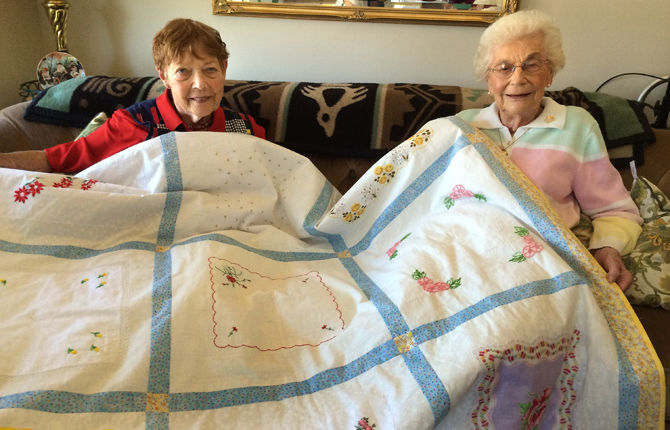
A new quilt hanging in Doris Smith’s bedroom at The Springs at Mill Creek has some old material in it: handkerchiefs she received during her student nursing days in World War II.
In 1943, at age 18, Smith joined the Army Nurse Corps, signing the required pledge to stick with the corps for the duration of the war, plus six months afterward.
She studied and worked as an Army cadet nurse at Lancaster Hospital, in her hometown of Lancaster, Penn. The war was over before she finished her training.
The civilians she treated were not allowed to tip their nurses, but they were allowed to gift a handkerchief, which was often a hand-stitched creation.
She’d collected a stack of handkerchiefs from her nursing days, and thought she’d sold them all in the estate sale she had before she moved to assisted living. But awhile ago, she came across a handful of handkerchiefs at her apartment that she’d accidentally kept, and the idea was born to turn them into a quilt.
The quilt was the handiwork of Joanne Smith, who also lives at The Springs (and is no relation to Doris), and Corliss Marsh.
Joanne touched up some of the hand-stitched handkerchiefs before hand-stitching them into a quilt. Doris said, “I don’t know how she ever did that.”
As Doris and Joanne visited with a reporter recently, the quilt laying over their laps for a photo op, Doris ran her hand over the quilt and said, “These hankies mean a lot and Joanne has done such a good job.”
Joanne replied, “It was a gift of love to you.”
The quilt, featuring nine handkerchiefs on the front and one on the back, ended up being much larger than intended. “It was supposed to be a lap quilt,” Joanne said.
The one on the back isn’t from the war era. It’s an unfinished start of a quilt from Doris’s friend Marie Carlisle. Doris wanted it included “So Marie would always know we were thinking of her.”
Kerchiefs are from a bygone era. “We women always used handkerchiefs because we didn’t have Kleenex,” Doris said.
Joanne still prefers kerchiefs. Tissues are just “too flimsy and thin.”
Doris told the story of how she got the hankies.
“Of course, we weren’t allowed to accept gifts from patients,” she said. “In those days patients stayed in the hospital much longer than they do now and you got attached to them.”
People didn’t have money to give gifts anyway.
The handkerchiefs “meant a lot to the people that made them, and that they’d give them to us, they appreciated everything we did for them.”
Today, patients might be in the hospital for just a day or two, and often won’t have the same nurse twice.
“The patients would give these as appreciation for us for being nice to them,” she said.
Joanne explained, “Back in those days people were afraid to come to the hospital.”
But they shouldn’t have been. “We kept them in bed,” Doris said. “We spoiled them and they liked that.”
Joanne said women stayed for two weeks in the hospital after having a baby.
“Some of the women enjoyed that,” Doris said.
“Especially the women that had six kids already,” Joanne observed.
All the young men were off to war. If men did show up at the hospital, “they were all 4-F or old men.” Men classified as unfit for military service were designated 4-F.
Doris could’ve gone to a military hospital for her last six months of service, but she and another hometown friend chose to stay in Lancaster, because they were asked to.
She agreed to stay on for a full year after the war ended.
“When they took all the nurses into service, there wasn’t anybody at the hospital to take care of people,” she said.
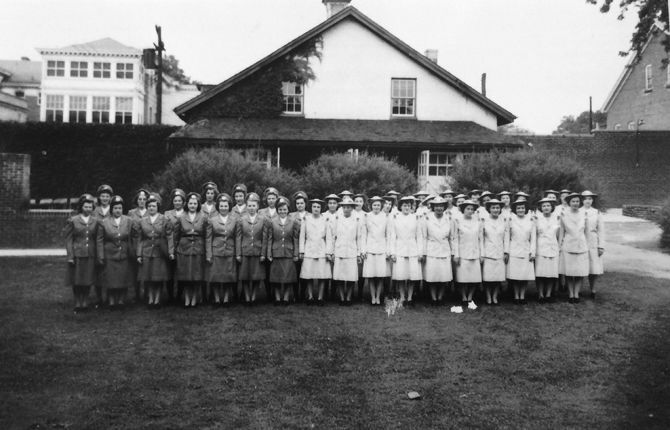
Now that she looks back, she wishes she would’ve done her last six months of service at a military hospital. Doris dug out pictures of her nursing class.
Her thoughts drift to her shoes, and how shoes were rationed. “Gas was rationed. What else? Oh, everything was rationed,” she said. “Sugar and food.”
She used yellow highlighter on the photograph to highlight herself. Joanne chortled at that, but Doris explained, “I was afraid I wouldn’t remember what I look like. That was our summer uniform.”
The neat rows of women are all in skirts. “We couldn’t wear pants in those days,” Doris said.
“Oh no, you can’t,” Joanne agreed.
But then Doris quipped, “Nowadays, I don’t wear dresses.”
“I think if I saw you in a dress I’d fall down,” Joanne said. But she’s the same way, although she noted, “I do own a dress.”
The training regimen for nurses was exhausting. “We had to go to class plus work in the hospital,” Doris said. “We had to work graveyard. I’d come off at seven in the morning, they made us eat breakfast and then they made us go to bed.”
They got up at 10 a.m. for class, then back to bed, then up again at 2 p.m. for class again. Then it was off to work for a 12-hour shift. They rotated days and graveyard shifts.
“Sometimes, during these 12 hours, they would give you time off to rest a bit.” The hands-on hospital work was invaluable. “You can learn a lot in a book but you’ve got to have experience with the patients. It doesn’t always work the way the book says.”
Doris stayed in nursing for seven years, then worked for the Atomic Energy Commission in Richland, where she met her husband, Earl, then they moved to The Dalles, where they ran Smith Oil Co.
“He made a bookkeeper out of me,” she said.
She always loved the hospital atmosphere, and volunteered at Mid-Columbia Medical Center for 32 years. “I loved it. I loved the atmosphere and I loved the patients but I didn’t want the responsibility.”
Recently, Doris was able to reconnect to her military service. Thanks to a tip from a nurse friend, Doris joined the Women in Military Service for America Memorial. When her daughter and granddaughter went to Washington, D.C., to visit her grandson, they got curious and decided to check if grandma was in the database.
“They plugged in my name and here it comes up. That was thrilling,” Doris recalled.
“Here my name is in Washington, D.C., at this memorial. It’s a thrill to have your family remember you. So that was exciting.”


Commented
Sorry, there are no recent results for popular commented articles.