
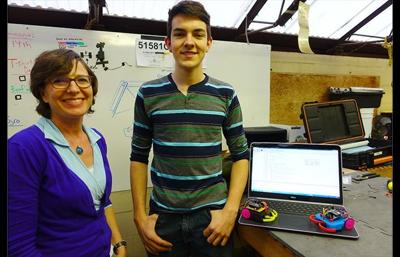
Jacob Field’s “Protobot” mini-robot project beat out proposals from 13 western states to win a presentation slot at the 4-H Western Regional Leadership Forum in California next March.
Field, a student at The Dalles High School, designed and tested both the robot and the curriculum as part of his project.
“It is an honor to be asked to present at this event as the forum highlights innovations and best practices in 4-H leadership and teaching,” said OSU Extension staff and project advisor, Lu Seapy.
The leadership forum is an annual three-day educational event featuring workshops and guest speakers. They offer offertraining opportunities for 4-H staff and master volunteers. Approximately 500 educators and volunteers attend this multi-state educational event.
Protobots, designed by Field, are mini-robots with touch and light sensors that can navigate a maze, zip through an obstacle course, or repeat a pattern.
“Imagine a little Roomba with no vacuum. The robots are simple, but kids love to play with them, watch them, and people ask if they can buy one,” said Field.
The robots aren’t for sale. Instead, students build and program them.
Field began developing the robot in March 2017. He started by researching different builds that could be easily assembled using a 3-D printer and inexpensive parts found on eBay. His goal was to build robots for under $15 each.
Wasco County 4-H STEM educator Joel Riese calls the robots unique in that they are advanced enough to have sensors and simple enough to be assembled by elementary students. “The fact that you can get something so functional for such a small price is great. That it’s developed by a student is mind blowing,” he said.
The program started as a personal project because Field wanted to have a robot to tinker with.
“I kept getting hung up on the idea that I didn't have the funds to really do anything, but I started thinking and realized that I could design a robot that used easy to find, cheap components sourced from eBay.” He later realized that there might be a use for these in schools.
He approached Wasco County 4-H staff at the Robotics Club at TDHS with his idea for sharing these mini-robots with younger students. “I loved it from the minute he started talking about it,” said Seapy, who was specifically attracted to the project’s accessibility and affordability.
In building the bots, participants add motors and sensors to a 3-D printed robot frame and solder components on a circuit board designed by Field.
Not only has Field designed the robot, developed a parts list and designed multiple Arduino programming libraries for the bot, he has also designed colorful and easy to use instructional handouts. The handouts make it easy to construct and repair the robots should problems arise. He is currently working on an instructional video to accompany the learning materials.
The robots are programed using Arduino Developer software. One of Field’s goals with the project was to keep it open source: The software is free and resources are available at GitHub.
“I am so impressed by Jacob’s ingenuity and work on this project,” said Seapy.
The project has developed through several stages so far. In testing and designing the bot, Field worked with local robotics engineer and 3-D printing specialist Aram Soghikian and designed several different models. Once he had a prototype he felt comfortable with, he worked with a local middle school student, Connor Sam, to test the Protobot building process. Sam said he enjoyed building the robot, and said it was “just the right amount of challenge. Not too easy, but not too difficult either.”
At a one-day Maker Camp this summer, a dozen local students were able to build robots using Jacob’s design and take them home.
“People were a lot more excited about the project than I expected them to be. I only hope they'll be this excited about programming them, since that's where you can really push the limits of what these can do,” said Field.
The next step is developing the robot over a series so that individuals get more familiar with programming the bots, thus expanding their capabilities. “This is no small undertaking and the project has additional room for growth,” says Seapy.
Field is currently working on a program where the robot uses artificial intelligence to learn how to navigate a room without bumping into any obstacles at all.
Donations are being sought to defray travel costs to the event. Anyone wishing to donate to the project can contact lu.seapy@oregonstate.edu.
The Protobot Project has been developed in conjunction with Wasco County 4-H with funding support from the Oregon Department of Education STEM Beyond Schools grant and Google. Tutorials and resources available to download at https://github.com/Bobcatmodder/ProtoBots.


Commented
Sorry, there are no recent results for popular commented articles.