
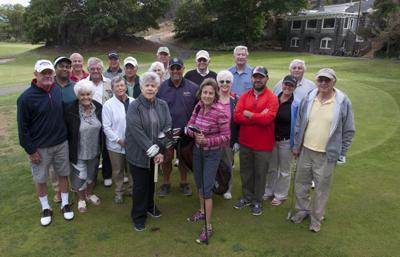
Of the two things I vowed never to do again, one was to play golf.
I’d golfed as a kid; my skills honed enough to place me in junior tournaments. My gratification of the sport at that time was more on par with the ice-cold Seven-Up and Old Dutch potato chips in a red plastic basket at the end of nine holes.
Over the years my country club membership went in the same direction as golf.
Competitive long distance running became my game of choice. Over the decades I trained and competed until my name began to appear in rankings listed in running magazines. At the height of my running career, I was hobbled in this order: a hip replacement, two broken legs, foot surgery and, most recently, a stress fracture.
When I moved to The Dalles two years ago, I had a house and studio built across from a defunct driving range, a ghostly reminder of a past I’d outrun. Golf was not for athletes like me but for people with the luxury of time to chase a little white ball over manicured grass. Envisioning me bent over a putter seemed as likely as taking up needle point.
Bones healed and there was a little giddy-up in my hitch as I gradually returned to running. Then my runner’s high took a nose dive again: on the very same day, I received the results of an MRI and discovered my husband of 26 years had died in his sleep.
Grief and a stress fracture in my good hip grounded me. No exercise at all if I didn’t want to end up more like the cripple I was becoming. In those hard days I needed to hit something hard and thought about golf as a passive outlet for the sorry athlete in me.
A post on the Facebook page, “You know you’re from The Dalles if …” brought the first of many people, golf and me back into life.
PERSONAL TRAINERS
Connie Thomasian answered my Facebook inquiry, gifting me with a set of old clubs in a bag with enough pouches to conceal a decade of national security secrets. I relegated the bag to the garage as I used only the five wood to drive out the blues by hitting balls over the bank of my home. When my orthopedic surgeon okayed real golf if played gently, I filled those pouches with warm clothes and took it to The Dalles Country Club.
Amy Wilson, the club’s pro, gave me a first lesson.
Over the next month, rain, shine or gale, I rewarded myself after a day behind my desk with an hour of practice. Chasing a little ball charged the air around me with different shades of blue as I swore at every hack, whiff and duff.
You can take the legs out of the girl but not a running girl. My theory was to give golf a cardio twist as I jog down the green, pulling a cart. Rushing the ball to time myself between holes proved unrealistic. Golf required patience and timing not natural to someone hurrying to cross a finish line.
Often, during my solo practices real golfers would offer advice. One day Bob Smith saw me on the chipping green and pulled over to set me straight.
Bob’s advice, “rock your upper body like a cradle,” brought me closer to the flag.
Bev Tuttle greeted me on the first trial women’s day and her continuing guidance includes, but is not limited to…”weight your legs, bend your leg, stand tall, butt out, head over putter…never listen to what the men tell you…only listen to Amy.”
Dan McHale teaches me to keep my arm straight and to follow through as I observe him swinging “out of his socks,” as Bev would say and driving like a corkscrew, a tee-shot that downs aircraft in Dallesport.
His wife, Mindy, a hard-hitting straight shooter, observes that I get better loft on the green with a three wood.
Jim Bishop takes me out in his golf cart, offers encouragement and suggestions that include: keep the ball between your feet, feet in line with the hole and don’t look up.
“Don’t think about the water. Golf is 90 percent mental and 10 percent physical.”
Dick Link observes me on the chipping green trying to hit over an imaginary lake the size of which I’d drowned three balls on hole nine, while driving with a five wood the day before.
Running, I also remember all my racing friends said, was 90 percent mental and 10 percent physical. I’m still trying to calculate this problem on the golf course.
When I miss a putt by an eighth of an inch I feel like I did when I came in two seconds behind to lose first place in a half marathon.
When my chip flops, I try to figure out what when wrong, like when I placed second in a 12 K race. What little adjustment would make me win?
Tom Biddle tells me, “Keep your shoulder to your chin.” Dan Keizur adds, “And don’t bend your wrist on impact.” One evening I hear Kent Smith, the head coach of The Dalles boy’s golf team tell these young men to focus on their tempo.
Tempo? Now, I’m supposed to keep in time with the greenway grooves?
Everyone reminds me to keep my eye on the ball.
All those sage voices start talking together as I drive, chip, and putt.
Trying to listen to them all at the same time is enough to make my arms limp, my legs break, and my follow-through jack-knife as I hoe up the fairway like a farmer.
My background as a runner, though, keeps me on the course. I’ve finished every race I ever entered, even when I knew I was failing my personal best. There was always the next race.
I’m learning this about golf too. There is always the next round and caring people who support me on this course. Again.
Oh, the other thing I said I’d never do again? Well, that’s another story…


Commented
Sorry, there are no recent results for popular commented articles.