
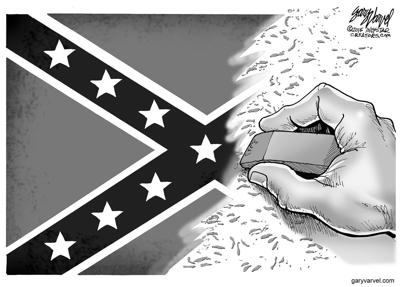
I am a Rebel.
And a Saint, for a while. But mostly a Wildcat.
I think of my own tribalism as we witness this new, and much-needed, national conversation on the Confederate flag image.
In Salem, a debate is rising on what to do with the Mississippi flag flying on a 50-states plaza on the capitol grounds. It is the only state flag still incorporating the Confederate design. Do we leave it flying because, as one official said, “No one has complained”? Do we just remove the Mississippi banner? Or do we replace it with an alternate one bearing the Magnolia State image?
I suggest another course: the state could remove all 50 flags until the day that all southern states have permanently removed the Stars and Bars from all public property.
Taking down all flags would be an act of solidarity at a time when our country could use such an example.
That said, I confess to my own youthful brushes with the “stars and bars.”
My high school was South Albany, Home of the Rebels, “fight on Red and Gray,” I think we sang. From there I attended Mt. Hood CC, where I served a year as a Saint before heading to Linfield College, where I became (and most identify as) a Wildcat. (My mascots in junior high were the Royals and the Vikings, so between those two and the Rebels in my teens I was trending tyrants and autocrats.)
Something led me, at age 8 on our family visit to Disneyland, to choose what now feels like a strange set of souvenirs. It was not a pair of mouse ears but a felt Confederate general’s hat — gray with red piping, go team! — and plastic sword. (Timeline context: this was 1966, and even Uncle Walt’s minions were unenlightened back then. I thought about calling the Anaheim gift shop to ask, but decided it is safe to say that today no such merchandise can be found in the Magic Kingdom.)
If my parents tried to dissuade me from spending my allowance on cheap representations of America’s brutal slave era, I do not recall it. I think it probably pained them, but they let me work my own way through these things.
About that time we had an LP with classic American songs, among them “I Wish I Was In Dixie” (you know, “In Dixeland, I’ll take my stand, to live and die in Dixie ...”). I listened to that album a lot and I got that song in my head for a long time. Not that I fully understood it; “Loogie-Way, Loogie Way, Loogie Way, Dixieland” is how I thought it went.
(Two surprising facts about the song, courtesy of Wikipedia: it was written in 1859 by a Northerner, Daniel Emmett of Mt. Vernon, Ohio, and the Union band played it at the request of Abraham Lincoln when the president learned of the Confederate surrender at Appomattox.)
I have also lived in Dixie. I spent my 18th summer working at a YMCA conference center in North Carolina, where my co-workers were mainly from Louisiana, Alabama, Mississippi, Georgia and Florida; I was one of two staffers from west of the Mississippi. I know that summer I got into my share of stupid youthful arguments, being a stupid youth, but I recall not one instance of anyone mentioning or displaying, let alone defending, the Confederate flag. It might have happened, but what I recall was talking with a pastor who was there on the bridge in Selma in 1963, and waking up every morning to another anthem of the region, “Carolina in the Morning.”
Back to South Albany: one of my assignments as a high school reporter, c. 1974, was to take a photo of the new mural on the SAHS gym, that of a Confederate soldier waving — you guessed it — the Stars and Bars. I am sure no one bothered to ask the three or four African-American students how they felt about it. I know I did not. It was just accepted.
And my Stonewall Jackson Confederate hat? Not sure what happened to it, but the sword got snapped in two a week later by my older brother Brent. He was 12. I thought he was just being an ornery big brother. Now I know he was taking a stand.


Commented