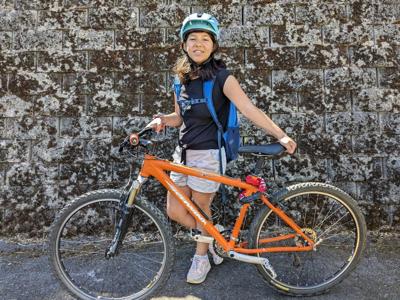
“I never thought this would be my life,” said Genesis, a Hood River County School District student who now has a bicycle of her own and the skills needed to ride it.
“I never thought this would be my life,” said Genesis, a Hood River County School District student who now has a bicycle of her own and the skills needed to ride it.
Three years ago, Hood River County, population 25,000, had little to no culture of kids walking or biking for transportation despite its outdoor, active lifestyle. The bike train that I started in October 2020 was the catalyst for change and gifted me the job that I have today.
I have the privilege of working with students to transform their community, and a seventh grader named Genesis is one of them. “I never thought this would be my life,” is what she said to me. It’s my rally cry and I’ll save her story for the end.
My metaphorical blueprint for change is a snow fort — you can take the girl out of Wisconsin, but you can’t… you get the picture. Four types of snowballs make up my blueprint of change: Education, free bikes, kids in the street and infrastructure. My snow buddies are principals, teachers, passionate parents and leaders in the city and county.
My first snowball takes place during physical education class for kindergarten through eighth grade. Alongside teachers, I have taught 1,500 students bike confidence, fun and laws while riding. More than 100 have learned to ride from scratch, the most fulfilling indication of change.
My second snowball is free bikes. Working with physical education teachers, I have helped Anson’s Bike Buddies donate bikes to 200 kids in need. I can’t tell you how many moms hug me or cry when their child gets one.
If you are following me, we now have a kid who has on-bike education, who has a bike at home — this is not a groundbreaking formula to change a kid’s life, but here comes the truly transformational stuff.
My third snowball is getting kids in the street, like leading a bike bus to school, walking with a hundred Mid Valley students and their families along Odell Highway for International Walk & Roll to School Day, or taking fifth graders on a celebratory ride around their school’s neighborhood after a week of bike rodeo skills learned. Inevitably, neighbors will see us, stop what they are doing and smile as we go by.
Why is this important? Besides waiting for safe infrastructure to invite participation, bringing kids into the street shows them that they have a right to that space and shows our leaders that they belong, building the case for…
The final snowball: Infrastructure. In a community of no resources or transportation planners, I find the grant applications and send them to the relevant agencies. Our Safe Routes to School coalition has won $11 million in just three years, which includes the parks district receiving $7 million for a trail to the car-dependent high school and the recently removed youth-driven demonstration around the middle school. That project cost only $11,000 and instantaneously engaged the kids and their caregivers.
Which brings me back to Genesis, a product of my snow fort of change. In less than three years, she has learned on-bike safety in school, received a free Homegrown Schwinn bike that she rides every day to school, joined my after school club and engaged the neighbors required to install the demonstration project around her school.
“I never thought this would be my life” is what she said to me when we were biking to Wahclella Falls this summer. When children like Genesis find joy, freedom and a voice, we’re not just building snow forts, but crafting futures.
If you want to hear all children say, “I never thought this would be my life,” consider lending your voice, beginning with the survey for the Safe Routes to School Demonstration: www.tinyurl.com/bt3encpc.
This opinion piece is adapted from a presentation I gave for a session on “Building the Kid City” at the Vision Zero Cities conference in New York last month.
•••
Megan Ramey is the Safe Routes to School Manager for Hood River County School District.



Commented