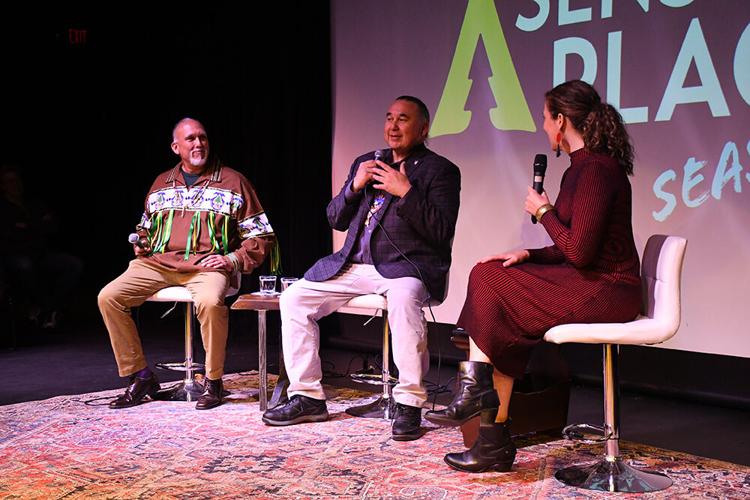
Yakama brothers and foresters Steve and Phil Rigdon talk tribal forestry management with Sarah Fox, host and curator of Sense of Place, at Columbia Center for the Arts on Nov. 18. Sean Avery photos
Yakama brothers and foresters Steve and Phil Rigdon talk tribal forestry management with Sarah Fox, host and curator of Sense of Place, at Columbia Center for the Arts on Nov. 18. Sean Avery photos
HOOD RIVER — When it comes to trees, whether operating as a conservationist or within the timber industry, it’s paramount that Indigenous voices — forest stewards since time immemorial — help lead the charge.
Yakama brothers Steve and Phil Rigdon spoke about the tribal approach to forestry at Columbia Center for the Arts on Nov. 18, in conversation with Sense of Place Season 17 host and curator Sarah Fox.
The Rigdons grew up near Wapato, Washington, a small town that lies on the northeast corner of the Yakama Indian Reservation. Born to a white father and Yakama mother, they learned to navigate spaces where they were wholly accepted and nurtured by some, and ostracized by others.
The town and surrounding areas, which they called “the corner,” was their childhood playground, as they spent the bulk of their time away from the house, fostering deep memories with cousins, friends, and the greater tribal community. The brothers recalled crazy adventures, from jumping into Toppenish Creek to racing down Potato Hill after picking huckleberries, that solidified a lasting connection to the land.
“If you’re from [Wapato], you have a lot of ride or die homies,” Steve Rigdon said. “They have your back in a way that they’re with you for life, they’re family, and they stay connected.”
Their mother was a counselor at Wapato Middle School and ran the Indian Club, encouraging generations of Yakama students to believe they could achieve greatness. That guidance rubbed off on the brothers, who have become prominent figures in forestry, balancing tribal traditional and modern practices in their work. “It planted some seeds that created really deep roots of why we do what we do,” Phil Rigdon said.
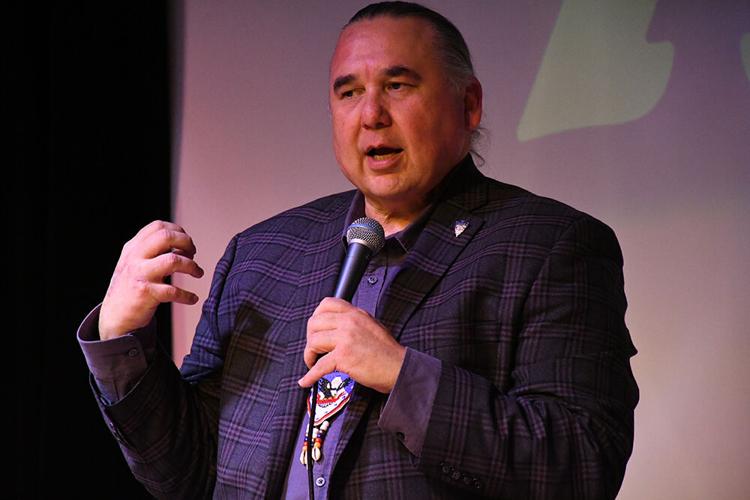
With forestry degrees from the University of Washington and Yale, Phil Rigdon has led the Yakama Nation’s Department of Natural Resources since 2005 and is vice president of the Intertribal Timber Council (ITC), having previously served as president, with whom he’s testified before Congress.
Phil Rigdon
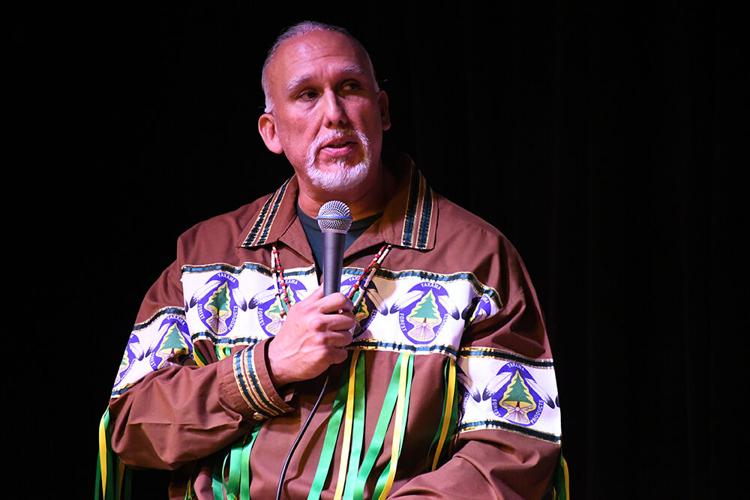
Steve Rigdon
Steve Rigdon, former general manager of Yakama Forest Products, is the tribal partnership and resource stewardship manager at the nonprofit Sustainable Northwest, which helped coordinate timber sourcing for the renovated PDX Airport.
The Confederated Tribes and Bands of the Yakama Nation, colloquially known as the Yakama Nation, encompass 14 tribes and bands whose members come from different parts of a broad ancestral territory extending well beyond today’s reservation. The Treaty of 1855 codified the ceding of land to the federal government while retaining — often unbestowed — rights to fish, hunt, gather, and practice ceremonies. Recognizing the treaty as sacred, the Yakama Nation has been one of the most litigious tribes fighting to reserve those rights, Phil Rigdon explained, especially in legal disputes over fishing.
But with their resources still in harm’s way, unable to rely on the good faith of the federal or state government, tribal leaders hired and trained their own specialists, from fish biologists to foresters. “They said we are going to depend upon ourselves,” Phil Rigdon said. “They invested in us.”
Phil Rigdon recalled the paternalistic approach from the Bureau of Indian Affairs, where agencies came “to tell [them] how to do forestry,” he said. Yakama foresters and elders pushed back, culminating in the tribe’s current authority over its forests.
The tribal approach to forestry originated with management practices before “contact” — before non-Indigenous parties invaded and pillaged the land. “The wood used by our people to heat us, to feed us, to cook, to travel, was intensively managed,” Steve Rigdon said. “We lost a lot of that…the symbiotic relationships and the reciprocity.”
The brothers described modern forest stewardship as a responsibility grounded in connection to the land — extracting resources with care, considering what the forest, water, wildlife, and community need, while leaving a healthy landscape for future generations.
Proper management thus falls at a middle ground between unchecked conservation and unchecked industry, balancing ecological and cultural priorities with economic benefit via lumber mills. Striking that balance means knowing where and what to cut.
For example, Steve Rigdon’s former employer reserved core employment for tribal members to leave “the best trees on the landscape,” while the timber industry at large focuses on “max yield.”
But weighing those ecological needs alongside economic realities brings tough choices: loggers need enough work to pay crews, and mills need suitable logs to operate.
Phil Rigdon added that timber has been essential to the Yakama Nation’s rural economy and self-determination and that disappearing mills have put pressure on communities, arguing to maintain meaningful work in the woods without treating loggers and mill workers as the problem. “You need to have that board foot taken out,” he said, while also criticizing practices that cut indiscriminately from ridge to ridge.
The solution: working with — actually speaking to — tribes as partners. For conservation groups, this means including them at the table rather than treating them as symbols and giving timber’s role as a renewable material fair consideration. Steve Rigdon gave a practical example: ask tribes whether places need protection or whether access roads are important for cultural use, fire management, or other needs.
For the timber industry, it means looking past the profit margins and maximum production, leaving the strongest trees in the soil.




Commented
Sorry, there are no recent results for popular commented articles.