
By Martin Gibson
Columbia Gorge News
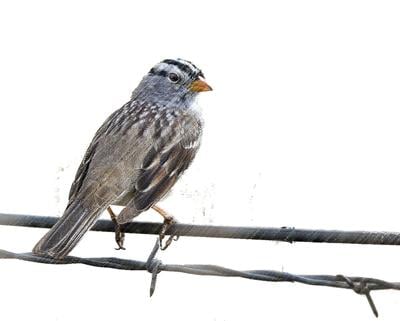
White-Crowned sparrows mostly visit in winter. They like to hang out on the shrubby, sagebrush shores of the Big River. Come spring, they’ll fly north to Alaska and northern Canada, though some populations will stay to breed in low shrubby habitats throughout the interior West.
They also have four distinct biological sexes.
Some sport white-and-black headstripes. Some,
white-and-tan.
Biological sex is tricky to define at the best of times. That either-or chromosome lottery your learned about in school doesn’t half cover it. But the basic definition goes by what parts of the population can, and choose to, have kids with each other.
Often, as with humans, those proportions are sort of close to half-and-half: we think of ourselves as having two sexes (sort of, because again, there are multiple possible combinations of chromosomes and characteristics that can wind up in either 50%).
And 99% of the time, white-striped females only mated with tan males; and tan-striped females only mated with white males. So the species is split into four quarters, each exclusively reproducing with just 1/4 of the population. So biologists say: four sexes.
Male or female, it’s the white-striped birds who sing more, defend territories, and cheat promiscuously. Male or female, it’s the tan-striped birds who stay quieter, stay home, and feed the chicks every day.
Elaina Tuttle and Rusty Gonsor, two biologists with Indiana State University, sequenced the bird’s DNA in the early 2000s. They found a certain chromosome in the birds that, compared to other species, was flipped — over a thousand genes turned upside-down, like a backwards alphabet.
The genes expressed through aggressive flamboyance, and the ones controlling head-stripe colors, are on the same chromosome, the one with the upside-down genes.
Because of the upside-down genes, when the = bird is just a dividing cell in its parent’s body, that chromosome is preserved untouched. Usually, chromosomes “cross over,” exchanging genetic material, to maintain diversity. Different characteristics would get recombined randomly, throughout a population, resulting in tan-stripes and white-stripes, aggression and sweetness, in every combination. But not here: white-striped birds are always aggressive, tan-striped always shy. Those genes are paired.
Just one other set of genes never “crosses over”: the sex chromosomes. You know, the bird equivalent of those two little, critical X and Y chromosomes that are supposed to determine whether we are male or female, but in reality only work for that if we’re lucky, and nothing goes wrong with the 50 or so hormones that carry out their will, and all of our other chemicals are working, and we got complete sets of chromosomes like we were supposed to...
In effect, sparrows have two sets of sex chromosomes to our measly one.
Of course, humans also have multiple physical variations, since our development into “male” or “female” bodies is dictated by all those hormones, some being stimulated by each other in chain reaction to change different parts of the body and also the brain; this complex system is often flawed or incomplete, leaving people with in-between or mismatched development.
Plus, while a lot of the things Western culture considers “masculine” or “feminine” are indeed inherent in human nature, they occur on a spectrum that doesn’t align with gender. To pick a controversial example, scientists think they have found genes that are expressed in people who are romantically attracted to men — and those genes are present in both some women and in some men.
•••
Some of you may get mad at me for pointing this out in a birding column. But the truth is, biology is deeply complicated. The sparrow, like all the other species we’ve caught expressing multiple genders and sexualities — bears, insects, seabirds, our near relatives among the apes, whales, so many others — reminds us that this is normal. Apparently all you need is one upside-down chromosome, and — bing! — new gender.
In nature, this sort of mix-up is ordinary, and paranoia toward difference is the rarer thing.


Commented
Sorry, there are no recent results for popular commented articles.