
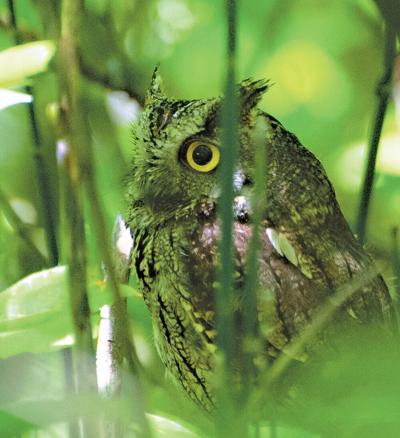
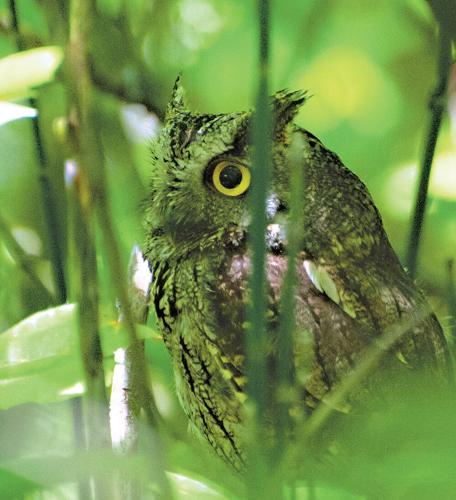
I have never surprised an owl. It’s a life-long goal of mine — one I’m unlikely to achieve, since owls have more acute senses than I and always see me coming.
One hot June day a half-dozen years ago, a companion and I escaped the sizzling summer heat into a local creek’s quiet pool. Five minutes later, I poked my head above water and saw two fistfuls of light-gray fluff, aligned atop a pine root, staring back with moon-like yellow eyes.
We’d found the cool, shady spot these fledgling Western Screech-owls (Megascops kennicottii) already knew. All summer they lingered, and we saw them occasionally.
I put out a trail camera, getting grainy gray photos of a small blob on a streamside stone, the infrared flash reflecting its membrane-backed night-vision eyes as twin silver blazes.
Every winter, screech-owls are silent. Maybe even absent. Then, in June, the evening forest fills with soft, lilting trills — the streambanks full of owls. A month later, I’ll find some soft-edged, cream-and-russet feathers, molted by owls, blown to me on the wind. And they’ll be silent, again.
Despite the name, they’re the most melodic animals I know, warbling liquid trills in different pitches, mated pairs dueting at dusk, when colors show but shapes have melted into shadows and animals like me, with small color-sensitive eyeballs, can’t see much.
Screech-owls inhabit wild, messy territories: Deciduous forest and streambanks. But they’ll take deserts, coasts and mountains too. Thick shrubberies, old oaks, bushy streambanks are good. Neat gardens and houses, not so much. Maybe that explains their slight decline since 1966: Burgeoning suburbs, and declining insect populations.
Screech-owls need big cavities for nests — nest boxes, made to the right specifications and well-placed in good habitat, are accepted — and lots of little edible mice, shrews, gophers, native rats, bats, rabbits, snakes, insects snatched mid-air, worms, crayfish (maybe what my little gray blob fished for?), slugs, scorpions(!), snails...
I’m lucky to see one owl a year. Rarely, I spot one peeking from some oak cavity at dusk. They often use one tree a few nights, then move. Sometimes a chorus of screaming sparrows, wrens, chickadees and jays reveals one, being bombarded by a cloud of irate birds. (If you hear a bush-full of short, sharp raspy calls; multiple species are alarming, and they continue for several minutes; you might have an owl. If you stride up and stare, screech-owls don’t like that much and sneak off. Circle round quietly, looking for a suspiciously-symmetrical bark fragment. That’s them.)
I sometimes watch the dusk beside a stream, hoping owls sing nearby. Their trills, resonant and soft, sound like crickets playing flutes — breathtaking from yards away.
Sometimes I even glimpse a little gray blot, vanishing. Owls’ soft-edged feathers make their escape silent. And isn’t that splendid, that degraded, logged-over forests near cities still hold this secretive, mischievous mystery?


Commented