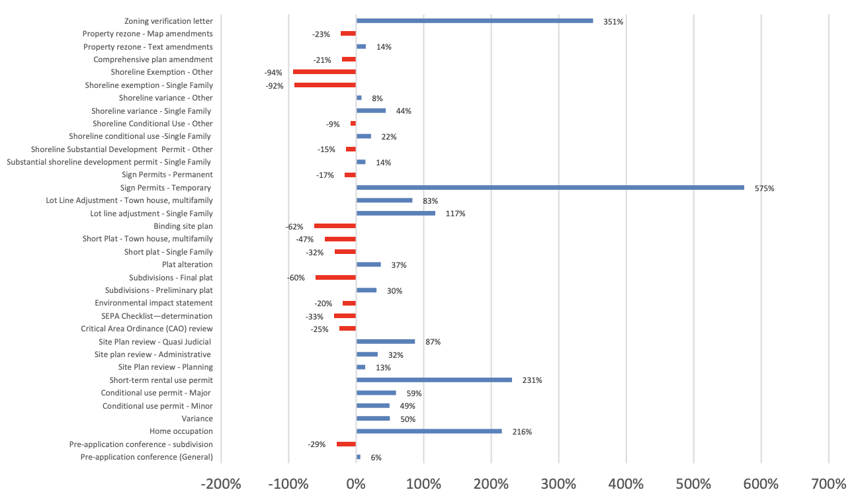
The average percent difference of White Salmon’s 38 land use fees compared to five neighboring jurisdictions: Hood River, Hood River County, Klickitat County, The Dalles and Stevenson. In blue are lower fee averages. Red represents White Salmon’s fees that are higher than other jurisdictions.
The average percent difference of White Salmon’s 38 land use fees compared to five neighboring jurisdictions: Hood River, Hood River County, Klickitat County, The Dalles and Stevenson. In blue are lower fee averages. Red represents White Salmon’s fees that are higher than other jurisdictions.
WHITE SALMON — After three years of work by the CityLab Board and several rounds of draft revisions, White Salmon’s City Council, yet again, did not approve the Greenhouse Gas Emissions Reduction Plan during its Feb. 5 meeting, where the disconnect between administration and council was evident.
The plan includes a list of priority recommendations intended to help White Salmon meet the goals identified in council’s 2021 Climate Crisis Resolution: namely, eliminating all municipal greenhouse gas emissions by 2050. Largely made up of community members, council established CityLab in 2022 as the vehicle to achieve the resolution’s aims.
During their last meeting, as reported by Columbia Gorge News, council requested that administration incorporate the strategic focus areas, a section that undergirds the priority recommendations and offers many other, more specific climate solutions, from the original draft back into the plan.
The updated version, however, did not reflect that request, spurring a philosophical and practical debate.
Marla Keethler, White Salmon mayor
“Members of the public deserve to know how and why we prioritize different things,” said Kate Bennett as public comment began. “Providing them with context on how we’ve made decisions seems important, and disaggregating it to an entirely different section that we all know is going to be buried in an agenda item on a city council meeting — it’s a disappointment.”
Bennett previously served on CityLab and co-authored both the emissions reduction plan and Climate Crisis Resolution. Bennett has since stepped down after what she said was a “charged and personal attack” by Mayor Marla Keethler at council’s Jan. 15 meeting, where a tense exchange about the strategic focus areas, among other removed sections, occurred.
In an email after the fact, Keethler said she didn’t want Bennett to feel like her “perspective and contribution [are] not valued” and offered an opportunity to talk in person, but Bennett did not respond.
City Attorney Shawn MacPherson said the strategic focus areas, including their timelines, unnecessarily binds council and that administration modeled the plan based on similar ones, like the Transportation System Lite Plan, which council passed as an ordinance.
“This plan was always intended to be aspirational and advisory, not binding. That’s the fundamental difference between a resolution and an ordinance,” said resident Peter Wright after Bennett’s remarks. “Instead of championing this project as an example of how a small town can advocate for its priorities with limited technical financial resources, the administration has overstepped its role to stifle a community-based vision for illegitimate bureaucratic and legal reasons.”
Six other members of the public testified in support of including the strategic focus areas, and Councilor Jim Ransier, who’s on CityLab, expressed his frustration with the end result. Whatever joy was present when CityLab began its work, he said, is now gone, and Councilor David Lindley agreed.
“I would rather have a report that puts the challenge to us and future councils to figure out if they’re going to pick up this fall,” said Lindley. “We should constantly be pushed. We should fail, try again, fail better and try again.” Councilor Patty Fink took it a step further.
“Shawn, I don’t mean any disrespect, but it really, really feels as if you represent the mayor and not the council,” she said. Fink acknowledged that MacPherson and Keethler likely have a different idea of what the emissions reduction plan should stand for, but disputed the lack of movement, transparency and inadequate time for council to review the plan beforehand.
“We were trying, and are trying, to get you to a place where there’s a resolution that, once passed, we are comfortable with signing and are proud to implement,” said Keethler. “So, I am sorry, because it seems that a very different view and version has unfolded, and I seem to be the embodiment of that.”
Councilors agreed to hold a workshop and resolve their differences on the emissions reduction plan, but those issues with the city administration’s internal operations overshadowed the rest of the meeting.
A ‘backward’ planning process
During public comment, Jeff Broderick, who served as White Salmon’s city planner for nine months in 2022, described the work environment under Keethler as “toxic.” He accused Keethler of treating her employees poorly and unduly influencing his responsibility as city planner.
“I felt more like political staff employed directly by the mayor, instead of working for the city and the community,” said Broderick. “I felt tremendous pressure to make decisions based on her feelings, or to ignore code entirely. I would not do that, and I know this made her angry.”
While Keethler did not address Broderick’s comments during the meeting, in a later email, she wrote, “I take very seriously the responsibility of upholding the integrity of the office and ensuring a safe work environment for everyone employed by the city.”
Keethler noted that she implemented outside human resources support three years ago so emplyees have an “unbiased, objective outlet for personnel concerns,” along with formal on-boarding and off-boarding procedures. She has instructed city staff to investigate whether Broderick participated in an exit interview for her review.
Since Broderick stepped down, White Salmon has relied on consulting company Facet Inc. for city planning services. Council discussed extending Facet’s contract to complete ongoing development applications while simultaneously renewing Skamania County’s contract for planning services.
Keethler said she hopes to hire a full-time city planner by the end of this year, primarily depending on Skamania County in the meantime. Fink questioned whether this was the most cost-effective strategy and continued to criticize how these decisions played out.
“What has happened in the past, and what is happening now with Facet, is we are put into a position of having to do this because it’s [in] the best interests of the people who are coming in for [planning services],” said Fink, citing the financial implications. “Not everything has to [wait] until the last minute, and it feels very manipulative.”
As Councilor Jason Hartmann was absent, council approved Facet’s contract extension in a 4-0 vote and renewed Skamania’s contract in a 3-0 vote, with Fink abstaining.
Former Clerk Treasurer Stephanie Porter and City Administrator Troy Rayburn have also left their positions within the past few weeks, replaced by Deputy Clerk Troy Rosenburg and Interim City Administrator Paul Koch.
Porter said the following in her resignation to Keethler and the city: “Even though changing jobs was the best move for my family and me, please never doubt the impact your leadership has on those around you. Thank you for being a manager I can look up to and admire.”
In the last major matter of note, councilors heard a presentation from Facet about increasing White Salmon’s land use fees, such as boundary line adjustments, which haven’t seen an across-the-board update since 2007. Compared to similar jurisdictions like Hood River, The Dalles and Stevenson, White Salmon’s fees were 42% lower on average. Out of 38 fees analyzed, neighboring jurisdictions had a higher average for 20 of them.
While councilors conceded that White Salmon’s land use fees are outdated, Fink and Lindley argued it was necessary to address how the city reviews development applications first. According to Fink, developers struggle to complete an application and are often met with a laundry list of items to resolve.
“I feel like both internally and externally, we need a decision framework,” said Lindley. “Applicants need to be very clear about, based on the review of that application checklist, what their pathway is, what consultant or what staff is handling [and] what additional fees may be applied.”
With Fink and Lindley opposed, the ordinance failed in a 2-2 vote. Starting at 6 p.m., the next city council meeting is Feb. 19 in White Salmon’s Fire Hall.





Commented