Welcome to March! As I write this in mid-February, it sure does not look much like spring here in wintry Trout Lake. But I know change is coming as the season inevitably progresses.
March 20 will mark the vernal equinox, the spring date when day and night are roughly equal. Around that time, the increase in day length is at its greatest, more than 3 minutes a day. Rates of change are greatest around the equinoxes (first day of spring and first day of fall), and the slowest around the solstices (first day of summer and winter). Add in the start of daylight savings time (March 9) and it can increase the perception of change. We go from a sunset time of 6:02 p.m. on March 8 to 7:04 p.m. on March 9.
The big event for March this year is a total Lunar Eclipse, which will occur on the night of March 13-14. On that night, the Earth will slide right between the Moon and the Sun, causing the Moon to darken, sometimes into a striking reddish color. It will be a late-night affair, with the eclipse starting at about 9 p.m. Totality will occur from about 11:30 p.m. to about 12:30 a.m. Let’s hope for clear skies!
Why does the Moon appear reddish at times during a total Lunar Eclipse? You can thank Earth’s atmosphere for that. Even though the Earth blocks sunlight from hitting the Moon directly during totality, sunlight filtering through Earth’s atmosphere is bent and partly illuminates the Moon. Most of the light rays are scattered in Earth’s atmosphere, but the longer, red wavelengths are not as scattered and reach the Moon, giving it the red color. The same principle applies to our reddish sunrises and sunsets. A total Lunar Eclipse is definitely worth viewing!
A great place to see the eclipse will be the Goldendale Observatory. Our iconic Washington State Park will be open from 9 p.m. to 3 a.m. Check out the “Special Events” link on the Observatory’s web page (www.goldendaleobservatory.com) for details.
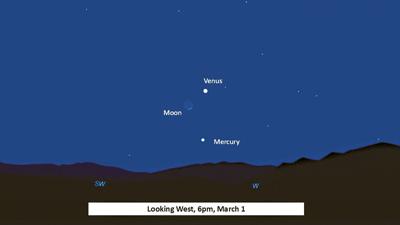
We still have some nice planetary views in March. Jupiter is still nicely visible in the southwestern sky, and Mars rides high in the south. Venus is a bright beacon, low in the west after sunset. Mercury joins Venus in the western sky in early March, a great time to spot the solar system’s innermost planet. If skies are clear on March 1, a very nice view will occur low in the west after sunset. Venus will shine bright, with a bright Mercury below it, and the young, thin crescent Moon between them.
Mars, while visible in the southern sky, is growing distant from us. Located in the constellation Gemini, it will outshine that constellation’s two bright stars, Castor and Pollux.
The Moon starts March low in the west between Venus and Mercury, as previously mentioned. On the 5th, the nearly first-quarter Moon will be between Jupiter and the Pleiades. On the 8th, the waxing gibbous Moon will be just to the left of Mars. On the 11th, the nearly full Moon will be just above the bright star Regulus in Leo.
The bright winter constellations of Orion, Taurus, and Gemini will be low in the western sky in March. Leo rides high in the southeast, to the left of Gemini and Mars. In the east, Bootes the sheepherder, with its bright star Arcturus, is low in the sky after sunset. In the northeast, an upside-down Big Dipper (part of Ursa major) is above the Little Dipper (Ursa minor) and Polaris, the north star.



Commented
Sorry, there are no recent results for popular commented articles.