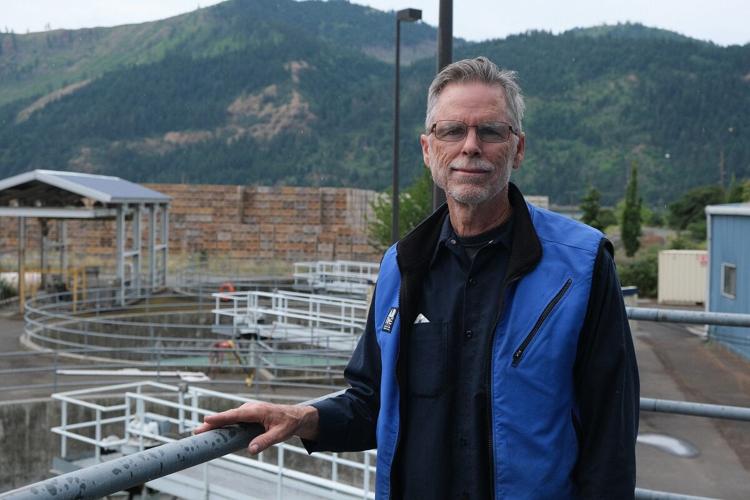
Treatment plant operator Tom Hons stands outside his office at the Bingen Wastewater Treatment Plant on Marina Way. The plant, he said, "works not only for treating sewage, but for treating people."
At the end of the month, Hons will be retiring from his job at the plant, marking more than three decades of working to ensure Bingen and White Salmon’s wastewater coming into the plant leaves in a clean and pollutant-free fashion.
Treatment plant operator Tom Hons stands outside his office at the Bingen Wastewater Treatment Plant on Marina Way. The plant, he said, "works not only for treating sewage, but for treating people."
Jacob Bertram photo
BINGEN — The Bingen Wastewater Treatment Plant improvement project is nearly complete, with about a month to go on the rest of the updates planned for the plant, which services the cities of Bingen and White Salmon.
Approved last year, the improvements include the addition of a few components, as well as replacements and maintenance of old components which have degraded over decades of use.
“This is a good thing for both Bingen and White Salmon,” said Bingen Mayor Betty Barnes. The improvements should allow for 20 years of use into the future and expand capacity for future gradual growth in the two cities.
Crews from TEK Construction, Inc., are preparing to install the remaining pieces of the improvements project, such as a recirculation pump, which would complete the addition of what is called a bio-selector, an instrument that will help to control the process of mixing bacteria into the wastewater within the oxidation ditch — a large, racetrack looking structure that mixes sludge with the wastewater. Within the sludge is oxygen-starved bacteria, which, when mixed in with wastewater, feast on the oxygen found in the wastewater delivered to the plant. The process, known as aeration, provides for rapid growth of the bacteria and allows for an easier and more thorough separation of the water and the bacteria as they get run through clarifiers.
Once the water is separated from the solids, it then runs through a disinfection process done through ultraviolet light shining through the water, and then runs off into the Columbia River.
The solids are collected and stored in tanks where they enter a drying process that lasts between three and four months, culminating in a nitrogen compound that is collected and spread in a field in central Klickitat County.
“The water we send out to the river is really, very clean,” plant operator Tom Hons said in an interview last Friday.
Hons, along with fellow operator James “Buck” Buckland, have worked to ensure operation of the plant runs 24 hours a day.
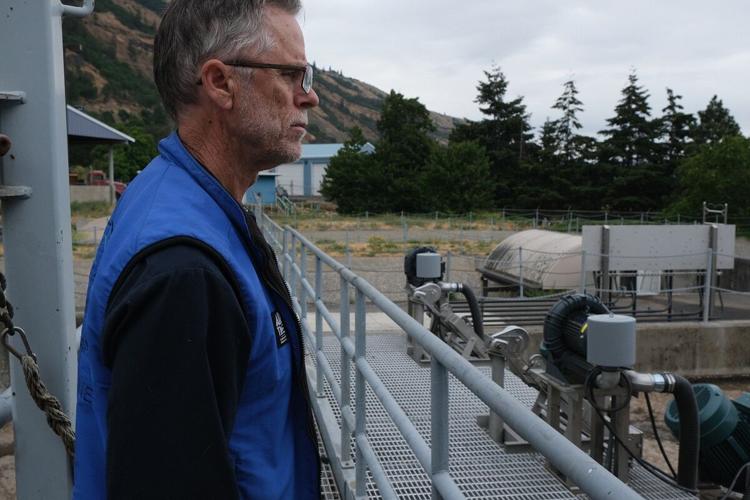
At the end of the month, Hons will be retiring from his job at the plant, marking more than three decades of working to ensure Bingen and White Salmon’s wastewater coming into the plant leaves in a clean and pollutant-free fashion.
Jacob Bertram photo
At the end of the month, Hons will be retiring from his job at the plant, marking more than three decades of working to ensure Bingen and White Salmon’s wastewater coming into the plant leaves in a clean and pollutant-free fashion. The improvements project marks the second major upgrade he has seen at the plant since his entry into the field; in 1996, the Bingen Wastewater Treatment Plant upgraded its plant to include the current larger oxidation ditch as well as the UV disinfection component, which replaced the previous component that used chlorine to clean the water — “much better for the fish,” said Hons.
Along with the bio-selector, most recent improvements to the wastewater system include a more advanced automation system for the plant’s operations, as well as surface repairs and replacement of older components. Outside the plant, contractors replaced approximately 1,750 linear feet of existing 10-inch sewer lines with newer and larger 18-inch lines, replaced older lines with newer lines the same size, and rehabilitated 22 existing manholes.
Hons said the improvements have been in the works and been planned for nearly 10 years. All told, the improvements will mark an increase in solids capacity from 20-30%, he said.
“It’s nice to see all that work led to these improvements,” said Hons.
As Hons gets set to spend more time with his family upon retirement, the City of Bingen named Brian Zabel as the person to take up the mantle as one of two operators of the plant, along with Buckland. Zabel has worked with the city since the project got underway as the project inspector.
“The aim and goal of [the project] is to be able to maintain with consideration for growth,” Zabel said.
The project was funded through a variety of sources, with both cities of Bingen and White Salmon pitching in, along with a loan from the Washington Department of Ecology. Vancouver-based firm Gray & Osborne is leading the engineering services of the project, while TEK Construction was hired for work on the project.



Commented